In his book “The Element”, Ken Robinson argues that a person is in his or her element when they are at the intersection between what they love to do and what they are good at.
 Going by this, I’d say that Uttara Sarkar Crees is squarely in her element. In fact, I’d even go so far as to say that she has found her Shangri-La.
Born and educated in Uganda of Bengali parents, Uttara has called Shangri-La her home for the last 17 years. Of course, when she first arrived in Gyalthang in 1996, it wasn’t called Shangri-La then.
(Pictured left: Uttara in her Shangri-La)
It was then known as Gyalthang (Tibetan for “royal plains”) to describe this fertile high-altitude (3,300m) valley flanked by mountain ranges. The capital of Diqin Tibetan Autonomous Prefecture, it later took on the name of Zhongdian (Central Heaven) and subsequently Shangri-La when tourism authorities recognized the hook this would have for travellers looking for their Lost Horizon.
Uttara had found her way to Gyalthang via Nepal where she had been involved with the Tiger Tops team – she worked on really what was the first eco-tourism lodge in Asia to gain international reputation. She also helped set up their adventure travel arm, Mountain Travel.
Clearly born with an appetite for blazing new trails, Uttara was drawn to Gyalthang, which had then in 1996 just decided to open its doors for international tourism. Her first project was acting as advisor to the Gyalthang Dzong Hotel, the first international standard property in the town. Today, the hotel is managed by Colours of Angsana, a sub-brand of the Banyan Tree Group.
She then set up her own travel company, Gyalthang Eco-Travel, which brought in the first international tourists (in modern times) in June 1996 – members of the Hermes family who today remain her customers.
.gif) Since then, her company has organised personal journeys for intrepid travellers from all over the world, taking them into remote reaches of Tibet, India, Myanmar and other parts of China.
Since then, her company has organised personal journeys for intrepid travellers from all over the world, taking them into remote reaches of Tibet, India, Myanmar and other parts of China.
Today, she continues to curate itineraries for travellers, most of whom have become her friends, and some of whom have heard of her by word of mouth.
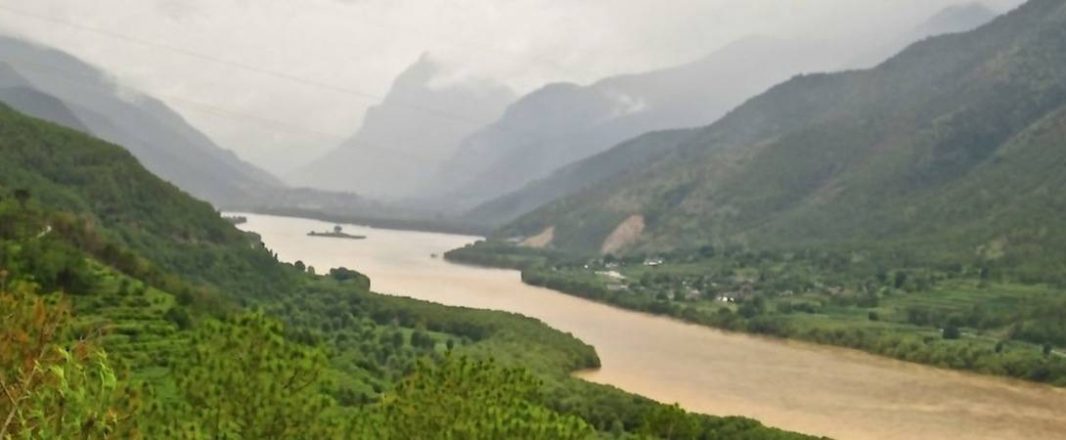
(Pictured right: A misty Shangri-La)
Apart from being an explorer, Uttara’s also passionate about all forms of conservation. One of her pet projects was working on the Wanglang Panda Sanctuary in Sichuan Province, where she advised the local authorities on how to introduce eco-tourism principles and activities to the area and making the model financially sustainable.
In 2008, she turned her attention to heritage conservation in her hometown. Concerned that the historic trading houses within the Dukardzong old town of Gyalthang were being destroyed, she took out a lease on a 100-year-old trading house.
Said Uttara, “The house is a very significant part of Gyalthang’s history. It is only one of a few original trading houses left, and they served as important stops for merchants on the Tea and Horse Caravan Trail from southern Yunnan to Gyalthang before they crossed into Tibet or India.”
 She then roped in local builders and craftsmen to restore the house, piece by piece. Every bit of material was recycled and reused, nothing was thrown away or wasted. The walls were stripped away to reveal the original rammed earth wall of a hundred years ago.
It was hard, laborious and, not to mention, costly work but Uttara was determined to prove that it could be done and that historic buildings could be restored, given new life and become sustainable businesses.
It re-opened as the Tara Gallery Restaurant & Café in 2009 (pictured left). When I visited it recently, I was blown away by the sense of history and attention to detail that’s been given to the house. The story of the restoration is told through pictures on the walls. The trading room acts as a cozy lounge area and the most ornate room belonged to the favorite concubine of the previous merchant owner.
The food is good. Other than Yunnanese dishes, she’s taught her cooks to whip up Indian dishes – and her curries are the talk of a town in which every other restaurant is offering hot pot and other standard Yunnanese fare.
After a week on the road from Dali to Gyalthang, where Uttara and I had covered the old trading route, I was ready for some non-Yunnanese fare.
That’s not to say the Tara does not do Yunnan cuisine – on my final night on the Trail, Chef Yamu prepared Gyalthang hot pot which was simply delicious. The magic ingredient is in the Yunnan smoked ham in the stock.
Two doors away from No 29, which is Tara, Uttara took on an old inn, a former staging post for traders and their horses, and converted the downstairs into a Gallery (selling handicrafts, rugs and Tibetan art pieces) while the second floor was turned into lodging – it has a total of three rooms, which can accommodate up to 10 guests, paying RMB50 per bed.
Another project she took on was the conversion of what was considered “the ugly duckling of town” into her office. Again, the idea was to give the dilapidated building new life as a commercial enterprise, and to make it environmentally-friendly. Again, every piece of material was reused and she had a conservatory built out so that it’d attract light and heat and therefore cut energy use – which it has by at least 50%.
.gif) In the week we spent together reliving parts of the old Tea and Horse Caravan Trail, I could sense Uttara’s one-ness with her world. When she first arrived, she could not speak Mandarin. Today, she is fluent and carries herself naturally with everyone – be they high government officials or her guides or drivers or her industry peers.
In the week we spent together reliving parts of the old Tea and Horse Caravan Trail, I could sense Uttara’s one-ness with her world. When she first arrived, she could not speak Mandarin. Today, she is fluent and carries herself naturally with everyone – be they high government officials or her guides or drivers or her industry peers.
(Friends on the Tea and Horse Carawan Trail: Yeoh Siew Hoon on the left with Uttara and driver cum guide, Pangan)
She lives in the old town, again restoring an old Tibetan house to create her own space, and when you walk with her through the cobbled streets of Dukardzong, everyone knows her – she is one of only two Indians living in the old town.
Her home is filled with antiques and collectibles from her travels but she’s proudest of her Tea and Horse Caravan Trail artefacts – old saddle bags, suitcases, carried by the merchants of old.
You can tell Uttara’s been on her own Tea and Horse Caravan Trail since the day she was born. As a child, she remembers travelling with her father to places in Africa that he had to visit in his job as a consultant to sugar plantations. “I followed my father everywhere,” she said.
And while things have definitely changed in Shangri-La – it’s more of a city than town now, it has seen a lot of development and tourism growth, particularly from domestic travellers whose needs are different from the travellers she serves – Uttara remains committed to the place she now calls home.
“It’s getting more competitive for sure and customers are different these days but all of us have to reinvent ourselves to remain relevant,” she said. “I believe, however, that the quest for adventure, to see new places and experience new things, is inbuilt in humans, no matter the nationality or background.
.gif) “There are still some very beautiful places to explore around this region and that’s what keeps me going – exploring and discovering new areas that I can share with my customers and, at the same time, spreading the love of conservation and heritage among the people I come into contact with.”
“There are still some very beautiful places to explore around this region and that’s what keeps me going – exploring and discovering new areas that I can share with my customers and, at the same time, spreading the love of conservation and heritage among the people I come into contact with.”
In Yuku, just outside Lijiang, I dropped into Joseph Rock’s residence (pictured right). Rock was National Geographic’s “man in China” in the 1920s onwards, and his discoveries as a botanist and exploits as a foreigner living with native cultures are well-documented in his residence-turned-museum.
As I walked around the house, I couldn’t help but think that Rock probably had the best job in the world – and that Uttara too has the best job in the world but make no mistake, the journey has not been an easy one.
“It’s been pretty hard but it seems to be part of my nature to go to wilderness areas and build something. My father used to say, listen to your heart always and remember, fear is only in your head. So he must have influenced me in some ways,” said Uttara.