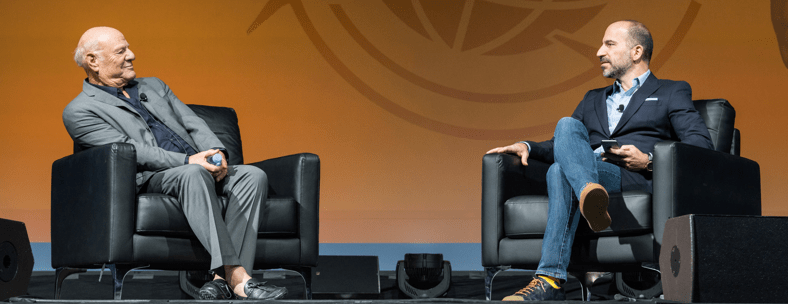
Voice is the next technology frontier and companies who do not plough resources into it now will be in danger of being disintermediated and disrupted, said Barry Diller, chairman of IAC/InterActive Corp and Expedia Inc, at the Expedia Partners Conference in Las Vegas last week.
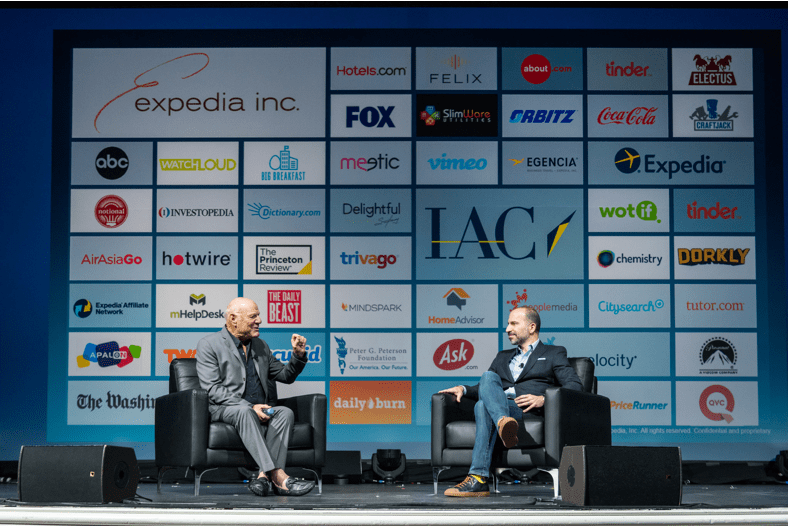
Diller (left) and Khosrowshahi: “An extraodinary development.”
Speaking to CEO of Expedia Inc, Dara Khosrowshahi, he equated voice as an “iPhone moment” – just as the iPhone changed people’s habits, voice will too. “It’s in its infancy now but it is going to power so much activity. As a consumer, it is an extraordinary development,” he said.
As with all new technology, there is both danger and opportunity. “It is another disintermediating factor. For companies not to plough into it now, you really would be in danger.”
Aman Bhutani, president of Brand Expedia Group, also believes that as the technology gets better, it will change people’s behavior. He doesn’t see it replacing but rather it will become one of the steps in travel planning and booking. “We will use voice because it’s natural for us to do so and because it’s faster.”
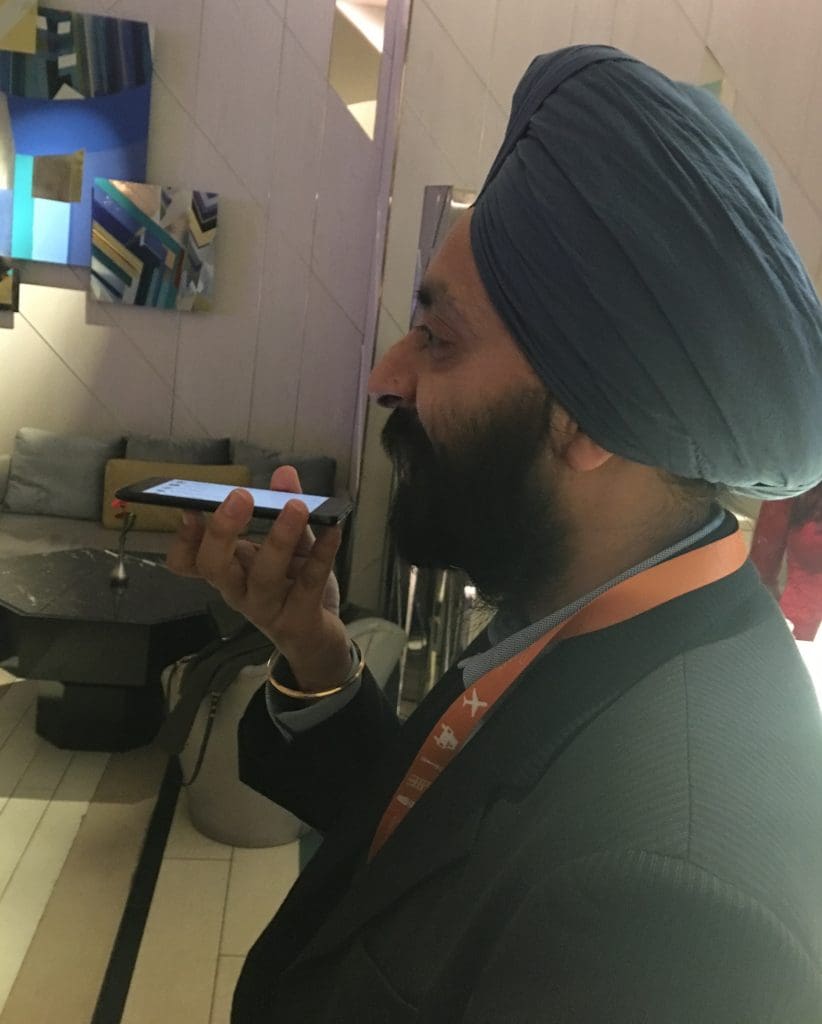
Bhutani: “We will use voice because it’s natural and because it’s faster.”
Last month, Expedia.com® launched a travel updates skill for the Amazon Alexa service, which gives customers the ability to interact with Alexa-enabled devices such as the Amazon Echo and Echo Dot to receive travel updates and information.
The Expedia skill for Alexa offers a voice-activated method to hear details on upcoming trips purchased on Expedia.com with other features embedded within the skill that allow travelers to ask for specifics regarding hotel bookings, flight status, loyalty points balance, rental car reservations, and more.
Asked to predict when voice would become mainstream, Bhutani said, “If you had asked someone 10 years ago would we book anything on mobile, we would have laughed. But now you can pay with voice. Different modes are coming together so that the way we interact is going to change.
“It is hard to tell when it will go from slowly to suddenly, but if you were to ask me chat vs voice, it’s voice and I see it evolving so that the next five years, we will be using a huge amount of voice. It will be an exponential change.”
Adding his voice to the debate, Johan Svanstrom, CEO of Hotels.com, shared a data point that proved humans can speak faster than we can type, and said voice offered “so many flavours and shortcuts”.
Trying out the new Google Now service in Las Vegas, I was impressed by how fast and accurately it generated results to my voice search. It’s also more conversational in that you can drill down your search with each question, unlike Apple’s Siri where it’s more instructional and not sequential. Given that I was using it in a very loud place and that it could still deliver results was pretty impressive.
In his conversation with Khosrowshahi, Diller said there would be “plenty of winners” with this next disruption which would involve AI, robotics and Virtual Reality. “As things get disrupted, new things come along or old things adapt.”
One “old thing” that hasn’t adapted well, he said, are legacy media companies and the industry is just at the beginning of digital disruption. This is an industry that has been dominated by very few players for the past 100 years and now we’ve gone from scarcity to “anyone can publish” and as such, it will reach complete velocity in the next 5-7 years, he said.
Netflix has now become the largest media company in the world by reach – 80m subscribers – versus HBO’s 35m. “HBO is purely US while Netflix is global and has invested every dime to go worldwide. And with Amazon, we now have two new players producing great programmes.”
Another “aha” moment he had in technology recently was when driving his Tesla, he accidentally flipped a switch which put the car in self-drive mode. At first he freaked out and then thought, “wow, the car drives itself”. “That he (Elon Musk) could do this and he did it and created 30,000 jobs and now he wants to power the world with solar energy and send people to Mars. Now that is ambition.”
As such, he picked the South African entrepreneur behind Tesla and SpaceX as his choice of best CEO.
The interview would not have been complete without discussion about the disruption caused by the US Presidential Elections and its results. Without doubt, Diller said “there was a desire for radical change and the feeling among people that the establishment had taken people for granted”.
Being an optimist, he said he would keep an open mind about President-Elect Donald Trump and his policies, not to mention, tweets. “It is possible I have something to learn. The best thing we can do is swim along with it, enjoy it and be prepared to learn – maybe we are wrong.”
On travel, he said, “as long as people breathe, they are going to travel” and he said he didn’t see trade policies or “putting up walls” changing that.
What’s inevitable is the tech disruption that will continue. “We can’t stop it but there’s a way to manage it and make disruption least harmful to as few people as possible.”