CLOSING out the year, battered by news of yet another Greek tragedy unfolding in our world and the travel industry, I was determined to start 2022 on an optimistic note.
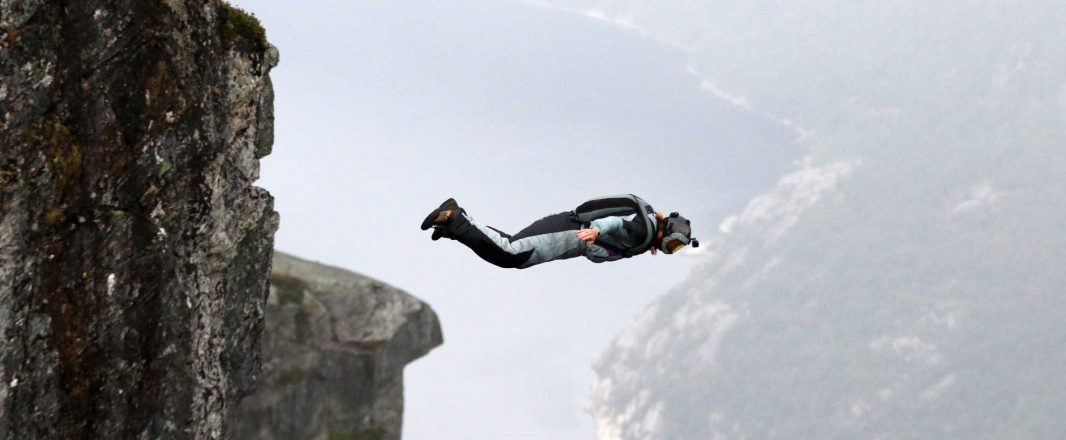
So I listened to an interview with Espen Fadnes, one of the world’s most famous base jumpers, who I think is the most optimistic human being on our planet. His sport, which has people dressing up like squirrels and jumping from cliffs, carries a 0.2-0.4% injury rate per jump, and a fatality rate of 0.04% per jump – that means around four deaths for every 10,000 jumps.
He’s jumped 8,000 times and in fact, the interviewer first spoke to him 10 years ago and said she was surprised that he was still alive, to which he replied that he believes he will live to 100.
He says he got his optimism from his father who himself climbed everything he could find – ice, rocks, you named it. “I’m exactly like him,” said Fadnes.
The only thing my father climbed was the chiku tree in our backyard, to get them before the bats did.
Fadnes is on the extreme spectrum of what is called optimism bias – defined in this study as “the difference between a person’s expectation and the outcome that follows” and it seems 80% of us have that bias. Ten percent are neutral and the other 10% pessimistic – they don’t work in the travel industry.
Says the study, “Humans … exhibit a pervasive and surprising bias: when it comes to predicting what will happen to us tomorrow, next week, or fifty years from now, we overestimate the likelihood of positive events, and underestimate the likelihood of negative events.
“For example, we underrate our chances of getting divorced, being in a car accident, or suffering from cancer. We also expect to live longer than objective measures would warrant, overestimate our success in the job market, and believe that our children will be especially talented.”
It’s probably also why, as beautifully and tragically depicted in the movie “Don’t Look Up”, even with a comet approaching to kill us all off, we still continue about our lives as though there will always be a tomorrow.
Like Fadnes who sees each jump as an opportunity to learn and execute a better jump tomorrow. “I make mistakes all the time … I almost died. Everytime I make a mistake when I land, I get upset … I analyse it and find a clear change in behaviour.”
Then he says, “Cool, I am fine, I go straight up again.”
The disadvantage to his optimism is he tends to say yes too often to projects and finds himself failing to deliver on time because he believes he can do all of it.
Apparently, another disadvantage is that optimistic people tend to be late for appointments and meetings because they believe everything is 10 minutes away (like me), except that I am realistic enough to know I ought to add another zero when I am in Jakarta.
Other than those two disadvantages, it seems it’s not a bad thing to have an optimism bias.
And that seems to be reflected in the answers we got to our series of “Year In Review And Looking Forward to 2022” articles, which we ran in four parts. When asked to rate on a scale of 1 to 10, how optimistic they are about 2022, the majority of respondents gave it an 8 – only one gave it a 7 while one gave it a 10. (That’s probably Fadnes’ avatar.)
But I believe optimism should be tempered with a dash of realism so that even as we endeavour to climb out of this Covid chasm, step by step, we should be mindful that something pretty big is shifting in our world and with our planet.
It may not be a comet hurtling down to earth but it’s something slow, inexorable and inevitable, if we continue as we do.
In this New York Times article, “This Isn’t the California I Married”, Elizabeth Weil, writing about the wildfires in her home state, calls it as “living through a discontinuity”.
She quotes climate futurist Alex Steffen. “Discontinuity is a moment where the experience and expertise you’ve built up over time cease to work,” he said. “It is extremely stressful, emotionally, to go through a process of understanding the world as we thought it was, is no longer there.”
She was referring to wildfires but I felt as though she was speaking about travel.
So as we start a new year, while we optimistically hope that this phase of the pandemic marks “the beginning of the end” – when pandemic shifts to endemic – we also need to, as Steffen argues, ditch the notion of “normal” – but please, also ditch the much over-used word “new normal”.
Concludes the article, “Relinquishing the idea of normal will require strength, levelheadedness, optimism and bravery, the grit to keep clinging to some thin vine of hope as we swing out of the wreckage toward some solid ground that we cannot yet see.”
So here’s to swinging out of the chasm this year, my friends, with strength, levelheadedness, optimism, grit and bravery – and a leap of faith.
• Featured image credit: Getty Images