In two weeks’ time, WiT will be back in Amsterdam, putting the spotlight on Asia and for the first time, Middle East. For companies looking for new growth, these two regions are critical for the future.
In the past four months, we have held events in Malaysia, Dubai and Seoul and one thing’s for sure, a lot is happening in both regions, developments you cannot afford to ignore if you want to grow your business.
Superapps lead the way in influencing Chinese outbound
China may be slowing down but there are plenty of pockets of opportunities to tap the rapidly changing outbound market. Superapps like Alipay and WeChat are expanding their eco-systems and, in so doing, giving Chinese travellers more confidence to venture beyond tried and tested paths.

Alibaba Group, which is on an aggressive globalisation strategy, is out to spread fun through travel by integrating Fliggy and Alipay. In 2018, the group served 642m consumers, by 2036, it plans to serve two billion consumers – that means, wherever the Chinese traveller goes, it intends to be there.
(Read this article for a summary of what’s happening across Asia)
This week’s news that Emaar, the name behind the iconic Burj Khalifa, The Dubai Mall and several thriving residential communities in Dubai, has launched the first-ever WeChat Mini-Program for a leisure attraction in the region is indicative of the moves suppliers are making to make it easier for Chinese travellers.
The service is fully integrated with WeChat Pay for At the Top, Burj Khalifa and as part of the WeChat ecosystem, the Mini-Program enables WeChat users to access all the information on the world’s highest observation deck and book tickets in advance.
What will this mean for tours & activities companies to whom attraction tickets are one of the best sellers?
Solving payment problems will open up Middle East even more to global brands
Sticking with the Middle East, we are seeing payment challenges resolved by companies like Checkout.com which this morning announced a raise of $230m in what is Europe’s largest fintech Series A round ever, and globally the third largest fintech Series A round of all time.
This gives the company more resources to open up the Middle East region further to global online travel brands struggling with a fragmented payment landscape in the region.

The outbound market in Middle East remains strong and robust, with Saudi Arabia a key contributor. Couple of things you need to know – it’s a very last minute market and mobile rules.
Brands born in other emerging markets such as Wego (Singapore), Cleartrip (India) and Travelstart (Scandinavia/South Africa) are in there, battling with the global OTAs and local online brands as well as traditional travel companies for a slice of the growing market.
(Read this article for a summary of what’s happening across the Middle East)
Sweet Seoul beckons with outbound promise
Beyond China and within North Asia, Seoul has risen as the second largest outbound market in Asia, overtaking Japan. Growth has practically doubled the last four years as low cost airlines launched and opened up the world to South Koreans, 28 million of whom travelled abroad in 2018.
The market is shifting rapidly from group to FIT as was shared by president of Hanatour Service, Sanghwan Park, at WiT Seoul this month and into this space has entered global OTAs and local online players to meet the needs of the new customer. Remember too that South Korea has the highest smartphone penetration in the world and will become the first country in the world to have 5G and you can just smell the changes coming.

South Korea was named most innovative country for the sixth time running in the 2019 Bloomberg Innovation Index. And from what we have seen of startups in South Korea, they are ambitious and aggressive in pursuing their ambitions to expand beyond their borders.
(Read this article for a summary of what’s happening in South Korea)
“Drastic market acceleration” of South-east Asia’s Internet economy
Moving on to South-east Asia, the 2018 study by Google and Temasek Holdings says that the Internet economy in the region will reach $240n by 25b, revising its previous estimate of $200b due to “drastic market acceleration”.
In 2018, it valued South-east Asia’s Internet economy at $72b, of which 30b was in online flights, hotels and vacation travels – and here’s the thing, 59% of travel bookings are still completed offline.
This is going to change rapidly as South-east Asia’s first travel unicorn Traveloka expands beyond Indonesia, a market of nearly 270m people, and digs deep into other verticals beyond flights and hotels. It may not call itself a superapp but its app offers other travel and lifestyle-related services such as restaurants and tours & activities.
Into this fray enters Grab which has launched hotel bookings (powered by partner/investor brands, Agoda and Booking.com) in its quest to become the “everyday superapp”.
(Read this article for an update on what Grab is doing)
That’s just a taste of what we will discuss at WiT Europe on May 16. See you in Amsterdam.
Sign up for Phocuswright Europe here
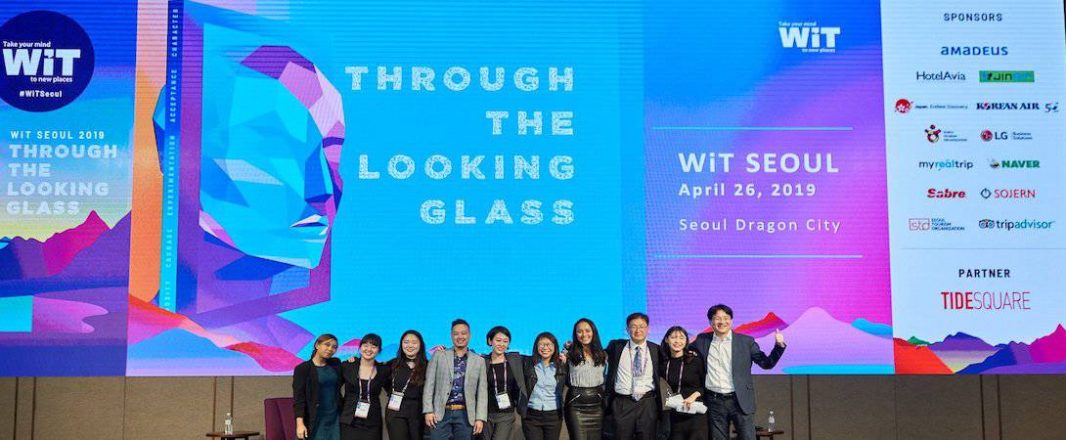
• Featured image: The WiT team at WiT Seoul 2019