In the news: Healthy Q2 for AirAsia group, surge in hotel bookings on SiteMinder’s platform, APAC travellers most tech-savvy
AirAsia Group carried 9.9mil passengers in Q2

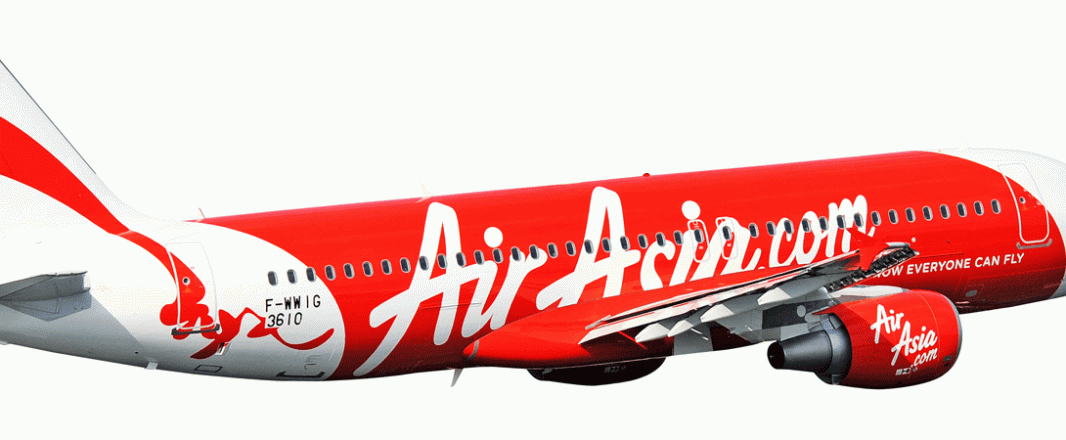
AirAsia flying high
AirAsia Berhad reported a healthy showing for the airliines in the group for the second quarter ended June 30, 2013 (Q2), recording a strong load factor of 80%, an increase of 1% from the same period last year.
The total number of passengers carried for the group increased by 20% year-on-year (y-o-y) to 9.99 million, in line with the increase in capacity of 18%, said the airline in a statement.
“Year-on-year AirAsia group took in 19 additional aircraft, which brings its total fleet at the end of June 2013 to 121 (126 including AirAsia Japan).”
Individually, Malaysia AirAsia remained resilient and posted a load factor of 80% in Q2, which is the same as Q2, 2012.
“The number of passengers carried during the reported period was up 12% at approximately 5.5 million, in line with the 12% capacity increase. The increase in passenger traffic was attributed to the addition of frequencies in a number of routes including Kuala Lumpur to Kuching, Bintulu and Langkawi for domestic, and Kuala Lumpur to Tiruchirappalli and Lombok for international,” said AirAsia on the performance of the Kuala Lumpur based airline.
The strong load factor and high passenger growth of Malaysia AirAsia is mainly due to its “continuous strategy to be load active and yield passive despite the challenges faced following the 13th general election and the Lahad Datu incident.”
At the end of June 2013, the total number of aircraft under Malaysia AirAsia was 66.
Thai AirAsia recorded a of 82% in Q2, a 3% increase y-o-y. The number of passengers carried rose 25% to 2.4 million, and was due to the additional frequencies in routes such as Bangkok to Hong Kong, Wuhan and Phuket.
Indonesia AirAsia saw a 1% increase in its load factor y-o-y to 79%. Passengers carried was up by 33% to 1.9 million, in line with the capacity increase of 32%. The growth was boosted by the introduction of three new routes: Medan-Jakarta, Surabaya-Singapore and Jakarta-Johor Bahru, as well as increases in seven other routes.
Indonesia AirAsia received two aircraft in the quarter under review, bringing its total fleet to 24 now.
“Philippines’AirAsia recorded load factor of 74% in Q1, 2013, a big increase as compared to 48% in the same quarter last year, driven by the summer season and improvement in distribution methods, ” said AirAsia.
The airline also saw an 114% increase in passengers to 140,034 in Q2 from 65,285 a year ago, with a capacity increase of 38% year-on-year.
At the end of June 2013, Philippines AirAsia has two aircraft, serving five routes: Clark-Kalibo, Davao, Hong Kong, Taipei and Singapore.
Online hotel bookings surge to 10.5 million with SiteMinder’s RDX

Healthy growth in hotel online reservations
SiteMinder’s connectivity distribution platform, RDX (Room Distribution Exchange), generated 10.5 million in hotel reservations during FY2012/13, equating to an average of USD$390 for each booking, an increase of nearly US$50 per booking compared to the previous period’s data.
This USD$4.2 billion in total booking revenue for hotels is double the revenue for the same period for the previous year (USD$2.1 billion).
“A rapidly expanding global property base and strong diversification in distribution channels are behind the rapid growth in year-on-year booking revenue,” said David Williams, SiteMinder’s executive sales and marketing director.
SiteMinder’s CEO and founder, Mike Ford, said the revenue increase continues to show that Online Travel Agent (OTA) bookings are a critical component to a hotel’s strategy and that the RDX’s distribution diversification into other channels – such as traditional wholesalers, GDS and meta sites such as Google and Trip Advisor – have helped drive this figure up over the past year.
“As the hotel distribution landscape continues to evolve, it is imperative that technology providers give their hotel clients extensive distribution opportunities. We have worked hard to ensure RDX is at the cutting edge of the distribution technology pack,” he added.
Over 50 technology companies now use SiteMinder’s RDX platform to power their distribution including MICROS, hetras, Sceptre Hospitality and Genares.
See infographic here.
APAC travellers most tech-savvy, reveals Visa survey
.gif)
Asian love affair with tech gadgets
The need to stay connected wherever they travel has made technology both a trusty companion and an indispensable resource for leisure travelers from Asia Pacific, revealed the Visa’s Global Travel Intentions Study 2013.
The top holiday tech companion for these travellers are phones (80%), followed by cameras (70%), computers (54%), and entertainment devices (32%). They use these gadgets for getting essential information and share their travel experiences with friends and family – reason for 65% of global travellers taking a smartphone with them.
Some key findings: