
In the news: Special “rescue fares “initiated by IATA, high demand for Bali hotels despite room glut on the island, workation for most Southeast Asian travellers
No passenger left behind – a pledge from IATA

Tony Tyler: Airlines put passenger needs first with the cooperation agreement. (Image credit: IATA)
The International Air Transport Association (IATA) has unveiled a new arrangement to help passengers affected by airline bankruptcy to return home through the offering of special discounted fares.
Under the voluntary agreement airlines flying to and from the European Union (EU) will offer special “rescue fares” or discounted tickets for the traveller’s return trip, subject to availability. This is to ensure no passenger is left behind in the event of an airline ceasing operations as a result of financial failure, said IATA.
The agreement formalises a long-standing custom, which many airlines have traditionally offered in these rare instances.
The “rescue fares” of a nominal amount will be available for purchase up to a maximum of two weeks after the event to anyone flying to and from, or within Europe. They are meant principally for passengers who are not covered by insurance in such an eventuality.
IATA reminds that states responsible for the licensing of the insolvent airline should also play their role in communicating to stranded passengers the possibility of this rescue service.
Tony Tyler, director general and CEO of IATA, said: “This agreement on rescue fares shows that the airline industry is more determined than ever to ensure reliable and consistently excellent customer service. Airlines have formalised a unique cooperation agreement that puts passenger needs first.”
The European Commission has estimated that between 2011 and 2020, only 0.07% of all passengers could be affected by airline bankruptcy, and of them, only 12% would require assistance in getting home.
There have been discussions of offering “rescue fares”, but the airline industry has opposed such a fund as financially prudent airlines would be subsidising riskier airlines. Additionally, operational costs are too high to make them a viable option. It is estimated that up to 85% of the money would be eaten up in administration.
Added Tyler: “A compulsory levy on airlines to deal with repatriation would not serve anybody’s interest. We commend the European Commission for resisting this, and for encouraging airlines to adopt this coordinated and customer-focused approach.”
Bali hotels still basking in the sun despite the proliferation of rooms

High tourist arrivals in Bali have help filled the island’s hotels. (Image credit: chrishowey/iStock)
Demand for Bali’s hotels are still on the rise despite broader concerns about what seems to be an endless stream of new rooms coming online, reveals a new report by leading hospitality firms Horwath HTL and C9 Hotelworks.
Statistics in the report show overseas arrivals through August 2014 surged 14% year-on-year. By the end of 2014, international passenger arrivals through Ngurah Rai Airport are expected to reach a record 3.8 million.
The encouraging arrivals are a welcome relief to hoteliers who are battling increased room inventory across the island.
Matt Gebbie of Horwath HTL said: “Bali hotels in many cases are weathering the storm of new supply, admirably holding rates and taking a small hit on occupancy. Individualism, management and product quality at every price point are more important than ever.”
The report noted that while overseas sentiment remains strong, the base tourism market for Bali remains that of South East Asia’s largest economy – Indonesia. In 2012 and 2013, approximately 68% of visitor arrivals were from the domestic sector. The country hosted 8.8 million international travellers last year, but on a far more compelling scale were domestic hotel stays that exceeded 200 million.
Domestic consumption, viewed as a lead economic indicator, has also pushed through to the island’ property sector.
Bill Barnett, C9 Hotelworks managing director said developers of hotel branded residences have picked up on this trend.
“The mix of yield-motivated investment buyers are also driven by the desire of personal usage in hospitality projects, hence the robust pipeline of condominium hotel projects though out South Bali.”
In 2015 Bali will be looking at a mass-market strategy due to Indonesian government announcing visa waivers for five countries – China, Japan, Russia, South Korea and Australia.
“It’s a pointed market pivot as it recognises the potential of both the island’s core business and the leading emerging markets. At mid-year 2014, over 90% of visitors to Bali came from Asia Pacific source markets. While the Eastern European initiative is clearly aimed to take a share of Thailand’s substantial Russian travel trade,” added Barnett.
On the future of South Bali, Barnett said: “There is an expanding halo effect from the existing critical mass of destination visitors and recently improved infrastructure that is now expanding into Lombok, the Gili Island, Sumba and Flores. Not only is tourism seeing expanded demand in these areas, but property developers are starting to recognise that opportunities are on the rise to tap into a Greater Bali economic picture.”
Click here to download a copy of Bali Hotel ad Branded Residence Update 2014.
Two in three Southeast Asian travellers work while on holiday

Urgent matters requiring attention is main reason for travellers working while on holiday.(Image credit: nyul/iStock)
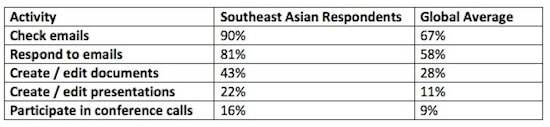
A global on-vacation study by travel site, TripAdvisor, reveals that nine in 10 travellers in Southeast Asia check their emails on vacation, while 67% reported having worked, compared to the global average of 46%.
The survey was carried out among 16,765 employed respondents across 14 countries, including 618 in Southeast Asia.
Some key findings:
• 56% of respondents in Southeast Asia say they do not mind doing a little work during their vacation, while 36% prefer to be totally disconnected, and 8% enjoy being connected to work while on vacation.
• Respondents across all countries surveyed cite urgent situations needing attention as main reason for working on vacation; 75% of Southeast Asian respondents report feeling this way, higher than the global average of 58%.
• 19% of Southeast Asian respondents are most likely to feel guilty if they do not work on vacation, while 15% say that their managers expect it (15%).
• 90% those surveyed in Southeast Asia check their work emails while on vacation, with 44% of this group saying it is a daily and do not consider it to be “work”.
• 41% check their work email once a day, while another 41% admit to checking several times a day.
• 46% of respondents say the rise in internet connectivity and access to mobile devices have created expectations from employers that employees should always be available to work, thus feeling the need to check in while out of the office.
• 59% of the respondents in Southeast Asian plan to take their full annual leave this year, but this still depend on work commitments.
• 56% of all respondents surveyed say they are not able to take all their time off in past years, as there was too much to do at work.
• 69% of respondents in Southeast Asia say their vacations leave them feeling refreshed and recharged, with 29% stating hey are better able to handle work stress after taking a vacation.
Jean Ow-Yeong, TripAdvisor spokesperson, said: “The TripAdvisor survey shows that travellers in Southeast Asia receive less annual leave than other Western countries, and when they do take time-off it is often more like a ‘workation’ than a vacation. In today’s highly connected world, Southeast Asian travellers feel the need to stay plugged in even when on vacation.”
Top work activities during vacation
• Featured image credit (boy at airport): MiniImpressions/iStock