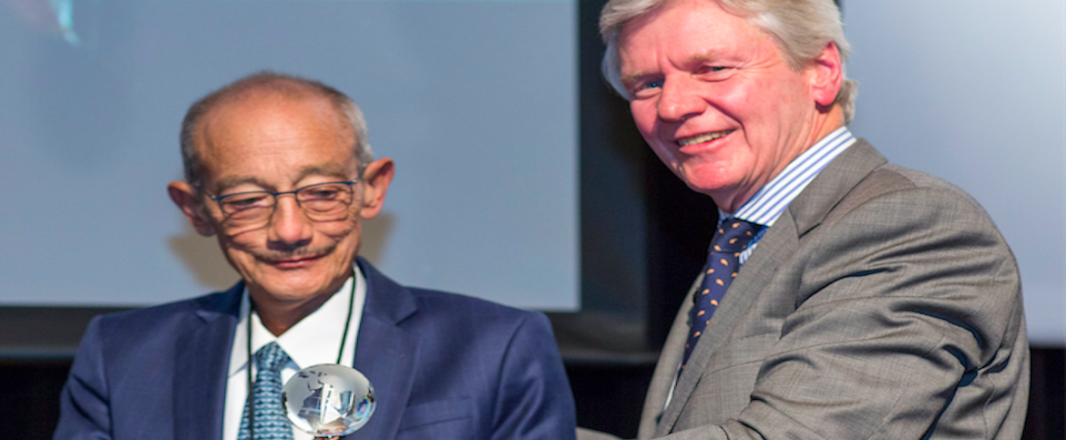
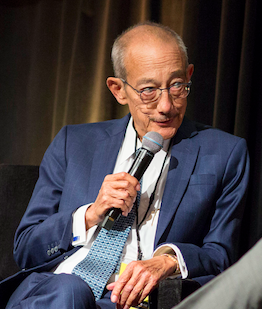
It was good to see veteran hotelier Richard Hartman on stage at Hotelsworld Sydney being recognised for his contribution to hospitality – he received the conference’s 2016 Global First Award – and in familiar fine fighting form.
Richard Hartman: “They get less and less and we got away with it.” (Above, rather fitting he received the award from former employee Tony South who conducted the interview)
One of the things I liked about Hartman, best known for leading the aggressive growth of Sheraton in Asia from six to 40 hotels in the late 80s to early 90s and then running InterContinental Hotels in Asia Pacific and later EMEA from a London base, is his directness. This is a hotelier not bound by corporate speak, daring to utter sound bites that you remember forever.
And clearly I wasn’t the only one to recall his most memorable quote on innovation when he said many years ago – around 2008 – that the only thing hoteliers have innovated is folding up the corners of the toilet roll.
Asked if there had been innovation since then, the Hawaii-born hotelier said, “To transfer what we did for the customers to what the customers have to do for themselves, and they don’t seem to mind. They get less and less and we got away with it.”
Hartman, who started his hotel career washing dishes 50 years ago, had his first general manager’s role in Hawaii. He then moved to New Zealand and worked in Australia and Asia most of his career.
Speaking about his interest in failures, he said, the biggest challenge of any leader is “leading people into battle where they don’t want to go and do what they don’t want to do”.
He spent a lot of time studying leaders in the military and what made some good leaders, and what made some great leaders.
His philosophy – find them, trust them, give them the tools, leave them alone and make sure they are doing it within simple but fair guidelines. “If you have the right people, they don’t need a lot of over-supervision and policing.”
The bottomline of mergers that go wrong
Having gone through several mergers and acquisitions in his career, he was asked for his insights into those that worked and those that failed.
“The bottomline of mergers that go wrong – you wait too long or you come in with a big broom and sweep everything up without realizing you’re killing the culture. It is easy to get rid of people but hard to find good people to integrate it.”
I wondered if this was going through Michael Issenberg’s head when he took to the stage. The chairman of Accor Asia Pacific has been responsible for the integration with Fairmont Hotels & Resorts and has spent the past few months shuttling between Paris and Toronto, ensuring a smooth integration between two companies with very different cultures.
The best day of the integration – the appointment of veteran hotelier, Chris Cahill, who helped build FRHI via Canadian Pacific’s acquisitions of Fairmont, Raffles and Swissotel, as the CEO/luxury brands, which will include Raffles, Fairmont, Sofitel Legend, So Sofitel, Sofitel, MGallery by Sofitel, Pullman and Swissôtel.
The worst day – “when kicking off the integration, we went to Toronto and organised 30 executives from FHRI and 30 from Accor – but the shareholders said we couldn’t have the meeting. I had to call Sebastien (Bazin, chairman/CEO of AccorHotels) for help and he came in early and convinced everyone to go ahead with the meeting.”
The biggest fear was “making sure we retained the best people”. Nine executives were taken out during the initial integration.
Why Frasers’ Choe Peng Sum changed his mind about boutique hotels
In Choe Peng Sum’s case, the £363m acquisition of the two UK-based boutique lifestyle brands, Malmaison and Hotel du Vin, opened his eyes to a new world. The CEO of Frasers Hospitality, who was Frasers first employee 19 years ago, said called it the natural next leap for the Singapore-based group to get into “boutique, anti-establishment, designer hotels”.

Choe Peng Sum: “All of a sudden, I see this the other way around.”
Debunking the traditional perception that “you can’t make money from hotels with less than 100 keys and restaurants”, Choe said he had always believed in less f&b and more rooms but “all of a sudden, I see this the other way round”.
“We took a deep dive into the two groups and found that their management has perfected the art of clustering – they have centralised a lot of processes, HR, call centres – and they are effective and efficient, very scalabe.”
He said the two groups had strong reach in the UK and instead of cost-cutting during the integration, they have widened the platform so that now more customers can come through the combined channels.
He said the acquisitions have allowed Frasers to accelerate global growth, leverage operational efficiencies, lower cost of distribution and work on its loyalty offerings. “Going forward, we will zoom in on driving brand direct business.”
I can just see Hartman smiling and nodding. “Yes, get customers to do more and we do less.”
Either that or “build boutique hotels for short people and sell to companies like Accor and Frasers”, as Tony Ryan, managing director, global mergers and acquisitions, hotels & hospitality group of Jones Lang LaSalle Property Consultant, jested at the close of the panel.