
Usually at the end of each year, I am asked to reflect on what happened in the world of airline and travel technology the previous year and what can be expected for the coming year. The process often drives me to have near term thoughts and see if this fits into a somewhat loose understanding I have of the future and its impact on the marketplace. Here’s my prediction for travel in 2017.
One of my key beliefs is that sooner or later we will move away from what I call the Explicit User Experience (E-UX) to a more intuitive and less clear but more valuable Implicit User Experience (I-UX).
I believe that this will come about in all parts of the Travel Planning, Buying and Execution process. The analogy we can use is to consider the process of mapping. We have gone from abstract directions to imprecise paper directions to formal maps plotted and planned by pioneers who do this via land without the benefit of the dimension of an aerial view.
Then we have had vast digital mapping resources from various heights all the way out into deep space. For us mortals we have stopped using the paper maps. First we relied on GPS/SatNavs and now that is in our phones. (Like so many other things that have gone into these things we carry around with us).
Similarly in the planning of getting from A to B we have been (and still largely do) use arcane tools. Consider a GDS interface. Not really consumer friendly. The driving need for the skills to operate these complex legacy systems that power much of the business is counter balanced by less and less utility.
Thus this year, I feel we are finally starting to see the erosion of the E-UX world. Consider this:
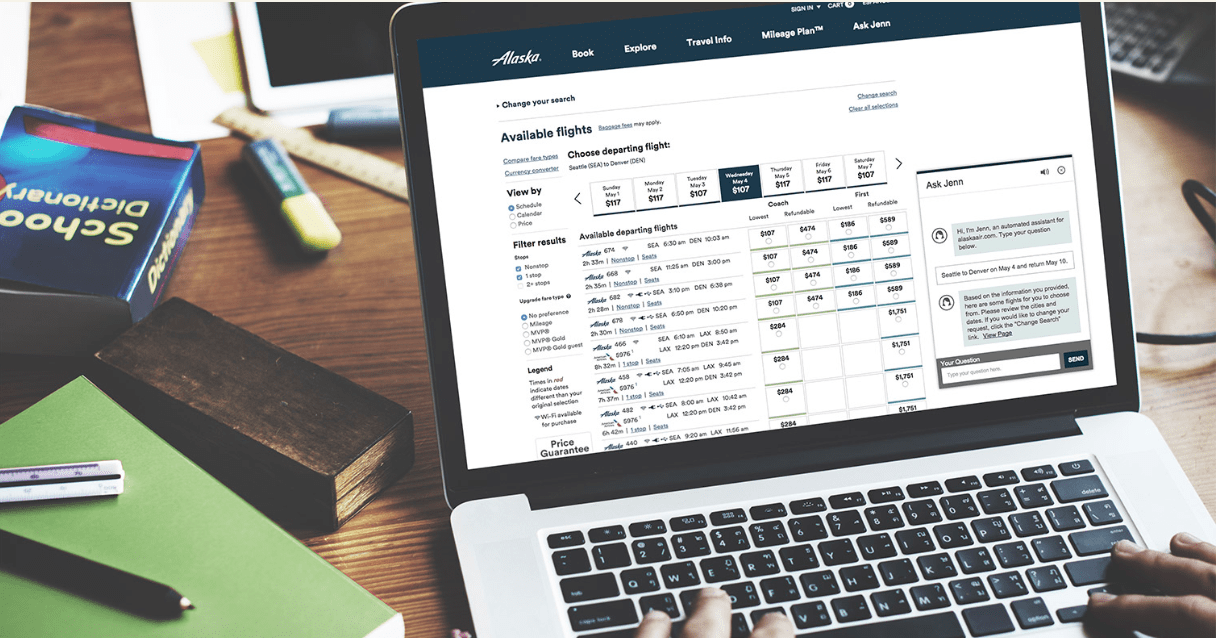
Alaska Airlines’ Ask Jenn, powered by NextIT, has answered 20 million questions so far.
Voice and Text – chatbots and AI are enabling humans to get the information they need of a higher order than ever previously possible. Drawing on the success of pioneers like NextIT (http://www.nextit.com/work/alaska-airlines.php), the consumer is no longer going to have to deal with a 1:1 relationship with a customer service representative. Now a Customer Service Agent can be a human OR a software programme. For the more esoteric amongst us – check out the following Patent. US 20130226847 A1.
The superstar of this year has been (if you can believe the PR) Lola Travel founded by Paul English, one of the founders of Kayak.
We are seeing a convergence of the process of human natural interaction with the computer systems. Today the 4 major systems General AI systems reflect their parentage. Google search responds to everything. Cortana comes from Microsoft, Siri from Apple and Alexa from Amazon.
These interfaces are now appearing in places where the interaction is natural and near at hand. Take for example the decision of the Wynn Hotel in Las Vegas (and presumably all the other properties they manage) to put an Alexa device in every hotel room. https://techcrunch.com/2016/12/14/whathappensinvegasstayswithamazon/
The removal of the explicit interface is merging with these hardware and software based systems to create the I-UX type interaction of which I have been thinking about. I am not sure if I would feel entirely comfortable having machine listen to all the sounds and words that occur in my hotel room. I thought what happened in Vegas was supposed to stay there!
If you are interested to try such a device out – they are currently available as the Amazon Echo Dot for a mere US$39 retail.
This migration away from E-UX will not occur overnight. It will take a long time – years and possibly generations. For those of us who are still used to something called a “manual” these are welcome changes, it will make our lives generally easier. For Millennials, they have no comprehension of what the concept of having someone write a full set of complex documentation that serves only to be a CYA to the tool that they can easily use without it.
Chatbots, speech and text recognition AI/Deep Learning/Machine Learning are all coming together to enable us as humans to control the machines that service us. These machines then can draw on massive amounts of data to present to us real time information that is timely and contextual so we can turn it into knowledge and use it.
With this freedom of the user interaction comes the Travel industry’s obligation to serve up the data in forms that can be consumed by these new tools. Guess what – this is really a giant black hole. Years of legacy thinking have gone to building gigantic and complex silos of data that REQUIRE skilled operators to interpret and utilize the information.
This is going to haunt the industry for years. Our sins will now come back to haunt us – just like Jacob Marley (Scrooge’s deceased business partner damned to wander the earth in Charles Dickens’ A Christmas Carol), we will be forever encumbered. We still have time to address this and to create new solutions.
But don’t expect those who have become gatekeepers to the data to realise the imminent threat. They have dodged the bullet before – this time however there are a lot of other smart people who think this is an interesting problem to solve and they WILL address it. Perhaps now might be a good time to short those stocks of GDS, PSS, CRS, etc systems in airlines and hotels etc.
You have been warned. Everything comes at a price.
Picture above: Jim Carrey and Gary Oldman in “A Christmas Carol”