Ang Choo Pin left the world of politics and diplomacy to join travel because he saw an opportunity to make an impact in an industry that he believes is truly a force for good. Yeoh Siew Hoon catches up with Expedia Group’s senior director for government and corporate affairs for Asia to find out what his job entails and what his mission is.
Q: You have an impressive background in politics and economics – worked with Standard Chartered Bank as head of public affairs, and before that, a diplomat in Singapore’s Ministry of Foreign Affairs covering International Organisations, Middle East, and Northeast Asia, where you were Singapore’s Deputy Consul-General to Shanghai. So why did you choose to enter travel – some might perceive travel to not be as serious an industry as banking or diplomacy or politics?
It was three years ago and I still remember the phone call I got. The first question was, have you ever thought about entering travel? My answer was no but I love travel. When I came in, and learnt more, I became intrigued. Things were changing so fast, and travel makes people smile. Banking does not.
Q: How do you bring the world of diplomacy to travel?
I was a diplomat for eight years. A lot of the skills are specialised and can be transported to other industries. I think the most important skill is getting to the crux of the issue and knowing why something matters – which is problem solving.
As a diplomat, you represent the country and help solve problems. You have to work with international bodies, you have to know your own politics and interests, as well as the other parties’, to come to a mutual solution.

Ang Choo Pin: “Congestion in key destinations is a growing concern, and we are working with both Indonesia and Thailand.”
Q: It’s like having empathy in other words?
Yes, you have to understand the other person’s point of view – are these the reasons they can only say this – and help them arrive at a mutually acceptable point.
Q: What’s your mission as Expedia Group’s Senior Director for Government and Corporate Affairs for Asia?
How can we use diplomacy as a tool to break down barriers in travel to empower and better the lives of people? How can they benefit in a sustainable way? For tourism to succeed, it has to be sustainable, not only in environmental terms but also on equitable ones. Travellers should not only be going to one or two cities but should be dispersed to other areas.
Q: What’s the eventual outcome of what you do?
The optimal allocation of resources so that tourism exerts itself in a positive way. Tourism is a tremendous force for good and has the ability to change lives.
Q: What tangible help do you provide to achieve that outcome?
As an example, Expedia Group recently launched two new features on Expedia Group Partner Central, to help new hotel partners who are unfamiliar with online distribution ease their transition into the digital world.
(Co-Browse is a trouble-shooting tool to solve hotel partners’ pain points when they have navigation problems on the platform and the Adaptive Landing Page is designed to provide customised content and recommendations on the homepage for hotel partners based on their current needs and familiarity with the different tools within Partner Central.)
We also signed a MoU with the Tourism Authority of Thailand to conduct a series of educational workshops to accelerate digital skills transfer to the hospitality industry in secondary cities – this is to address their concern about tourist congestion in main tourism spots like Bangkok and Phuket.
Congestion in key destinations is a growing concern – and we are working with both Indonesia and Thailand. For example, we are doing joint promotions with Thailand to promote places like Chiang Mai, Chiang Rai, Mae Hong Son and Trat and in Indonesia, we are running campaigns to promote Lake Toba, Flores and Raja Ampat.
As a traveller – I love diving – I go to many far-flung parts of Asia and I see how important resorts and restaurants are in these areas to travellers, I really see their value in the supply chain, but the ability of these businesses to reach out to travellers is not happening fast enough.
Q: There’s also the growing issue of pollution – Thailand recently had to close one of its beaches.
Yes, we’ve been talking to the Thai government. The first issue is plastic pollution and since we bring a lot of travellers, we can help spread the message. We are working with our hotel partners on an initiative to help reduce plastic waste. Thailand is our pilot project and we will take the learnings from that and apply elsewhere.
Consumers are making the green choice and we are working on tech solutions to allow consumers to filter for green hotels.
Q: But are consumers prepared to pay more?
As more hoteliers do it, and if related industries start to support the movement, we should give consumers the choice.
Q: The challenge is most governments see travel as an opportunity for more taxes and there’s a tendency in some countries to regulate it further.
Yes, some governments have looked at tourism and travel as tax receipts and they want to regulate it – there is a tendency to over-regulate it.
That’d be like killing the goose (that lays the golden egg). They need to let it grow and be more creative and thoughtful in their approach. Today, they can analyse data to see where the trends are going and work with the right people.
Thailand is looking at it very closely, they get 37m visitors, it’s a big part of GDP – and they are saying, our goal is not to attract more, but good quality tourists who appreciate the local culture.
Q: When the Internet was founded in 1989, people extolled its ability to create a fairer world with equal access to information for all and later on, commerce. Yet the divide between the haves and have-nots has become larger in most economies – can this be fixed or are we further away from the ideals of a fairer world because technology today seems to favour those with scale and masses of data?
The eco-system has to come together. In South-east Asia, what impedes growth is the lack of speed (of the Internet). More than three seconds’ delay in loading a page, 40% of traffic drops off. Internet speed is still woefully slow in some parts of Asia.
We’re seeing some progress in the fin tech sector – which is allowing small merchants to receive payments – and cross-border payments within ASEAN are becoming more possible.
How travel and the digitisation of travel can help put power in the hands of people does not happen on its own. It has to be thoughtful and companies have to factor in the network effect to the fullest and help both consumers and partners by removing layers of inefficiencies.
Q: Booking.com runs its Booking Booster programme which supports sustainable tourism startups. Does Expedia run something similar to support startups that are addressing environmental/community/conservation issues?
Every company supports sustainability in a different way, we have selected a path of working with governments in a targeted way. This role did not exist three years ago, now we have one person in South-east Asia and one in Australia and we are looking to hire one in North-east Asia.
Q: You speak English, Chinese, German and Spanish, so no problem for you to be a traveller. If there was one pain point travel could fix, what would you like it to be?
The biggest pain point is the last mile – the journey to the dive destination in a remote place like El Nido – getting to the airport is the beginning of the journey. If we can solve the entire journey, travel would be more vibrant.
Q: And if you only had one wish and one policy you wished to see changed that related to travel, what would it be?
That governments look at travel as potential game changers in the way people live, as a force for good, and be conscious of that.
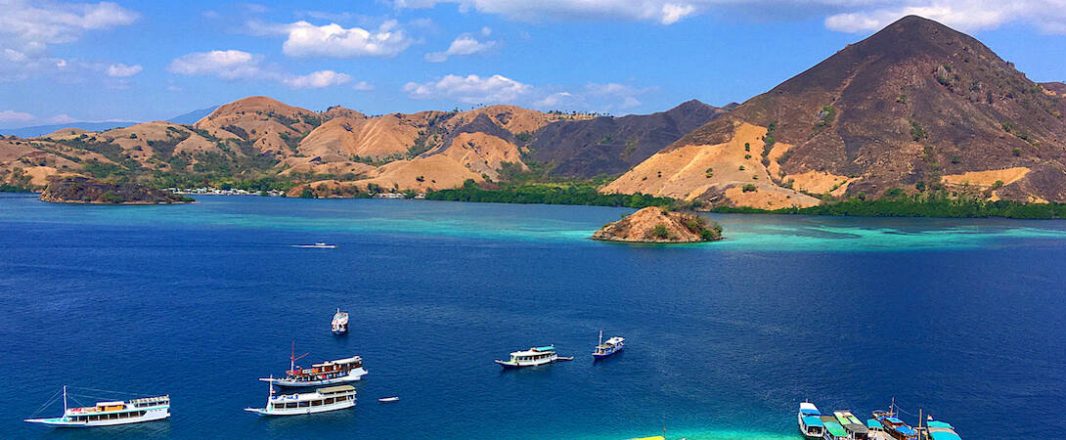
• Featured image credit (Komodo Island, Labuan Bajo on Flores in Indonesia): User3a14f790_939/Getty Images