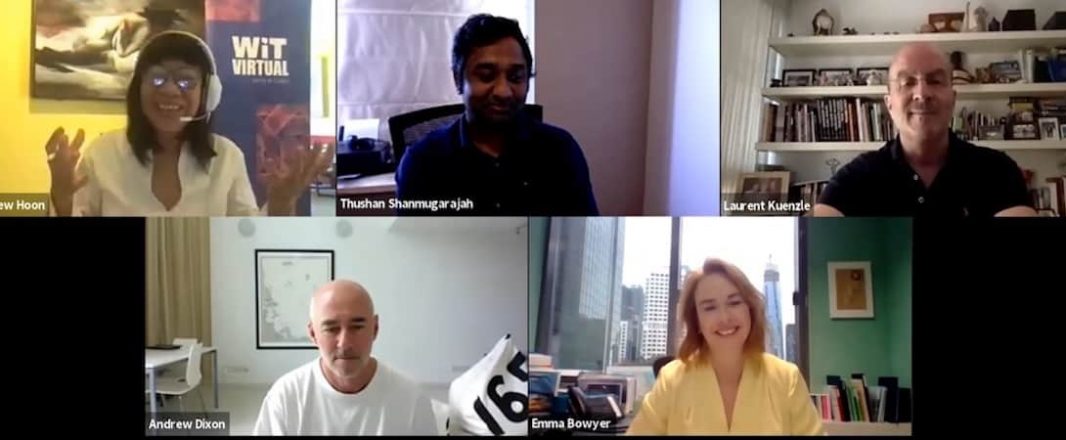
Emma Bowyer, Laurent Kuenzle, Andrew Dixon and Thushan Shanmugarajah have one thing in common – they are doing all they can to get through the Covid-19 crisis with their people intact, and each is doing it differently.
In fact, Bowyer, managing director of ICMS Australasia, even hired a new staff during the period as she pivoted her business to virtual events and as she took her time to make the right decisions.
Asked what was the toughest thing she had to do during the crisis, Bowyer, during the WiT Virtual on “Unsung Heroes” recently, said, “In the early days when I was sort of witnessing some big decisions being made by other people in their businesses, I thought, well, I’m going to stay true to a course that I felt was the right thing to do. And I do feel that that has been the right decision. But buying time was certainly the big thing for me.”

She has managed to keep the 35 staff intact, with no reduced working hours or holiday time for anyone. “We’re actually busier in some ways, but obviously, where we haven’t been operational, we’re redirecting resources to doing things where they can still contribute to the success and the value of the business. So I think that’s been a really good outcome to keep everybody together. And that’s been my goal from the beginning.”
Kuenzle, managing director of Asian Trails, said his goal is to also get through the crisis with as many of its people intact as possible despite the difficulty of not knowing how long the pandemic will last, and what the tourism world would be like when it is over.
He acknowledges the company is in crisis and in survival mode. “We have to cut as much cost as we possibly can, and our full focus is on retaining as much cash flow as possible. It’s very tough. I mean, we have to cut everybody’s salaries, we have to take tough measures with regards to people. But my objective really is to try to get everyone from our teams through this crisis, get out of it, be ready for it. And in all of that, of course, not losing sight of our long term objectives.”

Kuenzle said the two most important assets are the team and technology. The company has kept intact its staff of 700 across 35 offices. It is focusing on technology development and enhancing a new system it rolled out last year. “We have big things coming up in the B2B world, in what we want to do with the connectivity to our clients and our partners.”
Dixon of Nikoi/Cempedak Islands said dealing with the uncertainty has been tough. His challenge is also getting staff, who typically do not come from strong educational background, to understand some of the issues and how they will play out.
“Not being able to give any sort of timeline on when things might improve is difficult for everyone. So we’ve spent a lot of time on the foundation (The Island Foundation) we’re supporting and helping it raise money. We did a fundraiser amongst the shareholders of the group.

“The two organisations are in a pretty good space, and TIF has done some fantastic work in terms of getting out and educating the local population on the impact of Covid-19, and help them set up things like hand-washing.”
The resorts have had to furlough some staff, but Dixon has given them rein of the islands to allow them to harvest some products from the islands like nuts, berries, coconuts to feed their family. The staff is also invited to work on the farm and they get to take home what they grow and harvest. It has also set up a Staff Fund which is supported by sales of products such as Nikoi craft beer and other food items, which he sells in Singapore.
For Shanmugarajah, co-founder and CEO of FindMyFare.com, its 72 staff started working from home in March, and the company redeployed some of its travel consultants to support customer service for health care and pharmaceutical companies that were delivering much-demanded supplies during the lockdown.

For him, the difficulty is also not knowing how long the recovery will take, and ‘s gotten creative with redeploying his staff to work with other companies, a necessity he said in a country that does not have any safety net for retrenched workers.
As 95% of the company’s business is outbound travel, he is unsure when business will pick up even after the lockdown is over.
It recently signed a deal “with an insurance company and a wealth management company to sell their products to our customer base,” he said.
Passion and belief in a bigger outcome
The other thing these four individuals have in common is passion for what they do and belief in a bigger outcome.
ICMS’s Bowyer said many of her clients are working in contributing industries related to science, technology, education and maths, and she wants her business to contribute to these industries.
“So for us, it’s really about things to do related to science, technology, education and maths. And one of those clients we’re working with is the Australian space agency. We’re looking at future generations of potentially advanced sectors in the industry.”
A “big, big, big passion for travel” and the people who work in it is how Asian Trails’ Kuenzle put it. After a year’s sabbatical travelling to many countries, he couldn’t wait to get back to the business and the company, as well as to clients who have become friends over the years.
Nikoi & Champedak islands’ Dixon believes in the bigger outcome. “We’ve been, as a business, very focused on trying to be sustainable. And for us, sustainability goes across what we call the four C’s, which is community, culture, conservation and commerce. For us, it’s a combination of those things.”
FindMyFare.com’s Shanmugarajah wants to enact a change by disrupting the way people book travel in his country with e-commerce, through transparency and accessibility.
Their sentiment was echoed in the poll conducted during the webinar that asks the same question, with 50% of participants choosing “Passion” as the reason for doing what they do.

On motivation and lessons learned during the crisis
On how they have stayed motivated through the crisis, amid the uncertainty, and what lessons they had learnt, Bowyer said curiosity has sustained her. “I don’t know all the answers and reading, going to webinars, having conversations with people, picking up the telephone are all very important.”
Kuenzle’s response was, “I’m actually not quite sure, to be honest, what I have learned because so much has happened and there has been so much news and so much negativity. Staying positive, of course, is not easy. Maybe I have learned to be a bit more patient.”
For Dixon, the current crisis took him back to his early banking career when he was working with distressed companies on restructuring, and often going in with no knowledge or experience of the business. “That early training has come in handy.”
Like Bowyer he believes it is important to stay calm and try to work through things rather than rush and make decisions, as well as stay the course. “And that’s what we’ve tried to do. And so I really resonate with what she (Bowyer) said.”
He noted there are many other businesses that rely on the hospitality industry as well. “We’d like to see them survive because we want to work with them going forward. So it’s not just about the staff, it’s about the community too.”.
“I learned to teach online,” is what Thushan has learned. He has taught his immediate team too.. “So I think I consider myself to be a good coach after these couple of weeks teaching them.”

What do businesses need to do to survive the crisis?
Bowyer: “It’s adapting but sticking with the core values and why you run your business.”
Kuenzle: “Healthy cash flow to survive, and once you have survived, be able to adapt, be able to anticipate trends faster than others to have a competitive advantage and to move together as a team.”
Thushan: “Keeping everyone motivated. Give a positive outlook to the team, which is very important for survival.”