The battle to recover begins
LITTLE did I know that when we set April 22 as the date for our “Asia Arising” event to share stories of our region’s travel recovery, that would be the day Thailand and Singapore both decided to scrap all testing for vaccinated travellers.
That these two major destinations in the region decided to let loose is a game-changer for the region. Singapore’s role as a major connector in the region and Thailand’s role as Asia’s biggest destination (40 million visitors in 2019) are undisputed, and we need both places to be back and fully open for things to really get going in our region.
With Malaysia’s announcement yesterday – that it too will scrap all tests from May 1 – it leaves only Vietnam and Indonesia among major destinations in South-east Asia with tests requirements for inbound travel.
Testing is a major deterrent to free and open travel. There’s always the niggling feeling at the back of your mind – what if I test positive either pre-departure when you are in another country, ready to fly home or on-arrival when you’ve arrived in another country?
And then there’s that human thing that happens – after you test negative (hooray) two days before departure you suddenly feel invincible and you plunge yourself head over heels in love with the city you happen to be in. And why shouldn’t you? That’s the whole point of travelling, isn’t it, to immerse in local, authentic experiences?
In my case, it was London where as you know, local authentic parties are everywhere, including ones that shouldn’t have been held. Anyway, I tested negative two days before my flight – I do prefer those ART tests which you can do via video calls but watch those different time zones (oh wait, no need to worry anymore because that’s history) – and promptly spent the last 48 hours catching Hamilton, Tina Turner and dinosaurs (whatever was on my rest-to-do list).
Anyway, the upshot of it was I tested myself on arrival – niggling, aching suspicion – and voila, had to spend the next seven days in isolation, which also meant I had to facilitate the “Asia Arising” hybrid event at Marina Bay Sands remotely and virtually. Another first in the long line of firsts that Covid has so kindly given us.
So what’s the first thing you need to know about “Asia Arising”? Here are my key takeaways, from my remote vantage point.

Eric Gnock Fah: “The travel bug is real.”
• “Revenge travel trend” is real
Klook’s co-founder and COO, Eric Gnock Fah, said that in the recent few weeks, Klook has seen bookings grow three times compared to February. “It’s definitely coming back very strongly.”
In terms of outbound markets, Singapore is “definitely back on the revenge travel trend”, followed by South Korea and the Philippines, he said.
“The travel bug is real, especially for those who have managed to take that first leap of faith.” As he himself has done – moving from Hong Kong to Singapore to be closer to his Singapore and South-east Asian teams, Gnock Fah has visited Thailand twice since. And how has his tastes as a Millennial traveller change, I asked?
Saying that pre-Covid he’d go for off-the-beaten-type itineraries, he noted that on his recent trips to Bangkok, he went back to “cookie cutter itineraries” visiting attractions like the Grand Palace which he hadn’t been to despite having visited Bangkok several times.
“It felt new … and also the fact that it’s less crowded. So I would say that even for places that we think that we are so familiar with, it’s time to really rediscover those destinations. So it’s been fun, actually just revisiting the most popular spots without the big crowds.”
Which I have to agree with – in London, I found myself just wanting to walk past Trafalgar Square, Buckingham Palace, Hyde Park, Picaddily Square, Soho – all the staples – just to say hello again to old favourites. Everywhere was packed, with tourists from mainly Europe. Imagine what London will be like when travellers from Asia are fully back …
• Australia is leading the pack, airlines are critical connectors
While Australians are leading the pack in outbound travel, their inbound industry is starting to sparkle. Tourism Australia’s Brent Anderson spoke of the Great Connector that Singapore is – did you know, 13% of international visitors to Australia transited in Singapore in 2019 – and the critical role of Singapore Airlines (it not having a domestic market of its own) in fanning out travel cannot be downplayed. Look at what it did for Siem Reap when Cambodia first opened up …
And expect visitors to its home turf to hit new highs from April 26 when all testing requirements were removed for vaccinated travellers – that video call with Dr Anywhere? History, baby.
Google’s Hermione Joye fairly sparkled with joy when she spoke of her own experiences as a revenge and endemic traveller, starting from last October, and now consumers in Asia are sending travel searches through the roof. (See this article)
Airlines in Asia Pacific are still battered but are emerging, with low cost airlines leading the way. Scoot for example has seen a dramatic recovery for bookings in April with Campbell Wilson, CEO, quoted as saying, “There is no comparison … how much volume, how much demand and how much action we are seeing.”
IATA figures shared by Vinoop Goel, Asia Pacific regional director of Airports & External Relations for IATA, were more sobering indicating a slower recovery for Asia Pacific air travel than other regions – but for those of us who live and breathe the region, we know things can change as quickly as an ART test.
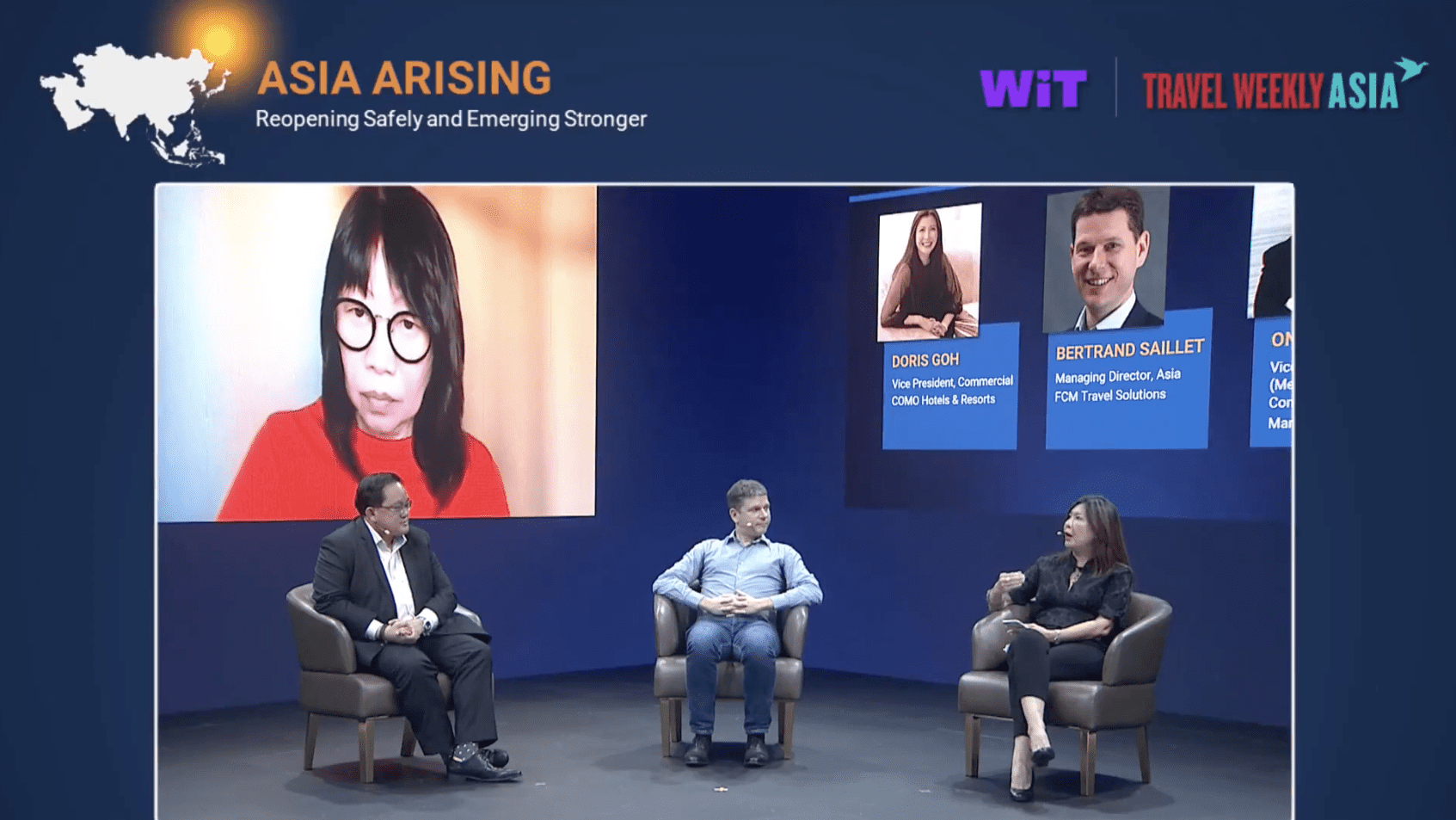
From left, Ong Wee Min, Bertrand Saillet and Doris Goh, sharing lessons from the front
• Business travel is off, so are events – “hybrid will break apart”
Bertrand Saillet, managing director of FCM Travel Solutions Asia, said that, despite rumours to the contrary, business travel is back, and that Flight Centre Travel Group last month achieved more than 80% of pre-Covid volume. “Asia is by far the slowest region to recover … but what we have seen in Singapore – from the moment restrictions are released, you can see travel happening right away.”
Currently, he said it’s mainly longhaul trips to Europe, Australia and the US given both Japan and China are “heavily closed” right now.
And MICE is also back, said Saillet. “People have not been together for two years, some projects are delayed, some sales teams are not trained or working together – we talk about the Great Resignation – one reason is the fact that people are not adhering to a culture anymore, because they are not seeing each other. So when it’s all about your pay slip, you can always find a job that’s a bit better paid.
“So now companies are reinvesting to try and get people together, and having a purpose together.”
A trend corroborated by Ong Wee Min, vice president, conventions and exhibitions, MICE, Marina Bay Sands. The week that Singapore announced it was moving to endemic, its leads jumped 1,000 percent and “all of them said 100 percent face to face. Looking at leads for 2023-2025, clients are looking at hybrid in a different way. In future, hybrid will break apart – you will see the face to face tentpole events and then the virtualisation of the event will happen before and after to allow people to collaborate, share experiences, transfer knowledge.”
• Fertile ground for resource-driven businesses and “wow ideas”
During her panel, Doris Goh, chief commercial officer of COMO Hotels and Resorts, said that Covid had provided fertile ground for resource-driven businesses. “There were a lot of unsung heroes, because people were looking at helping businesses survive and helping them do more with less.
“Instead of looking at it from the front, let’s look at what more can we do with what we have – and create businesses that help other businesses.”
She cited the example of the Tourism Authority of Thailand’s partnership with the Thailand Organic Consumer Association to develop an organic tourism marketplace that connects organic farmers with businesses and consumers. “That is amazing – there are opportunities, untapped opportunities such as these that make us look at how we can grow in new and different ways.”
Marina Bay Sands’ Ong added the pandemic provided fertile ground for “wow ideas”. “Without the pandemic, we would have waited three years for this,” he said, referring to the HybridBroadcast Studio, where the event was being held. “With the pandemic, it took three months to come up with a commercial model and seven days to build it.”
And he noted that facilities such as the studio, built during the pandemic, “will be here to stay.
This is going to stay at least eight to 10 years, because we firmly believe that technology will continue to be an enabler.”
• Sustainability, Sustainability, Sustainability
It used to be that “location, location, location” were the three defining words of a successful hotel. Today it’s sustainability. As Ong observed, “At the onset of the pandemic, we said that the pandemic is the battle of our lives and sustainability and environmental concerns, the war of our lifetime.”
Pre-Covid, sustainability consideration was something corporate companies did to tick a box, said Ong. “As we recover from the pandemic, we are seeing a lot of corporate companies pushing that right to the forefront. Are you doing this? Are you doing that? Are you carbon neutral? How are you supporting sustainable fisheries, sustainable food sources?”
Those questions directly impact the purchase decision of everything from travel to events, he said, adding he was thankful Marina Bay Sands started its sustainability journey in 2015. “It was very, very painful … we were grappling, not knowing what to do …”
In August 2020, it became the first carbon neutral MICE facility in the region “which is important for us because it helps us serve as a better platform … to serve the community in a more responsible manner.”
Referring to policies such as those by Ernst & Young – no shorthaul flight if there is rail alternative, no day trips, limited number of staff at one event – FCM’s Saillet said that the trend about favouring train as an alternative to flight is not new in markets with rail such as Japan and China. “We have displays in our online booking tools to favour trains because of less carbon emissions. We are working with corporations on how to offset their carbon footprint …
“It’s a trend that’s definitely accelerating.”
So the message – let’s all play our part in facilitating travel recovery to our region but let’s also think about we arise differently and sustainably.
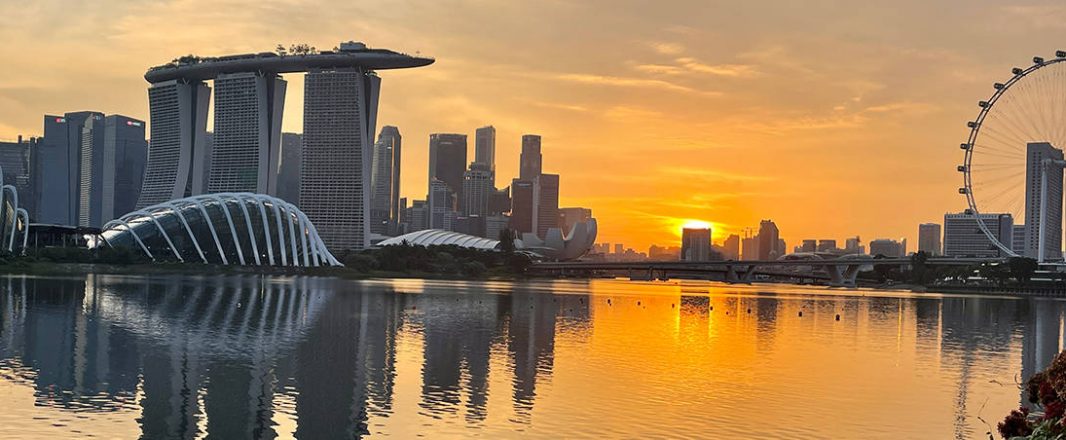
• Featured image: The iconic Gardens by the Bay, Singapore