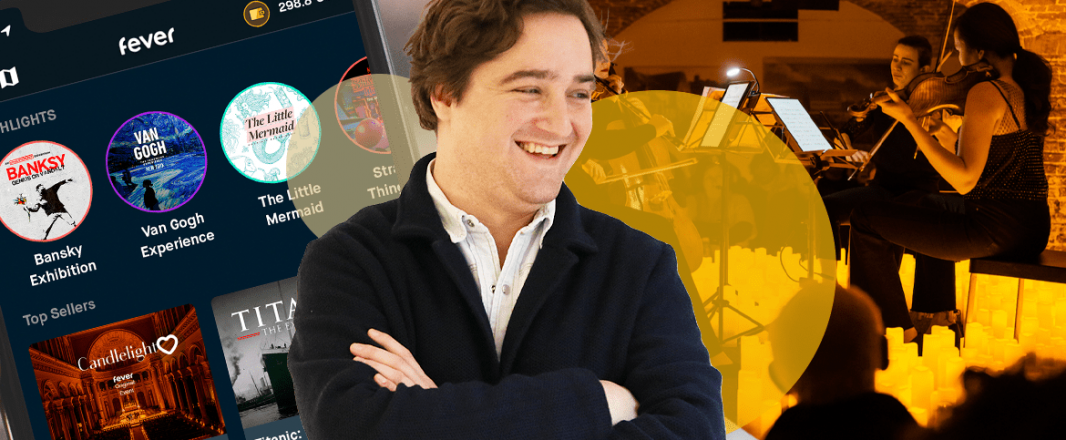
“From day one of the pandemic, we saw a strong demand for live entertainment. What changed was how people wanted to consume those experiences.”
It’s funny – it’s often easier to find things to do when you’re travelling to destinations outside the city, even in the remotest parts. You can hike or trek, eat at local watering holes, go camping, swimming, sightseeing, or just catch the sunrise or sunset.
Cities, on the other hand, always leave tourists stumped. Or that’s how I’ve felt anyway. Maybe it’s the fact that there’s too much choice, or that most suggestions include cafes and museums. Not that that’s a bad thing, but there’s only so much overpriced artisan coffee this tourist can take! Lately, I’ve been looking for live entertainment in cities that I visit. I find that plays, concerts, special movie screenings and stand-up comedy shows are great ways to experience different shades of a city in a communal setting.
It’s also a specific demand that Fever is catering to.
Launched in 2014 in Madrid, Spain, the idea behind the company is simple – the discovery of local live entertainment and cultural experiences. They’re also big on the democratisation of culture and entertainment, done via boosting awareness of live events on their platform. The platform is bolstered by in-house technology that allows Fever to understand audiences in the 100-over cities that they operate in.
At first glance, it’s easy to mistake Fever for a ticketing platform, which they are, but they’ve also carved their own niche as original content creators. If you’ve ever seen videos on social media of Candlelight Concerts, well, that’s Fever. These concerts feature local talent and are localised to a city’s culture. They can range from small, intimate gatherings to large-scale events in famous venues and landmarks.
View this post on Instagram
Most recently, Fever collaborated with Warner Bros to celebrate 100 years of the studio by playing symphonic renditions of their most famous movie themes and tunes. They also worked with Netflix on Stranger Things: The Experience.
All this momentum has garened the attention of pretty big investors. In February, Fever landed $110 million in fresh funding at a valuation of $1.8 billion, led by Goldman Sachs with Eurazeo, Convivialité Ventures, Goodwater Capital, Alignment Growth, Vitruvian Partners and Smash Capital also participating.
To understand the company’s unique positioning better, WiT caught up with Santiago Santamaria Soler, Global Head of Communications, Public and Institutional Relationships, Fever, to learn more about where the company is headed in a shifting post-pandemic landscape.

Santiago Santamaria Soler, Global Head of Communications, Public and Institutional Relationships, Fever
Q: Since Fever doubles as a content creator, what gap in the market is the company tackling?
Back when we started, we realised that sectors such as transport, music, and visual content had several on-demand platforms like Uber, Netflix, and Spotify. But in the leisure and entertainment industry, the way we communicate has barely evolved in the last few decades.
We have magazines and leaflets still, but not enough use of technology. And this is relevant because there are several studies that say entertainment is the third line of household spending. That was the beginning of Fever. Never before had it been possible to create a technological platform for something as vital and necessary as discovering what you could do with your trip. Since then, Fever has had the mission to democratise culture and entertainment, while helping a community of organisers and content creators to reach new audiences.
Q: You’ve produced, to great success and social media fame, these Candlelight Concerts and Fever Originals – when did you decide to produce your own content?
It was back in 2018 when the company realised that we had so much data that we could use to be more helpful to our partners. We’ve been able to help them with content creation and strategic information that allows them to scale the experiences further and better. That’s why we say that this is the natural evolution of the business. It’s faithful to the company’s mission, which is empowering content creators with technology and data.
In the specific case of Candlelight concerts, it was between 2018 and 2019, when Fever was already hosting classical music concerts. We started conversations with several traditional and cultural music institutions in Europe with the aim of helping them to reach younger generations. After research and several tests, we realised younger audiences were interested in experiencing more intimate and different experiences but didn’t attend these concerts because they didn’t have all the information. They were unsure.
We knew we had to make it easier, more approachable. Right now, 70% of our audience is under 40-years-old.
Q: How do you curate these concerts?
There are a few elements that influence the way we create shows for different cities. Candlelight events are brought to traditional concert halls and unique venues that form part of a city’s cultural heritage.
In the case of Singapore, we have held concerts in national monuments such as The Art House, Victoria Theater and CHIJMES. We also create locally unique setlists that colour the musical preferences in each city. In Singapore, some concerts used traditional Chinese instruments, themes from famous Chinese dramas and movies, but we also had K-Pop and K-Drama setlists to have a connection with [younger] audiences.
Q: What are some of the challenges in catering to different demographics across different regions
We’ve learned that there are actually more similarities than differences, but it’s true that there are behaviours that vary from city to city. For example, in Los Angeles, the acceptance of the [Fever] product was super fast, because it’s a city with a very strong entertainment culture. It was a bit more difficult in New York, because as a society, it’s a little harder and takes time in changing its habits. In Spain, people make decisions less in advance, while in the English market, they’re more plan-focused. However, once you enter the market, the product loyalty is very high.
All this information is not only useful for us, but also for the companies that we work with. We can give them information on how to communicate and reach those local audiences.

Q: What are some changes in consumer and audience behavior pre-and-post pandemic?
From day one of the pandemic, despite what many people thought, we kept seeing strong demand signals for live entertainment. What changed was how people wanted to consume those experiences. Something that was appealing pre-pandemic was not necessarily appealing in a post-pandemic world. The live entertainment industry, much like fashion, continuously changes. With the pandemic, those changes were even more notable.
It’s part of Fever’s job to relay information about these changes and trends to hundreds of content creators all around the world to help them adapt and even deliver experiences in international markets. When travelling was restricted in the US, we saw an intense interest in art experiences because people couldn’t go to different museums and exhibitions. So with something like our Van Gogh Immersive Experience, we were able to reach more than 10 cities in the US in less than a year.
Q: Since you’re playing in the ticketing ecosystem, what’s the revenue model for Fever?
It’s very simple – our business model is a marketplace one. The producer or the content creator is the owner of the experience and receives the revenue. We only charge a fee for each ticket sold through our services.
Q: The ticketing market is a competitive one. Tell us about marketing and making Fever the go-to for live entertainment discovery or booking arts-and-culture events?
The main marketing that Fever does is promote our own experiences. The quality of our experiences is the main spokesperson for Fever as a platform. The ticketing platform is just a commodity. That’s why Fever is relevant for both the content creators and the community. Thanks to our proprietary technology, we’re able to offer personalised recommendations to our audience and a lot of intelligence and data to our partners to improve their experiences.
There’s some added value there, too. Our platform is able to collect hundreds of millions of data points of what people like and don’t like. That includes what they buy tickets for, and also what they’re browsing, showing interest in, or adding to their cart. This information has proven to be a valuable asset to event-and-experiences producers. We’re able to understand which experiences are working, which could use more demand, and which ones can be taken to new cities.
Q: How about expansion, what’s next for Fever?
Right now, our two main objectives are to maintain a strong position in the markets that we already have. We’re in 100 cities around the world in 20 countries. We also want to continue hiring people to improve and make a stronger product in terms of technology, and we’ve already hired several high-profiles in the last year to do this.