
The biggest risk is cultural risk, says CEO Johannes Reck
Racing between meetings, and fresh from watching his first Singapore Grand Prix, you could say that Johannes Reck, CEO and co-founder of GetYourGuide, is as on top of the world as Ferrari’s Carlos Sainz, who won the Singapore race.
After all, things couldn’t be going any better for the experiences business Reck co-founded in 2008 with buddy Tao Tao – he will be best man at the latter’s wedding in a couple of months, by the way.
Three months ago, GYG raised another $194m, its European business is on a roll, it’s making good inroads into the US and even the slowest recovering region, Asia Pacific, is now at three times revenue pre-pandemic. “Since January 2022, GetYourGuide has grown four times over pre-pandemic levels, and we turned profitable this quarter,” he said, triumphantly.
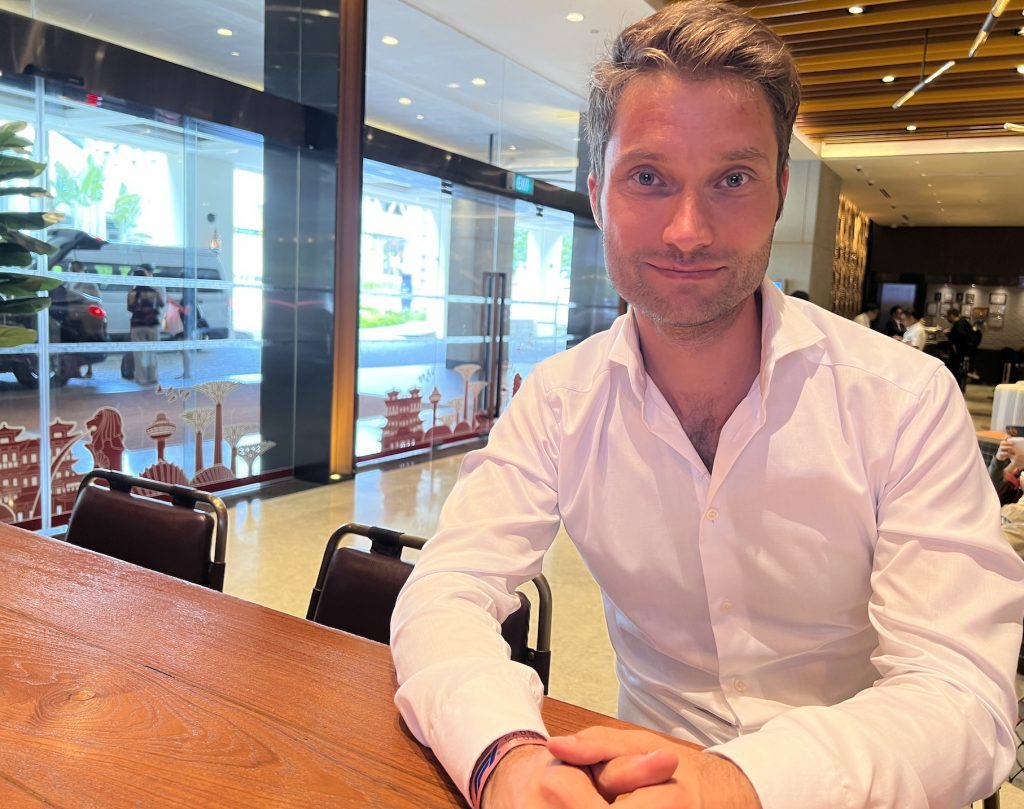
Johannes Reck:“I’m probably a much nicer person now.”
Taking a breather, he said the changes are striking between his last visit to Singapore in 2019 and now. “In 2019, it was market share at all costs, fast growth. Now it’s more rational – cooperation, collaboration, strong focus on specific markets, profitability vs growth. The funding landscape has dried up, China outbound is much smaller now.”
Indeed, Reck had just come from a meeting with Klook’s co-founder and COO, Eric Gnock Fah. “In 2019, there was a lot more tension between all of us, we thought we were competing with each other. But now we are all more focused. GetYourGuide is focused on Europe and the US, we see APAC as a destination and an outbound source. Klook has new ambitions, so it’s a friendlier environment and we can look for ways to cooperate, to standardise the industry.
“It’s a $250 billion market, a third each in APAC, Europe and US. We are all a fraction of the total market so we’ve got 20 years of growth ahead of us. We should all be trying to grow the market.”
Of course, if you look at the evolution of OTAs, a couple of very successful big companies will come to dominate globally eventually but as Reck puts it, “Let’s enjoy it while it lasts, we are a bit more relaxed now, having survived the worst time together.”
More clarity over what it will do and what it won’t do
Recalled Reck, “We were at zero revenues for most of 2020, beginning of 2021. One big issue was managing mental health. We were the first to move to remote and the first to move back to office. Our reason is, the sooner we can get back, the better for our psyche. We did a lot of activities – strengthening social in-person interaction. We offered mental health and coaching services and 15% of our employees used it – which showed the need for it.”
Did he use it? “I did not, I probably needed it. What’s that they say about traumatic events, while you are in it, you don’t feel it. I felt like a surgeon operating on a patient in ICU and all you think about is saving the patient.
“I probably wasn’t a very nice person then – I felt like I had a very short temper. It took me nearly a year to recalibrate myself so I think I am a nicer person now,” he said, laughing.
Post-pandemic, Reck said GetYourGuide is a far more empathetic workplace with greater transparency. “There’s clarity over where the company is going, we disclose numbers and strategic direction, and we are clear about what we will do and not do.”
What it will do – it will fortify its leadership position in Europe and gain inroads in the US, competing head-on with Viator; it will grow its global offerings – it doubled its selections to 100,000 in the last 12 months; and it will expand its GYG Originals, having refined the concept.
Said Reck, “The original concept didn’t work as well – we worked with existing tours and tried to modify elements and brand them, like a white label – and the consumer ended up confused. Now the concept is truly unique exclusive products you can only find on GetYourGuide.”
For example, when it first rolled out its “Exploring the world of McLaren Technology Centre” tour, tickets were sold out within 15 seconds with 25,000 on the waitlist, said Reck, who also took the opportunity to visit the McLaren team at the Singapore Grand Prix. “That was our most successful experience. We saw a 20% traffic uptake in the UK. I am not a car guy, but it’s an incredible facility and you have all the cars ever built for F1 all lined up here.”
Such exclusive experiences also have higher ticket as well as brand value. Creating such experiences will form the playbook around how GYG builds its brand. “We want to be the category leader in the West for experiences.”
What it won’t do – go into APAC and build a superapp
What won’t it do? “We won’t go into APAC and build a superapp, and add flights and other verticals. We want to be a super high quality experiences platform. Consumers in the West favour category specialists – Airbnb for homes, Booking for hotels, GYG for experiences.”
With APAC business now at three times the size from 2019, Reck said it would be investing in growing its team which currently stands at 20. It has offices in Bangkok, Hong Kong, Japan, Australia and Dubai and is considering an office in Singapore.
According to him, APAC is 10% of global revenues. “We have a good right to win in the Western-oriented affluent travel market in the region, but we are not interested in the staycations market. We have the best inventory in Europe and the US and want to partner with local players.”
For example, it has a partnership with MyRealTrip in South Korea. “There are so many players in Asia – Klook, Traveloka, Trip, Veltra – I don’t think the region needs another player.”
You could ask Reck then why doesn’t he just focus on Europe and not enter the US which is not an easy market for foreign brands to penetrate. “There’s tremendous synergies between Europe and the US, lots of traffic both ways, it makes sense. Whether we will be No 1 or No 2, that will be decided in a couple of years.”
Building the best trip planning platform for experiences with AI
During the pandemic, GetYourGuide also invested heavily in tech with the goal of building the best trip planning platform for experiences search, discovery and journey.
“We are not a newbie to AI – we have had a Machine Learning team for five years and have integrated AI into a lot of touchpoints in search and recommendations. So a person browsing in Singapore will see different recommendations from someone browsing somewhere else, depending on the traveller and context.
“Our customer service is also AI-driven. Unless it’s a very severe problem, machines can handle most of it – we have halved our customer service costs and increased customer satisfaction. Our translations are machine-driven, humans make sure there are no hallucinations, and we are training our suppliers to create product using AI.”
Deployment of AI has led to a huge reduction in costs. “Our cost base is equal to pre-pandemic but with four times the revenue.”
Reck has neither a dystopian nor utopian view of AI, “I don’t think AI will make people jobless,” he said.
“One, the biggest demographic change is happening in Germany and China – an ageing population – so AI will be a good thing, not a bad thing. Two, people can uplevel to different types of professions. In sales, people will spend less time writing emails, and more time on relationship building. Programmers will do fewer menial tasks, more systems architecture.
“It will drive productivity and growth by giving humans a better tool box. I remember when Jobs launched the iPhone, it took more than eight years before the mobile became a meaningful part of the business. So it took nearly a decade to manifest itself – and the same will happen with AI.”
Looking at me, he said, “Journalism is one of the most threatened professions. Your job will be different, your value will not be in the writing but in the relationships and capabilities of leveraging those relationships to get unique insights. And maybe you can spend a lot more time writing high quality pieces.”
Phew.
Having said that, GYG has also invested in building a content creators network. It now has 5,000 creators in Europe and US. “We don’t drive through discounts or coupons, more through direct recommendations and branding, so it’s a softer sell. Through metrics and AI, we can connect upper funnel with consideration of purchase.”
Creators are either paid a flat fee or a commission based on traffic or conversions. With TikTok’s influence also growing in the West, Reck said building a creators network was critical.
“Biggest risk is the cultural risk”
With everything going so well, I wondered if there was anything that concerned him, that kept him up at night?
“You never know what you don’t know,” he said, “but right now, the biggest challenge is scaling the business, scaling the culture. We are nearly at 1,000 people now and there’s a bond between the founders and the early team which, at some point, has to merge with the organisational structure.
“So the biggest risk is the cultural risk – can we keep the same level of drive, curiosity, innovation and trust? Culture takes years to build but is easy to break.”
And just as the tours and activities landscape has undergone striking changes between 2019 and now, Reck personally has also changed. Now a young father with two kids of 3.5 years and 11 months, he said, “I thought I would be this super charged CEO obsessive about my kids, then I found out that as long as there’s unconditional love and caring, everything will be fine.
“Kids look up to parents so being a good role model is important and that comes with a lot of love and support. I am not interested in shaping or moulding them to be like me.
“My family were lawyers and when I sat in my first law lecture, I thought it so boring so I did something different, and that’s worked out really well.”