



K Travel Tech Summit puts spotlight on role models and aspiring stars
If there was one key message from the first K Travel Tech Summit, held in conjunction with WiT Seoul, and organized by the Korea Tourism Organisation, it is that Korean travel startups are more than ready to take on the world.
With the help of course of the Korea Tourism Startup Center, a division which has been set up specially by the KTO and the Ministry of Culture, Sports and Tourism to facilitate the globalization of Korean travel startups.
Speaking at the K Travel Tech Summit, Ho Seong Yong, director general, Tourism Industry Policy Bureau, of the Ministry said with the pandemic having accelerated digitization, the government wants to play its part to accelerate the globalization of Korean travel startups.
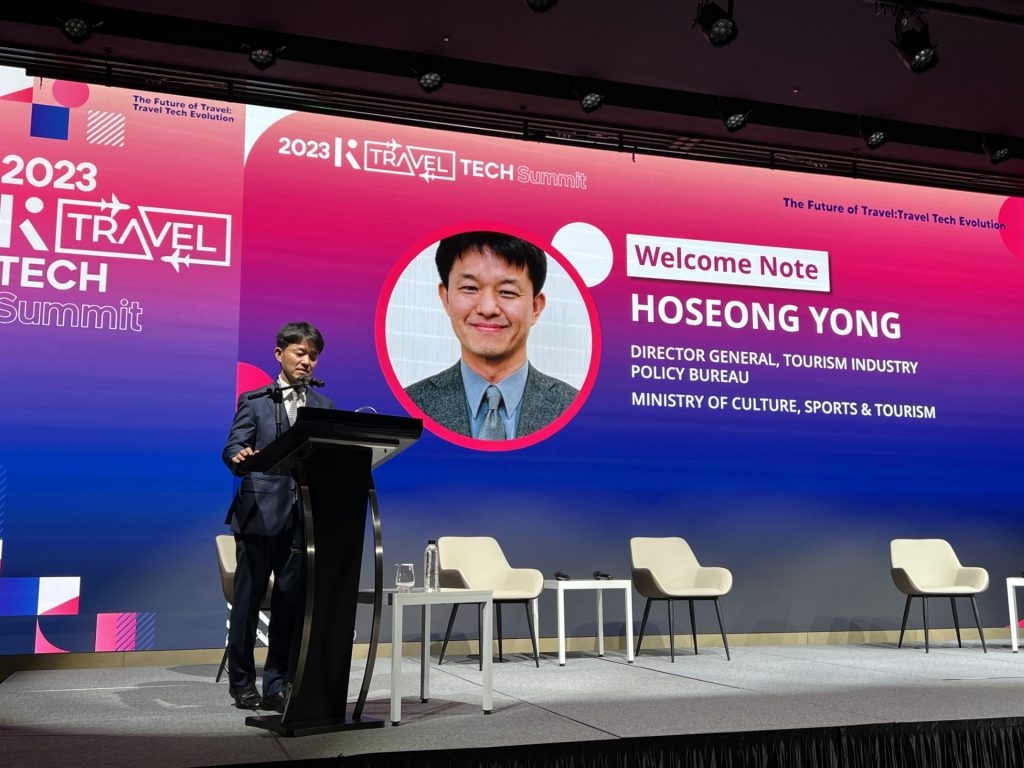
“During the pandemic, when people stopped travelling, tourism companies had to survive by increasing efficiencies and travel tech popped up. Companies started using AI and robotics to increase efficiencies and even traditional hotels deployed robots for room service and other services”, said Ho Seong Yong, director general, Tourism Industry Policy Bureau
The first Korea Tourism Startiup Center opened in Singapore earlier this year and Tokyo will follow in December. There are plans to open up to 10 centers within KTO overseas offices around the world.
“During the pandemic, when people stopped travelling, tourism companies had to survive by increasing efficiencies and travel tech popped up,” said Yong. “Companies started using AI and robotics to increase efficiencies and even traditional hotels deployed robots for room service and other services.”
The travel startup scene in South Korea is not new – MyRealTrip, the tours and activities startup, winning the WiT Japan Startup Pitch in 2014, a year before Klook did at the same event, put the spotlight on Korea. That same year, 2014, Daily Hotel, a mobile platform for luxury hotels and restaurants, also pitched in Tokyo – it was acquired by Yanolja in 2019.
Yanolja, the poster child, and the challenges of integration
Of course, Yanolja is the poster child of travel startups – growing from a humble aggregator of independent hotels in 2005 into a global unicorn, raising $1.9b in 2019. It has since acquired other startups – eZee, Innsoft, Sanha IT and most recently, Israel-based Go Global Travel – to grow its global Software-as-a-service Yanolja Cloud business.
This growth has not been without its pains and its reorganization in the South Korean market as it restructures to grow Yanolja Cloud globally has received much media attention locally. Part of the reorganization has meant the shutting down of its South-east Asia division with job redundancies in the region. Meanwhile, there are questions raised about the impact of the Israeli war on its latest acquisition of Go Global Travel.
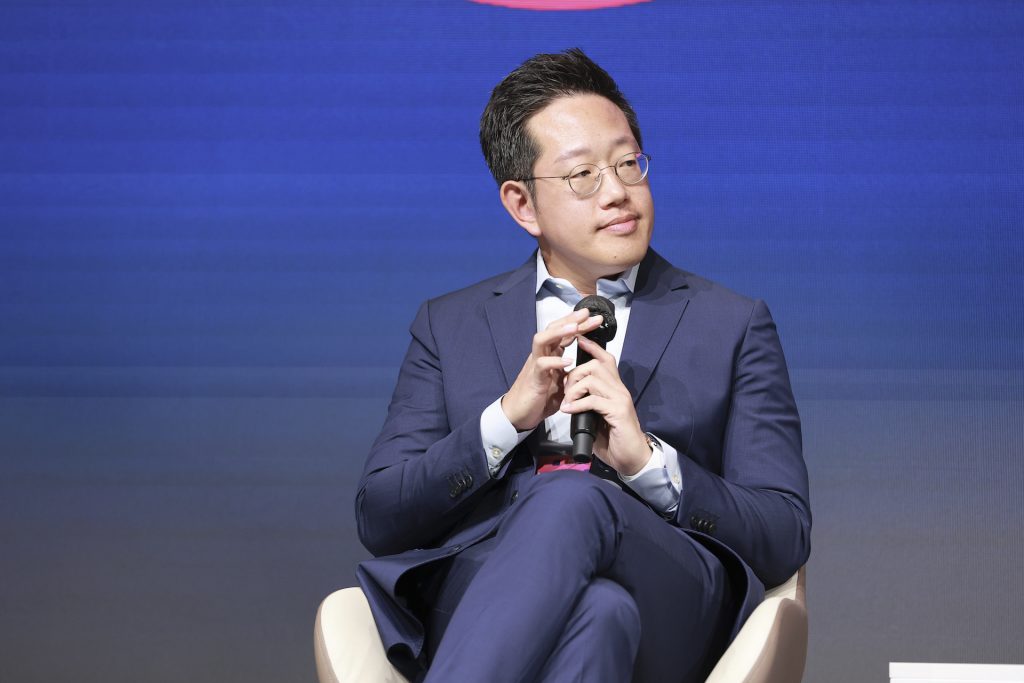
Jungyun Kim, CSO, Yanolja – between acquisitions and partnerships to grow, the latter path is “not as effective, in our experience”.
Jungyun Kim, CSO of Yanolja, told the audience that it would have limited impact as Go Global Travel is a diversified business with teams all over Eastern and Western Europe. The way Yanolja Cloud is scaling across the world is to divide it by regions, he said – Ezee to cover South-east Asia, Middle East and Africa, Sanha IT North Asia and GGT Europe and North America.
Kim, who came into Yanolja from Trustay, which is a property tech joint venture between Yanolja and KT Estate, admitted that integration of the different businesses is not easy. “It’s like getting married,” he said.
Earlier, Timothy Hughes, vice president, corporate development of Agoda, during a panel had been asked about Booking Holdings’ track record of founder retention. Steve Hafner, CEO of KAYAK and Open Table, remains in the group after 10 years. Rob Rosenstein, co-founder of Agoda, stayed as CEO for at least eight years and remains active on the advisory board. The three co-founders of Qlicka, acquired by Booking Holdings, are the CEO, CPO and CTO of Agoda today.
Kim said Yanolja typically had a three-year timeline for founders, saying that sometimes, it wasn’t healthy for founders to stay beyond that time as the business grows. This all depends of course on strategy, he said.
He also believes that between acquisitions and partnerships to grow, the latter path is “not as effective, in our experience”.
Beyond Yanolja, there have been other startups that have been growing quietly in the background – stories which were all showcased at the K Travel Tech Summit.
Travel market is like “Squid Game”, says Tidesquare’s Min Yoon
Min Yoon, founder and CEO of Tidesquare, and partner for WiT Seoul, started Tidesquare, a group of online travel businesses in flights and accommodation, in 2009. It began with launching a Privia travel service for Hyundai card members and its group of businesses now covers Tourvis, a consumer-facing OTA, as well as corporate travel and inbound.
It is generally regarded as the leading flight OTA in the country but during the pandemic, invested in technology and building direct connectivity and the supply chain for not only flights but also accommodation.
“My idea was to build the number one OTA, travel technology company in Korea,” said Min, when asked why he started Tidesquare. To do so, it has raised $100m since founding, and is also expanding its global outreach.
With Korea the second biggest outbound market in Asia Pacific, after China, pre-pandemic and with the outbound market having a robust recovery, Min is bullish about business but he is realistic enough to acknowledge the growing competition.
He likened Korea’s current travel market to the Netflix TV series “Squid Game” – “brutal and competitive and it’s all about strategy and execution”.
The challenge for a lot of startups, he observed, is scaling and going for that next phase of growth, which is why KTO’s initiative comes at the right time.
Surviving the “capital winter” is key, only the toughest will make it
During this “capital winter”, only the toughest entrepreneurs will be able to make it through, observed a panel of investors at the K Travel Tech Summit.
“Startups will have to manage in this age of tight money,” said Hughes of Agoda, “and maybe it’s a good thing. It will bring to the surface those entrepreneurs who really know how to build businesses instead of just spending on growth.”
Nicholas Cocks, founder and managing director of Velocity Ventures, whose travel and hospitality-focused fund has signed an MOU with KTO, said he was impressed by the government support and generosity for startups.
They all agreed this was an exciting time for innovation. Asked to tip the next big thing, Hughes cited, “Innovation in hospitality tech – it’s been too long in coming and now might be the time.”
Cocks cited AI help in back-end developer assistance and solutions that will turbocharge leapfrog activity in startups.
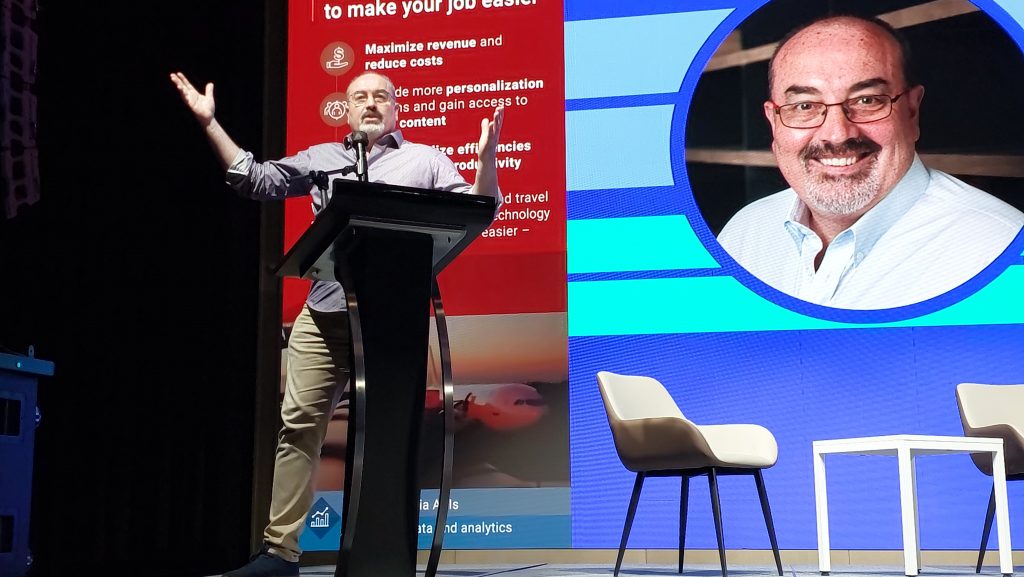
Agoda’s Tim Hughes says, “Startups will have to manage in this age of tight money and maybe it’s a good thing. It will bring to the surface those entrepreneurs who really know how to build businesses instead of just spending on growth.”
Hyuck-Tae Kwon, a veteran in the Korean tech startup scene who’s set up a new fund, Aurburndale Ventures, cited increased tech adoption by major travel suppliers in the country as a game changer, citing the example of the 9.81 theme park in Jeju, in which he is an investor. The tech startup that launched the park, Monolith created its “Smart Play Park” concept that extends user experiences beyond a physical space to a virtual network.
This is how Jongseok Kim, CEO of Monolith, describes the tech. “The core value of our business is connecting people through shared experience of the carefully designed content of gravity racing. The software algorithm built in-house is constantly running inside the game engine of the park’s operational system. We wanted to create an environment where we can extend the on-site experience to off-site sharing so that connections among players can naturally emerge.”
Connections, communications and community vital in startups
Sharing and connections are big common themes among startups in South Korea, as they look to scale their networks through community building and content in a highly social and mobile-heavy market.
It’s what Tripbtoz is building – connecting Korean travellers on its social video-based platform when they travel to one place so that they can make real-time connections and share real-time information. Tripbtoz is one of the startups supported by the KTO and Velocity Ventures has since taken a small investment in this new generation OTA.
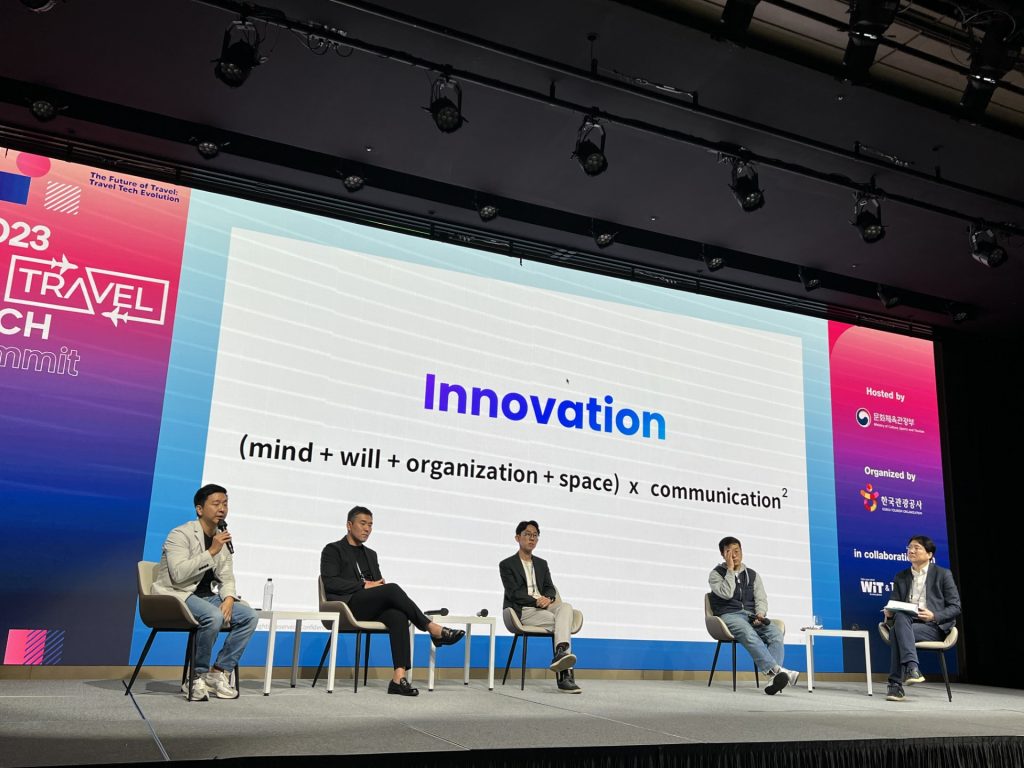
Tripbtoz CEO and founder Jiha Jung says for Korean startups to scale, communications is critical. Innovation cannot take place in a vacuum.
CEO and founder Jiha Jung believes that for Korean startups to scale, communications is critical. Innovation cannot take place in a vacuum – it needs communications to “bring it out into the world so that people know what it is you are building and creating”, he said.
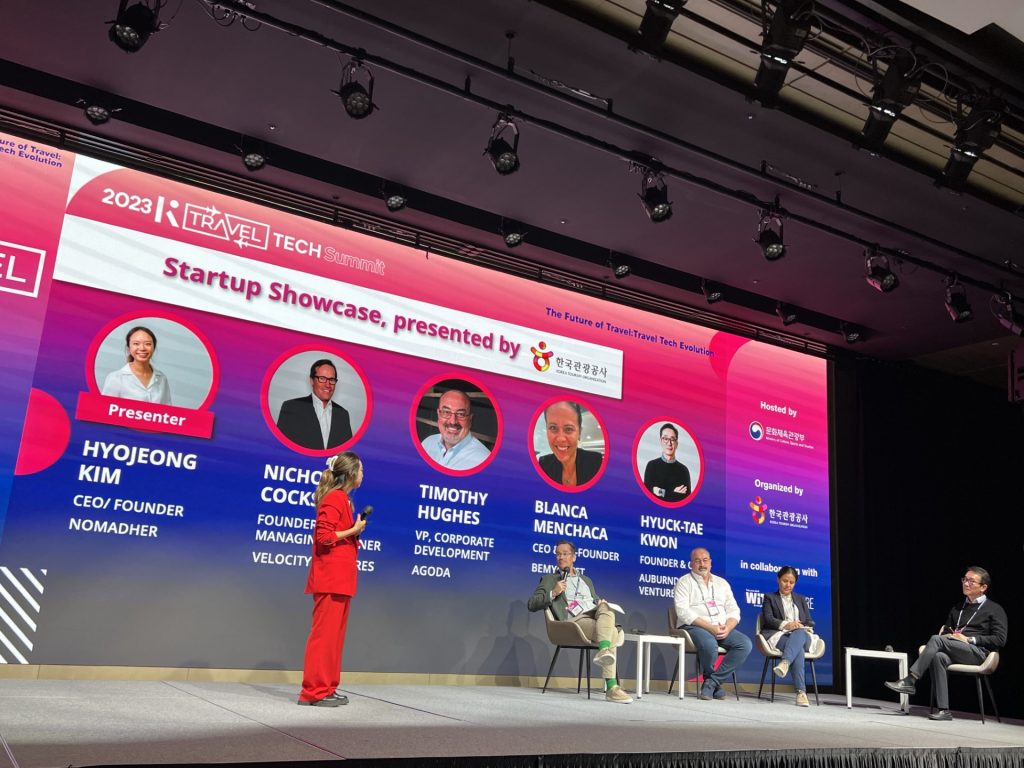
“Travel changed my life,” said Hyojeong Kim, CEO and founder, who studied in Paris. “And I want to make that possible for more young women.”
The startups that were showcased were also big on community and content. NomadHer is a platform for solo female travellers to bond and to travel safely. “Travel changed my life,” said Hyojeong Kim, CEO and founder, who studied in Paris. “And I want to make that possible for more young women.”
HANSEEK wants to help inbound travellers discover Korean cuisine. Food is the number one reason why people travel and when they come to South Korea, they want to experience authentic culinary experiences which are not easy to find for foreigners, said COO and co-founder Heejae Jeong.
As a frequent traveller to Seoul, I can attest to that and any platform that will make it easy for me to access local food experiences has my vote. I hope it goes beyond Korean barbeque and fried chicken though because I think these stereotypes do a great injustice to Seoul’s dining scene which boasts a diversity of culinary experiences especially in fine dining.
I was intrigued by a food discovery startup, Farmpatia, which curates experiences around local, seasonal produce. Its visit to Boseong, in Jeollanam-do, which is Korea’s number one green tea producer, is featured on KTO’s website. However finding other information online about them is not easy.
The challenge is of course commerce – how do you monetise after you’ve built community and content? And for consumer-facing startups, how do they acquire customer traffic? That was the question asked of one of the startups, MYRO, an AI Travel Planner, by Agoda’s Hughes who wondered how consumers would find them to which Joonhyung Cho, CEO, responded, “I was hoping you’d be able to advise me.”
Then there were the entrepreneurs who are trying to revitalize old neighbourhoods which are emptying out. An ageing population and increased urbanization is hollowing out Korean small towns and villages and three startups, Puzzle Lab, HIPCAL and Smalldays, talked about the different ways they were creating events such as jazz festivals and games competitions to put the attention back on small towns, create jobs and keep the towns alive.

“I was told, the profit’s tough, the tech is tough, but I felt it would give us a good channel to acquire customers instead of spending on buying traffic,” said Donggun Lee (Founder, MyRealTrip) on his decision to tackle the aviation market.
MyRealTrip – why Donggun Lee’s first startup failed
One of the best role models for Korean travel startups is MyRealTrip, which has transformed from a site connecting Korean travellers with tour guides, to a full-fledged OTA, selling flights, hotels, tours and activities, complete with a physical store because founder Donggun Lee wants to sell travel to people like his parents.
Sharing his story, Lee said after graduation, he worked on at least five internships with different companies across different disciplines so he could pick up a broad cross-section of skills. His first business venture was a crowdfunding startup which failed mainly because he believed he wasn’t 100% committed. “I always wondered if there was an alternative path so even though the idea was good, the team good, it was probably me who didn’t have the commitment.”
Armed with that lesson, he started MyRealTrip in 2012 with full conviction. The thing that took the business over the threshold in the early days was an investment of $20,000 from Primer, akin to the Y-Combinator of South Korea. “The amount was small but the advice I got from the five partners was invaluable and gave me the confidence,” said Lee.
Since then, Lee has raised $100m to grow and although he’s had a few M&A approaches, he’s turned them all down. There’s one he regrets “slightly”, he said, smiling. “It was in 2019, before the pandemic. I have a small regret there.”
Nevertheless, Lee, who remains the largest shareholder in the business, persevered through the pandemic and in fact, has built a stronger, bigger business, all with just 300 people. He said it reached breakeven point last July.
It’s acquired a couple of startups, one of which does niche experiences for family travel, and now it’s going after the older market, which makes sense in an ageing population.
“Our customers are FITs in their 20s-40s, but there are people over 50 who prefer to book group packages with a travel agent. Like my parents – they are digitally savvy, they know how to do things online, food delivery, shop, but they won’t buy travel.”
Hence, his decision to open a physical store. Lee comes across as an entrepreneur who knows what he wants and does it. When he first planned to get into flights, he was advised not to do it. “I was told, the profit’s tough, the tech is tough, but I felt it would give us a good channel to acquire customers instead of spending on buying traffic,” he said.
As for what’s the next big thing that will take MyRealTrip forward, he believes it will be AI. “We understood the mobile wave. Now the next wave will be AI, this is an important moment.”


