
It’s no secret that travelling can be a different experience for men and women, particularly when it comes to safety and security for solo female travellers. CEO and founder Hyojeong Kim (Hyo) identified three significant challenges faced by solo female travelers: information, trust, and expenses – gaps she’s tackling with her platform, NomadHer.
The community-based platform, which currently boasts about 150,000 members, aims to provide as much information about a destination, from a female traveller’s perspective, that’s commonly overlooked by traditional travel platforms.
“There is a lack of information written from women’s perspective, when it comes to cleanliness and safety,” explained Hyo during a recent sit-down with WiT in Seoul. “It’s also really hard to find trustworthy travel buddies. There are a lot of fake users. And last but not least, when you travel solo, it’s more costly because of the single charge. But we are focusing on safety, of course, as a whole.”
Of course, for any startup, viability is paramount and as important to the ‘why’ of it all.
Hyo highlighted the vastness of the market, as well as NomadHer’s potential for growth in the future. The platform is expected to reach one million users next year, surpassing Hyo’s expectations.
“This is too huge to be called a niche market,” emphasises Hyo. “According to our data and also data from TripAdvisor and Hostelworld, about 20% of travellers are solo travellers. It also includes leisure travelers and business travelers. And out of this 20%, over 80% are actually women; women tend to travel more as solo travellers than men.”
It’s an interesting stat, and one that a handful of startups and organisations are tapping into as an unsolved pain point in the travel space.
NomadHer currently focuses on building its community, with both B2C and B2B revenue models powering the startup. The B2C model involves collaborating with women-focused travel programs and hosts, taking a commission of around 20% to 30%.
Explaining further, Hyo said, “To give you an example, we have a women’s surfing camp in Bali. In Busan, we also partner with female surfers. We have hosted a camp in Jeju Island, because so far women have been a minority in those sectors. So we try to partner with local female hosts and we organise travels together.”
On the B2B front, NomadHer partners with tourism organizations, leveraging data insights to target female travelers effectively.
According to Hyo, investors find NomadHer’s approach ‘interesting and unique’, recognising the significance of serving female consumers in the travel industry. Hyo also called the segment lucrative because of the role of female travellers as decision-makers within a family or group dynamic.
“Everyone knows that in the travel industry, the one who in the end pays and uses the cards are women. Let’s say you go as a family, in the end, it’s the wife [who decides], because we are more sensitive when it comes to choosing a hotel – we want to make sure that it’s super clean and well situated next to a train station, for example.”
She continued, “So for that reason, they think we are really trendy. Right now, we’re focusing on the community. But later [the platform] can be linked to shopping, duty free, female-friendly hotels. A lot of potential.”
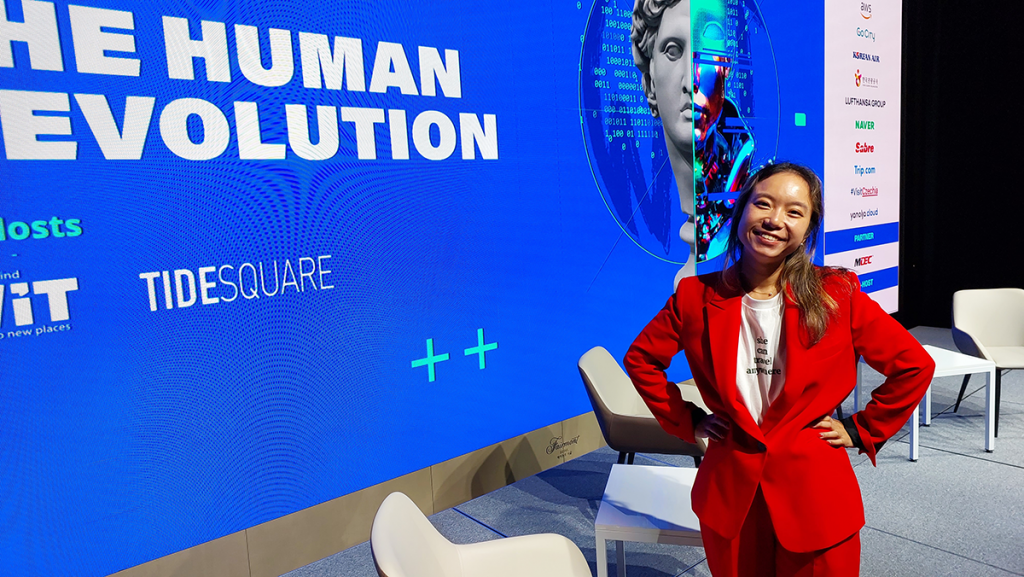
Hyo was one of the featured founders at KTO’s Startup Showcase at the K-Travel Tech Summit and WiT Seoul
Hyo shared that the platform has organised successful travel festivals, attracting around 200 people from around the world. The positive responses from users reflect the platform’s impact in fostering a supportive community.
Addressing security concerns, Kim shared that, for now, manual processes are in place with a small team of female staff ensuring user safety. As NomadHer scales, the platform plans to adopt AI technology to enhance security measures.
Hyo explained, “In our state, because we are not Klook or Agoda, I think we need to do it manually to better understand what their (customers) difficulties, and why they do it. How do they feel? I think we can better understand these things when we do it manually at the moment.”
Looking ahead to 2024, NomadHer aims to first reach a million users, raise $4 million, and become a leading community platform for female travellers, while tackling a byproduct of the startup – misrepresentation and miscommunication.
“Recently, we got the grand championship prize from UNWTO United Nations as the most innovative women empowerment travel tech company. So we see that there’s huge potential and we’d love to make more money. People first thought we were an NGO, or foundation. We want to show that actually, we have so much potential to make money.”
Despite the competitive landscape in the travel industry, Kim views other platforms as both competitors and potential partners. She appreciates the growing number of travel platforms targeting solo female travellers, recognising the shared goal of empowering and connecting women globally.