
If, like me, you’re winding down for the year and taking time out to reflect, well, do it. Power down the laptop, switch off the mobile, take a deep breath and slow down. Know you have deserved it. You helped build back travel in APAC.
For us in the region, it was just Year 1 of building back and it was both testing and exhilarating, and we did it together.
So at midnight, on New Year’s Eve, wherever you are, raise a glass to the sky and say, “Here’s looking at you, 2024. Bring it on.”
In 2024, let’s make a collective pledge to put the past behind us and not measure ourselves against “pre-pandemic levels”. I remember asking Johannes Reck, co-founder and CEO of GetYourGuide when he would stop comparisons to “pre-pandemic levels” and he unhesitatingly said 2024. “Starting next year, we will see normalized growth and we can stop the pre-pandemic benchmark.”
For me, it’s an opportunity to chart a new course for the industry we want to create and the businesses we want to build, knowing what we know now.
There’ll be lots to look forward to. Here’s what I am looking forward to – or maybe this is my wishlist.
Things get real around AI and sustainability
The hype around AI and sustainability will die down and that’s when things get interesting and real, and we will see real use cases.
AI will become like oxygen just as the Internet, then mobile, did when they first burst onto the scene. We will use it in ways that make sense for our business and not get sucked in by FOMO to try everything all at once, unless you can afford it.
The online travel giants will lead the way – brands like Booking, Expedia, Airbnb, Agoda, Trip. They’ve spent the past few years building, realigning, strengthening their tech stacks and getting their strategies in place. 2024 will be the year of relentless execution for these giants.
Remember what happens when elephants trample the grass? Ants, stay agile, get real and figure out what these giants cannot do, and do that.
Sustainability too will become like oxygen. It should pervade through every department, every business unit, every individual. Everyone should have a sustainability KPI – and remember, sustainability is not just one thing, it is manifold. It can be carbon footprint, community engagement, diversity/inclusion, environment, biodiversity.
Stop thinking about questions like, are travellers willing to pay and how much? We should lead the way and do it anyway. Don’t try to do everything – unless you can afford it. Get real, pick one thing and do it well. Then share it with industry friends so others can learn.
The regulators in Europe are coming down hard on green washers and chest-thumpers. Do it quietly and revel in the silence of quiet achievements.
The Generation Revolution is here
APAC is undergoing a revolution of the demographic kind. Millennials (1980-1994) are already being squeezed out by the next wave of Gen Z (1995-2012) and soon, there will be Gen Alpha (2013-2025). Already, we are seeing profound shifts in customer behaviour in APAC before anywhere else.
To end the year, we asked several Gen Z technology students in Singapore what the impact of trends like AI, social media and sustainability would have on their travels – and their answers are captured in this piece and video.
I travelled with a Gen Alpha the past week and it was so interesting seeing travel through an eight-old-year’s eyes. Everything is an adventure. Airport, yay. Flight, yay. On Singapore Airlines, he was given a travel journal to read, write and draw – brilliant engagement or rather, thank goodness, it kept him quiet for 10 minutes at least.
In a Grab car in Penang, he told the driver, “Uncle, speed limit 40.” He’s from Singapore, you see. Uncle replied, “It’s okay, this is Malaysia.”
Through travel, this Generation Alpha will learn that some rules can be broken, some are non-negotiable. They will learn tolerance and understanding of other cultures and people.
Gen Z, meanwhile, will demand we do things differently, do things right for the Planet.
The fragmentation of experiences – photo tourism, local tourism, “what can I do”
Different generations will want different kinds of tourism. I took my Gen Alpha to two “museums” in Penang – Dark Mansion (glow-in-the-dark) and Upside-Down Museum. Neither are authentic, local experiences that we keep talking about in our industry, they are just fun things to do, both for adults and kids.
In the first, you get to see things that glow in the dark, spot the creatures and animals lurking in the foliage, wave a glow stick about and imagine you’re Harry Potter. There’s an impressive piece by street artist, Edgar Muller, who’s created “the world’s largest anamorphic glow-in-the-dark pavement painting, the “Water & Fire” artwork”. The Grab driver told me it cost RM500,000 to create. I wouldn’t know whether that’s real or not – but what’s real is everyone wants to take photos with it because the optical illusion is fun.
In Upside Down, you basically go from room to room where things are literally upside down and the staff guide you to strike different poses, and they take photos and videos of each situation. So what you end up with are a lot of photos of you upside down, or is it the furniture? This is photo tourism at its most elemental.

At the Dark Mansion – Edgar Muller’s Water & Fire artwork plays tricks with the eye.
When I asked my Gen Alpha kid which he preferred, he chose Upside Down. “It’s fun.” Dark Mansion is possibly a bit too esoteric and not interactive enough for him because his constant cry is, “What can I do?”
That same question will become the cry of all generations – travellers, whatever age, want to get into the places they visit – to do things, not just see.
This week, I took a Singapore River Cruise. Not much had changed since my last cruise probably a decade ago, other than it’s now an electric bumboat. The audio kept breaking down in parts so you’d be left hanging if you were listening to it in the first place. It’s passive tourism, works for some but the younger tourists looked bored. The only time there was some excitement was when they snapped photos of the Merlion.
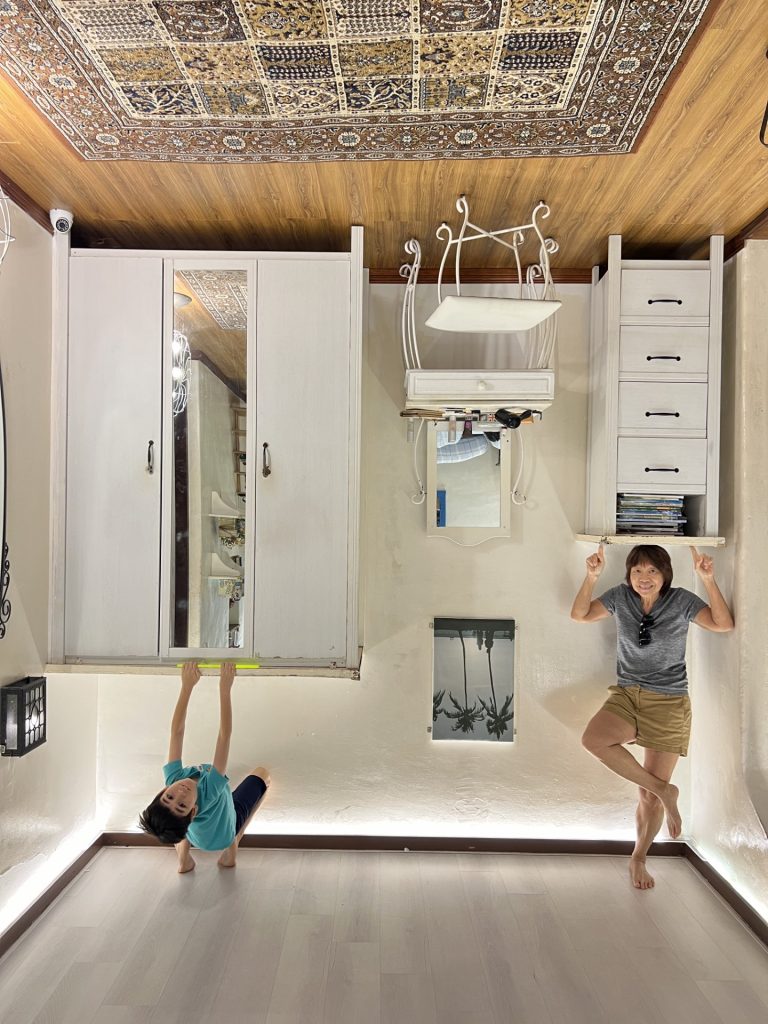
Seeing things Upside Down
Community champions and “village chiefs” will play a central role in building back better
One positive thing to have come out of the local tourism movement – when tourism went from global to local – is the rise of local champions within their own communities. In the past year, in my travels through Asia, I have met countless individuals doing incredible things for their communities, neighbourhoods or districts.
Think of them as the old-fashioned “village chief”, the one who would take responsibility for their village and pull the villagers together for a common purpose – whether it’s around environmental awareness, disappearing crafts, heritage, regenerating abandoned villages or supporting the disenfranchised.
They are the ones that will play a pivotal role in building back better and need to be supported and appreciated. If you know someone like that, applaud them and share their story. The power of storytelling from the grassroots cannot be quantified.
Backlash against crowded places and poorly-managed destination experiences
A girlfriend went to Osaka and Kyoto with her family in early December and said it was horrible. “So crowded,” she said. Discerning travellers will avoid crowded places – which is a good thing for dispersal of tourism. She knows she needs to go beyond the main cities but we also need to help travellers like her find alternative places.
Travellers will also not put up with poorly managed destinations – there is less room for forgiveness. We are paying more to travel and we expect some level of quality in return. You do not expect to wait up to four hours in immigration queues, as they did in Penang on December 2 when the government introduced a new digital arrival card system and no one seemed to know about it, let alone the officers, most of whom wisely took the day off work anyway.
Imagine the elderly and young standing for four hours with no officers in sight to control the crowds, and no one to explain what was happening.
Tourism boards need to accept their role goes beyond destination marketing – it’s easy putting together fun videos and going to trade shows to promote – but they should also take responsibility for the destination experience.
In Year 2 of building back travel, we need to get our act together to make it right for the people who want to fly in our planes, stay in our hotels and experience our tours and activities. We owe them that much at least.
So, happy new year. Here’s to 2024. Bring it on.