
Key takeaways from WiT Singapore 2024
As I was lying by the pool at Cempedak Private Island, watching the sun set over a calm South China Sea and being grateful for the wonders of travel, a strange ritual was taking place nearby.
A group of wellness devotees from Singapore were taking part in a cold-water immersion therapy, otherwise called ice baths. Basically, you plunge yourself in ice-cold-freezing water (6 degrees, I am told) and sit in the ice tub for four minutes. Why you’d want to go to a tropical island to do that, I don’t know, but everyone who emerges, red, goose-pimply and shivering from the cold, swears it’s amazing.
The activity was part of a wellness retreat organised by Cempedak in partnership with two life coaches, one of whom apparently has an ice tub in his apartment and does it everyday. He works in finance, perhaps that’s why he needs an ice bath every morning.

Ice baths on a tropical island, anyone?
I didn’t do it – I was still shivering from the experience of delivering “Next Generation” WiT Singapore – but it was interesting to talk to those who had signed up and paid for the retreat. One said, “My life coach said it’d be good for me.” Of the more than 20 who signed up, most were women and most appeared to be high-flying corporate executives and entrepreneurs in their 30s and beyond.
Wellness, longevity travel and the desire for experiences, emotional over transactional, was a key thread through the three days of WiT Singapore last week. People’s desire to feel better and age better is one of the prevailing traveller trends of this generation.
And just as AI is the glue by which we in travel tech can use to stitch together the connected trip, it will be the thing that further splinters travellers into ever more different and diverse tribes, with the ability to recommend specific itineraries based on specific requests by specific individuals.
Take the example of a couple from New York who, when asked how they found Cempedak island, said ChatGPT. The resort came up in the first mention after three prompts.
The first prompt was:
“Please find ten Honeymoon ideas with specific links to boats – luxury private boat tours in South East Asia – needs to be good to visit in late August Desire for luxury living on the boat, while being surrounded with amazing nature.”
Second prompt:
“There are only two of us, and we want it to remain relatively private – we don’t want to spend more than $1000 a night – What would you suggest? Are there any options that work well?”
Third prompt:
“Link some options with descriptions of some eco luxury lodges with water activities, please do so in table format and include estimated price Make sure they are good to visit in August.”
And that’s when Cempedak made its first appearance.
A few years ago, random travellers found the island either by Google search or maps. Now it’s AI, and it is this shift that will be at the heart of travel discovery in the Next Generation.
As travellers increasingly seek transformative experiences – whether it’s freezing in an ice bath or finding remote islands through AI – WiT Singapore 2024 explored the trends driving the next generation of travel.
Here are the key takeaways:
Technology as a Value Driver, not a Cost; Gen AI to Gen UI
We’ve moved from AI unknown to AI “a little known”. A year ago, travel tech was still experimenting around the edges of Generative AI. Now Gen AI is in almost every work process and most customer-facing products. The giants are well off the starting block.
Agoda’s CTO Idan Zalzberg stressed the significance of this moment in human history. For the first time, a tech that reasons and creates something out of nothing. It’s an exciting moment, he said, and all of us have arrived at this stage together, and should learn and work together to shape the future of travel.
When will Gen AI morph into Gen UI, for example, where AI drives the tech stack instead of being embedded within the stack?
Zalzberg underscored the difference between being “a travel company with some tech” and “a tech company that does travel”, a transition that Agoda made 10 years ago when he and his co-founders of Qlicka joined the Thailand-based OTA.
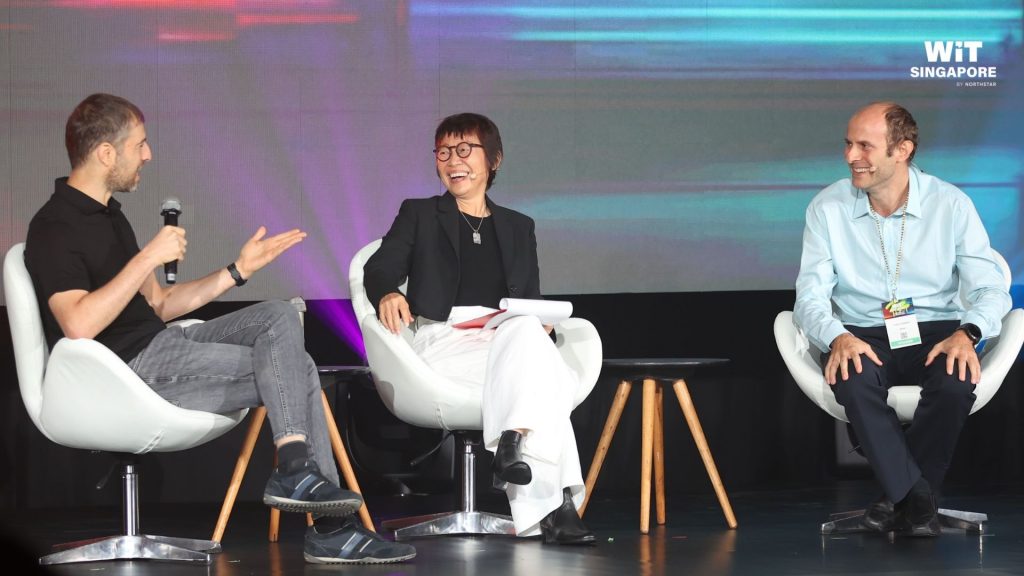
Agoda’s Idan Zalzberg (left) and Ittai Chorev on Main Stage: “When conditions around you change, you’re stuck in a box if you can’t move or change who you are.”
“A tech company is, first of all, looking at tech not as a cost center, but as a value driving center, long term value driving. Technology is the way to control your own destiny. When conditions around you change, you’re stuck in a box if you can’t move or change who you are,” he said.
Added Ittai Chorev, Agoda’s chief product officer, “We cannot build new products very quickly, adjusting ourselves to customer needs if we’re not a tech company.”
And what Gen AI has done is raised customer expectations. Said Zalzberg, “What always surprises me is how fast the consumer expectations come up. They see what’s out there, they see the kind of new technologies and new possibilities, and now they want it.
“And they’re saying, ‘I have a specific need, a specific type of travel. I want you to give me exactly what I want. Don’t shower me with information that is not interesting to me’.”
Long Live The Customer, Empathy in Product Design
This focus on the customer was a key thread in various conversations around product design, and it was heartening to see how, over the three decades that online travel has been around, the pendulum has shifted from tech to the human experience.
Perhaps it was Generative AI that opened up Pandora’s Box. It changed the human-machine interface and its mass adoption by consumers made us think differently of how we must engage with travellers.
Adrienne Enggist, Senior Director of Product, Customer Experience and Platforms for Booking.com, in her session on “Cooking Up Product and AI Love”, cited empathy as a key ingredient in the recipe.
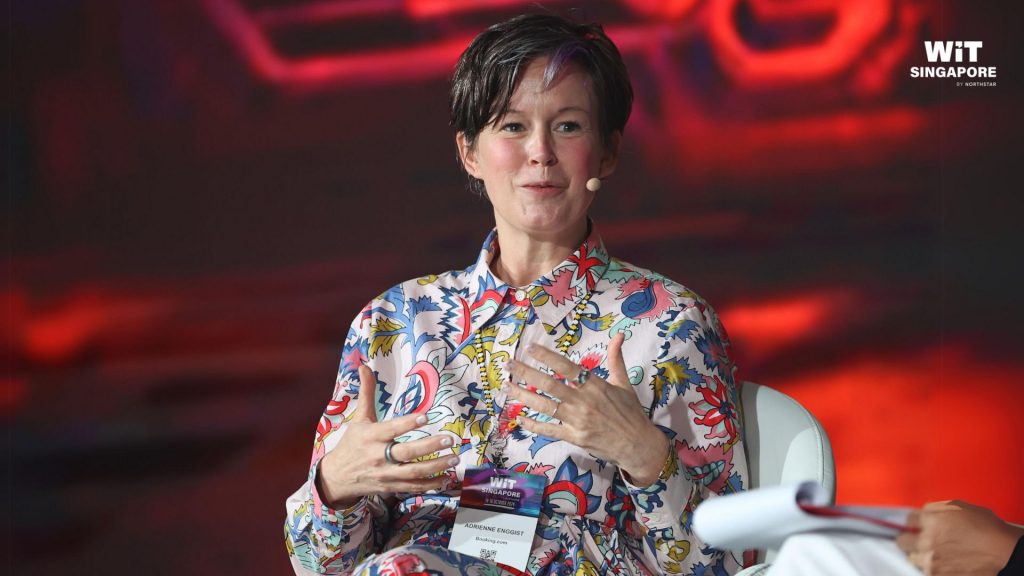
Adrienne Enggist, Booking.com: “If someone comes in and writes a paragraph and tells us their feelings, the emotions that they want to have, we need to do something with that to match that expectation.”
UX design in travel tech is evolving to incorporate greater empathy, focusing on understanding and responding to customers’ emotional needs and intentions, she said. “If someone comes in and writes a paragraph and tells us their feelings, the emotions that they want to have, we need to do something with that to match that expectation.
“When you have intent coming in at the rate and the sort of breadth of it, following the same path that we’ve taken on rails for doing product development doesn’t make sense any longer.”
Specific to Asia Pacific, she said the region is experiencing rapid technological innovation and adoption, particularly in mobile and payment technologies. “I envy the Asian players because it seems like there’s simply a different relationship with data than we have, and that means that they’re able to move forward more quickly than we can,” she said.
The AI Journey: Go Deep, Be Cautious, Take Small Steps
On the way towards winning customer love, it is wise to take a step-by-step approach, and it was interesting to learn of the different approaches taken by various companies.
Agoda has a “Empower, Enhance, Evolve” approach. Its first stage meant building 80 or more tools to empower its staff. In building out the next two customer-facing stages, Zalzberg said, “What we’re seeing today with Gen AI is how ignorant we are. We thought we have a lot of data. We thought we knew a lot, but actually we’re finding out everything we don’t know because the users are telling us now more than ever what they actually want to see.”
He said the focus is shifting from collecting more data points to gathering deeper, more intimate details about products and services to enhance user experience. “We’re finding now that actually we want less, we are less concentrated now on shallow data. Like more data points of the same, but more deep data, really intimate details of what we are selling …”
It’s also understanding that not all personal data is relevant for travel recommendations, and focusing on contextual, trip-specific information. “I don’t want to minimize people and reduce them to, like, ‘oh, if I just knew what music you like’. I don’t want to be intimate with you. I just want you to trust me that if you tell me what you want, I will deliver it for you.”
Booking’s Enggist said that companies must carefully balance the desire for rapid innovation with the need to protect customers and mitigate risks, especially in high-stakes areas like travel bookings and customer service.
“We’re constantly riding this edge of risk, and protecting customers takes the number one priority seat in how we roll things out. That’s why we might appear to be moving slowly in what we launch to customers.”
She also spoke of the impact of AI on human talent, stating that when developing new products or introducing changes, it’s crucial to maintain a balance that considers customer satisfaction, the well-being of staff, and the overall health of the company, ensuring sustainable growth and innovation without causing harm.
Ascott, the hospitality subsidiary of Singapore’s CapitaLand, has a “Attract, Convert, Close, Delight” approach, with chief commercial officer Tan Bee Leng saying, “I am a strong advocate of bite sizes. Have small wins before you scale big, then it’s an easier conversation with the CFO whereby they can see small wins along the way.”
Thus its AI chatbot, Cubby, is being developed along those four stages. “We are more at the attract and convert stage, whereby it’s about attracting the attention of customers, getting them aware, getting their eyeballs, knowing what we do. The closing part, which is the booking, that’s the next stage for Cubby, which is going to be our next year’s project.”
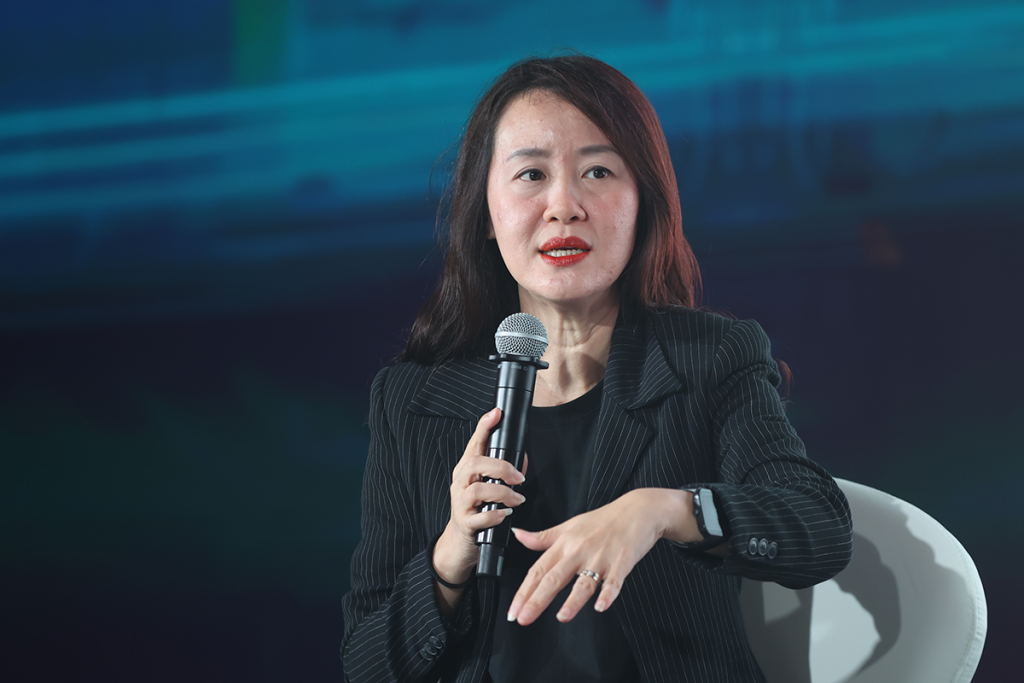
Ascott’s chief commercial officer, Tan Bee Leng: “I am a strong advocate of bite sizes. Have small wins before you scale big, then it’s an easier conversation with the CFO whereby they can see small wins along the way.”
“Delight” will be the most challenging phase because it will involve a balance between data and privacy concerns and will require the heaviest investment, she said.
The idea is for Cubby to become the Ascott guest’s trusted travel companion, focusing on building familiarity and trust rather than offering unlimited options.
From China, A Different Pace, A Different Story
Meanwhile, in China, it’s a different pace. Amy Wei, Sr. Product Director at Trip.com Group, Founder of TripGenie/TrainPal by Trip.com, noted that the Chinese market is experiencing rapid AI innovation and adoption, often outpacing global counterparts.
“Everything runs so fast in China. Because of the Chinese language barrier, maybe the Western world, the English-speaking people, have no idea. A lot of things and innovations are starting from China and they make it available in a very fast pace.”
Indeed, Trip.com launched its AI trip planning tool, TripGenie, two-and-a-half months after the launch of ChatGPT, the first OTA to do so, she said. To differentiate from other Chinese players, Wei said, “We try to be very specific and dedicated to travel, responding to users’ real needs rather than just chatting.”
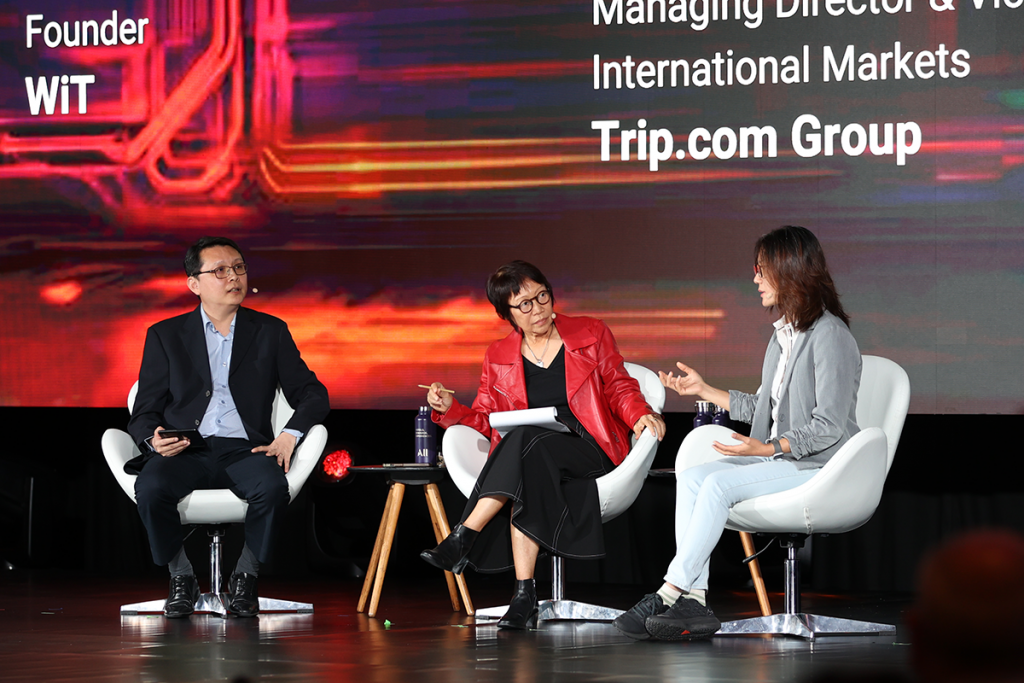
Trip.com’s Amy Wei (right): “A lot of things and innovations are starting from China and they make it available in a very fast pace.” (Left) Boon Sian Chai, Managing Director & VP International Markets, Trip.com Group: “It’s always customer number one, partner number two, actually our own employees number three.”
Think of TripGenie as the honey which attracts the bees, to stay longer. Boon Sian Chai, Managing Director & VP International Markets, Trip.com Group, said, “People who use TripGenie versus people who don’t, we are seeing double the conversion and also we’re seeing longer engagement time. People who use TripGenie spend about, on average, 20 minutes more on our app.”
By integrating with user generated content, the idea is to create a fly-wheel effect with the aim of increased stickiness, deeper engagement and increasing direct customer traffic.
At the heart of the flywheel is the customer, and the integration of AI in its customer service has delivered these benchmarks – within 30 seconds, answered by live person; if there’s an issue with booking, solved within 2m; and if unexpected event, customer will be contacted within 2m.
Said Chai, “It’s always customer number one, partner number two, actually our own employees number three. It’s a very clear strategy and philosophy across the organisation.”
Video Rules, Social Commerce Enters The Picture
The growth in shortform videos as inspiration has been nothing short of phenomenal in Asia and this has led to the convergence of social and commerce.
Google is launching YouTube Shopping in Indonesia, with Vietnam and Thailand to come, said Sapna Chadha, Vice President, Southeast Asia and South Asia Frontier, Google Asia Pacific. “What’s happening with video commerce will impact travel as well. We’re very excited about that,” she said.
Encouraged by the success of TikTok Shop in e-commerce in South-east Asian markets, TikTok is in the early stages of testing a dedicated travel shop, focusing on improving user targeting and journey optimisation.
Head of Travel, Strategic Partnership, TikTok SEA, Eason Zhang said, “One pain point we’re facing is a lot of people are inspired and discover content and travel destinations on TikTok, but they book it elsewhere. So, it’s kind of natural for us to close the loop to provide users the options to really book it.

TikTok SEA’s Eason Zhang: “One pain point we’re facing is a lot of people are inspired and discover content and travel destinations on TikTok, but they book it elsewhere.”
“We are already testing it. We definitely see a lot of success at the early stage, but we feel there is more work to be done,” he said.
And if you think the typical TikTok user is a teenager looking at dancing and cat videos, think again. Zhang said the user base is diversifying, with the median age of users at 30, with travel as one of the most searched for content. “We have more than 211 million searches per month in APAC alone. Two years ago, it was less than 20 million, so it’s a nine-fold growth.”
Travel brands are also creating their own shops. Expedia has launched more than 100 new shoppable Travel Shops curated by social media creators, tastemakers and brands, and they are now available in the US, Canada and the UK.
Said chief commercial officer, Greg Schulze, “What we’re doing is providing a place for influencers to store their content. And so they would link off from Instagram or TikTok into Expedia, where you can see all of the content, all the recommendations, and actually book the travel.”
Other than having its own Kreators programme, which leverages an influencer network to sell travel on its platform, Klook has a partnership with TikTok to broaden its social commerce reach.
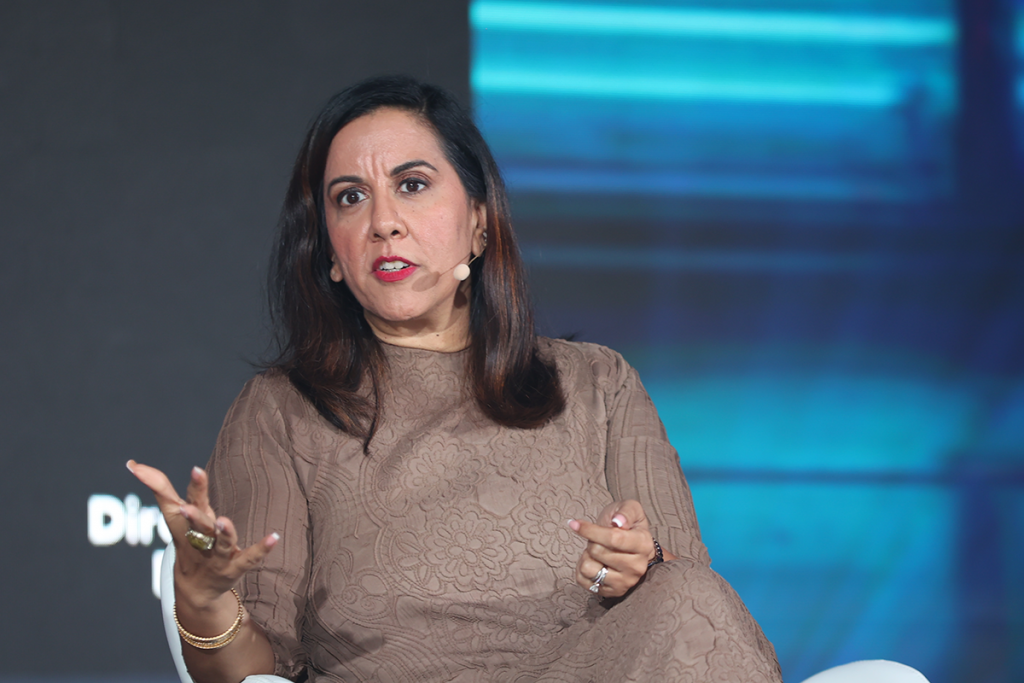
Google’s Sapna Chadha, Vice President, Southeast Asia and South Asia Frontier, Google Asia Pacific, said: “What’s happening with video commerce will impact travel as well. We’re very excited about that.”
Said Klook’s CEO and co-founder Ethan Lin, “Your own travel content itself is no longer big enough to be a self-sustained platform. TikTok, YouTube, IG, they are the largest content for travel, not the traditional travel, vertical content site. So the goal is how you embrace it instead of doing everything yourself.”
The Shift from Where To Why: From Space To Ground Control
Younger travellers are increasingly planning their trips based on unique and specific experiences, suggesting a paradigm shift where activities drive the choice of destination rather than being an afterthought.
Speaking for her generation, Jacinta Lim, co-founder of Seek Sophie, a Singapore-based marketplace offering niche experiences, “We’re actually choosing where to go based on the experience that you want to do. So, for example, if I don’t have plans to go to India, but if I see this really interesting retreat in India or really interesting hike in India, I’ll think, okay, I’m going to build my entire trip around that.”
This has put a premium on experiences, the most premium of which is space tourism where a ride on Virgin Galactic can set you back by $600,000.
Indeed, space tourism has progressed from a fantastical idea to a reality. Commented Fritz Demopoulos, CEO, Queen’s Road Capital, when he moderated the “New Frontiers in Travel” panel, “What’s interesting about space tourism is it actually started 23 years ago. So Dennis Tito, an American businessman, he paid $20 million to fly on a Soyuz rocket into space… And just recently, Jared Isaacman, 23 years later, spent $200 million to take him and three other civilians… into space.”
Intriq Journey’s Jess Yap, whose agency is selling Virgin Galactic flights in Asia, said that space travel is more than a physical journey; it’s an emotional voyage that offers a new perspective on life and our place in the universe, with the potential to profoundly change an individual’s worldview. “I think finally that connection and that whole experience of being up in space – that you are such a little person in the whole perspective of things.”
Marvyn Lim of In.Genius, a Singapore-based company, is working on balloon flights as an alternative space experience, priced at a more inclusive point of around $100,000. “We use stratospheric balloon very gently instead of rocketry, so it’s safer, so that common people, not only the ultra-rich or the super fit, can also dream of going to space,” said Lim.
On the ground, this appetite for transformational experiences is firing up the tours and activities sector with giants like Expedia and Booking now entering the fray.

Marvyn Lim of In.Genius, a Singapore-based company, is working on balloon flights as an alternative space experience, priced at a more inclusive point of around $100,000. Intriq Journey’s Jess Yap (right), whose agency is selling Virgin Galactic flights in Asia, said that space travel is more than a physical journey; it’s an emotional voyage.
Susan Spinney, SVP, Trips Partnerships, Expedia Group, said OTAs can leverage their data on customer bookings to provide targeted recommendations for in-destination experiences.
“When you’re looking at an OTA and across the connected trip, we can see when a customer and where they’re staying, what hotel they’re going to, how long they’re staying at that hotel. So, it’s a great opportunity for us to look and say and recommend the right product at the right time to those travellers.”
Austin Sheppard, Senior Vice President, Trips (Interim), Booking.com, said the concept of ‘connected trips’, where multiple travel services are bundled (flights, hotels, activities), is gaining traction, with Booking.com noting a 45% increase in such transactions.
“And being able to use technology like AI to really make contextual, very relevant recommendations for things to do in stay is the big opportunity,” he said.
With more growth projected in the online tours and activities sector – now at 28% online penetration of the total market – there is room to play for everyone, including giants, middle scale players and specialists.
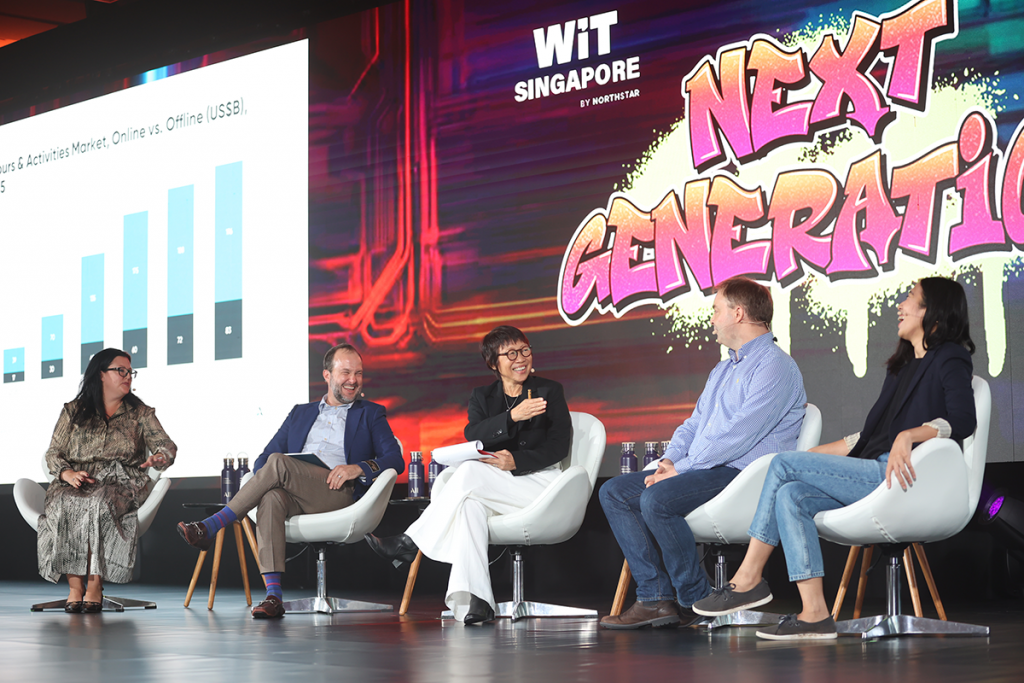
(From left) Expedia’s Susan Spinney, Booking.com’s Austin Sheppard, WiT’s Yeoh Siew Hoon, Go City’s Jon Owen, Seek Sophie’s Jacinta Lim: “I think it’s just really important that we have space for everybody in order to make sure all travellers are able to book what they want, how they want it.”
Said Spinney, “There are over 100 different categories in this space. So there’s a lot of opportunity for big players, small players, and I think it’s just really important that we have space for everybody in order to make sure all travellers are able to book what they want, how they want it.”
For Lim, it’s a question of finding her niche and doing things giants cannot. She said there’s a growing market segment interested in complex, multi-day experiences that offer depth and uniqueness, which presents an opportunity for specialized providers to thrive alongside larger OTAs.
The reality though is, she said, “there is ultimately going to be a balance between scale and hyperscale and sustainability. That’s why our planet is a little bit overstretched at the moment.”
Indeed, Klook’s Ethan Lim, when asked, what’s the one change he wants to see in the Asian travel industry in the Next Generation, said, “Sustainability.”
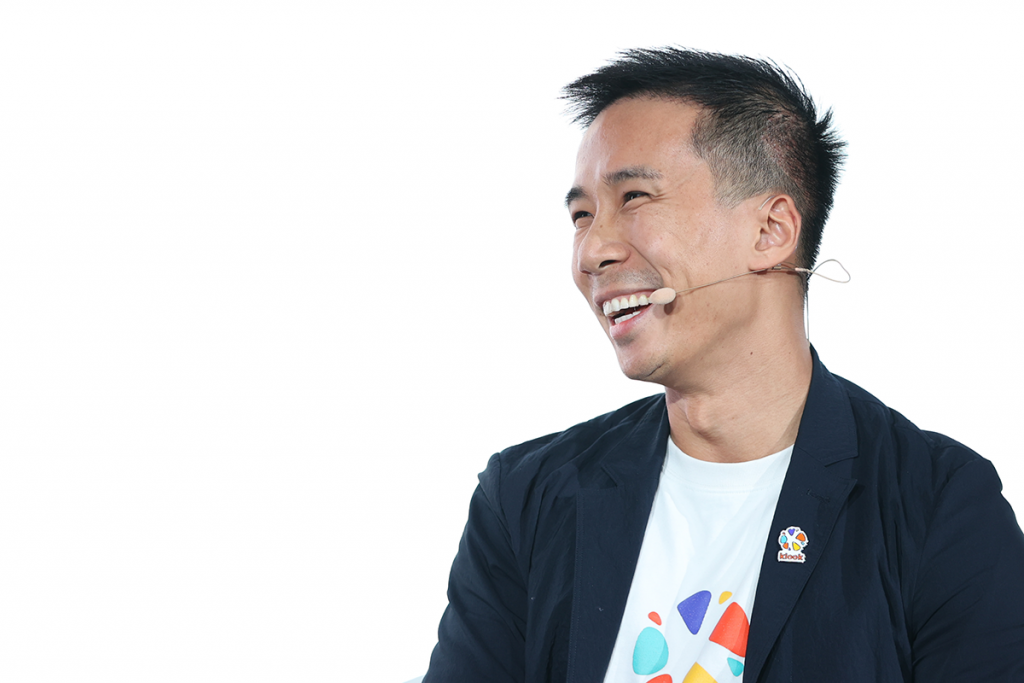
Said Klook’s CEO and co-founder Ethan Lin, “Your own travel content itself is no longer big enough to be a self-sustained platform. TikTok, YouTube, IG, they are the largest content for travel, not the traditional travel, vertical content site. So the goal is how you embrace it instead of doing everything yourself.”
“How do we manage the impact of tourism on destinations to preserve experiences for future travellers? We want to be able to experience the same things in the next decade and the next, how do we do that?”
It’s a clarion cry for all generations.
One thing is clear. As we in travel navigate this technology tipping point with our customers’ desire for personal and meaningful experiences, the Next Generation will be defined by how well we create, collaborate and connect to shape the future of travel together – and if that means taking a bracing dip together in a giant ice tub, so be it.