
2024 brought both promises and challenges to the travel industry, especially around sustainability, AI, and evolving traveller behaviors. As Timothy Hughes, Vice President of Corporate Development at Agoda, reflects on the past year, he offers insights that hint at what’s ahead in 2025. From the persistent desire for leisure travel to AI’s integration into the core of travel platforms, Hughes joined this special year-in-review edition of the WiT Podcast to share a vision that balances optimism with pragmatism.
Stream the full episode here:
Travel companies, including Agoda’s parent company Booking Holdings, have publicly committed to reducing their carbon footprint. However, Hughes recognises that there’s still a disconnect between these commitments and actual traveller experiences. “When I go and use a product, I’m still getting a lot of plastic,” he notes. This gap has led some consumers to consider travelling closer to home or making more eco-friendly choices. Yet, Hughes remains realistic about demand for traditional getaways, saying, “Never underestimate consumers’ desire for seven days on a beach drinking pina coladas.”
The challenge, Hughes suggests, lies in destination management. Overtourism, infrastructure strain, and environmental impact are issues that require coordinated efforts from governments and organizations. “Tourism infrastructure should be just as important as electrical infrastructure, as water infrastructure,” he highlights.
The changing travel funnel and how AI is the “oxygen” for travel tech
If 2024 was the year AI hype reached fever pitch, 2025 will be about its practical application. For Hughes, AI is not a buzzword but a fundamental layer of technology. “It’s not a thing. It’s the thing underneath the thing,” he explains. Rather than debating whether to adopt AI, the focus has shifted to how best to integrate it.
Agoda is empowering its teams by providing tools for experimentation. Hughes shares, “It’s about access and practice… giving tools to all of your staff who can get involved in building AI solutions.” This approach helps Agoda stay agile and innovative while navigating the rapid changes AI brings.
However, AI’s rise isn’t without pitfalls.
The issue of “hallucination” – AI generating incorrect or misleading information – is one example. As Hughes notes, “We do have to tread carefully… we need to make sure that there are no errors and that we’re making the sort of right conclusions.”
Short-form video content has disrupted the traditional travel booking process, decoupling inspiration from immediate search and booking. Platforms like TikTok offer stunning travel inspiration, but the conversion path remains unclear. “We still have this open question about the link between the timing of inspiration and the timing of booking,” Hughes observes.
AI could help bridge this gap by offering personalised, multi-modal booking experiences. “We might be able to, at some point, tell Agoda or Booking.com… ‘I want the site to look like this for me,’ and AI can just do it,” he envisions. This flexibility could reconnect inspiration and booking in a seamless way.
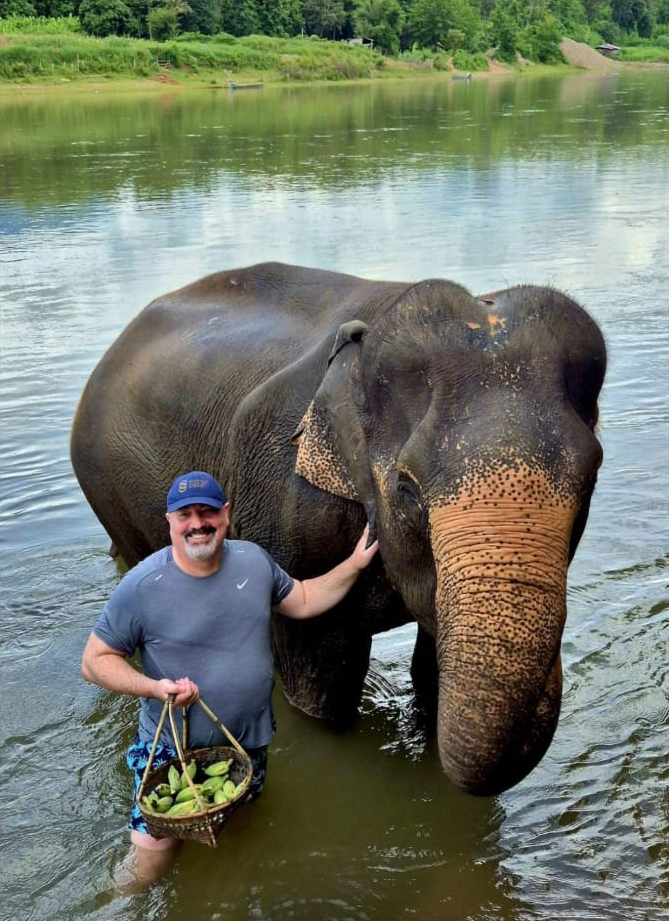
Tim Hughes calls visiting the elephants at the Elephant Village in Laos a powerful experience, as he looks back on travel and hospitality in 2024
Balancing innovation with practicality in hospitality tech
While front-end innovations capture headlines, Hughes remains frustrated with the lack of progress in behind-the-scenes technology. Despite significant investment in hospitality tech, basic processes like check-in remain cumbersome. “I’m still getting pieces of printed paper given to me,” Hughes laments.
He shares the perspective of Agoda’s co-founder, Rob Rosenstein, who advocates for solving structural issues over chasing “shiny new objects.” According to Hughes, “There’s a lot of inspiration, but not enough being done in the… structural plumbing part of it.”
According to Hughes, in 2025, expect to see travel platforms refine their AI capabilities, while sustainable travel remains a complex-yet-necessary goal. Despite technological advances, Hughes believes the fundamentals of travel will endure. As Hughes underscores in this episode, whether it’s solving the “plumbing” of hospitality or integrating AI responsibly, the travel industry’s journey in 2025 will be defined by its ability to balance innovation with practicality.