



AI cannot replace passion: Make safe decisions with limited resources, collaborate to put travellers first, focus on problems, not tech.
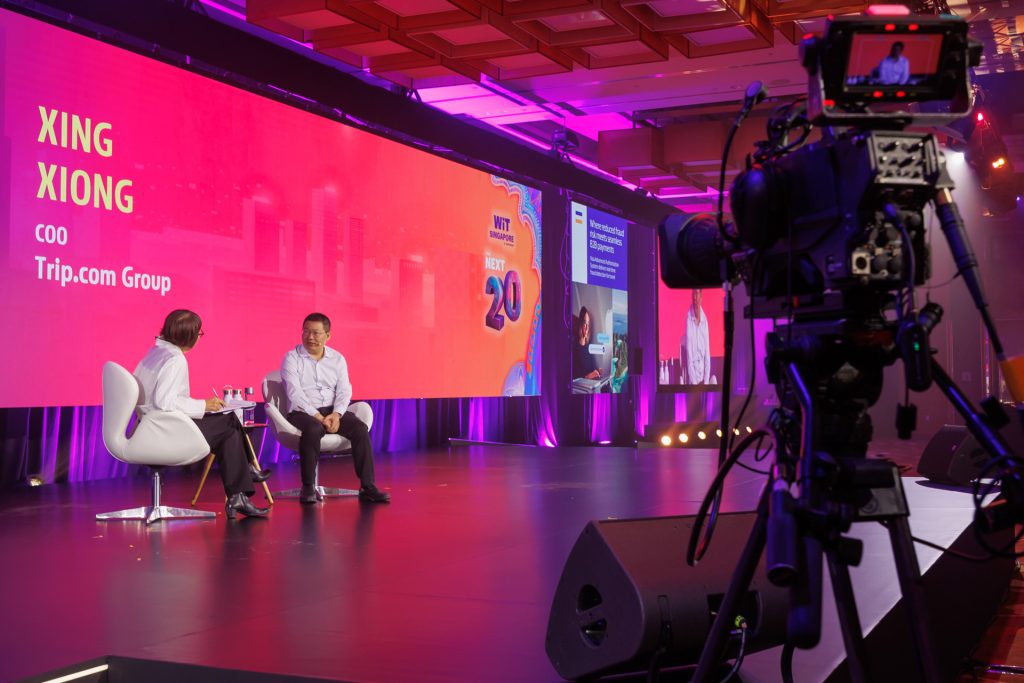
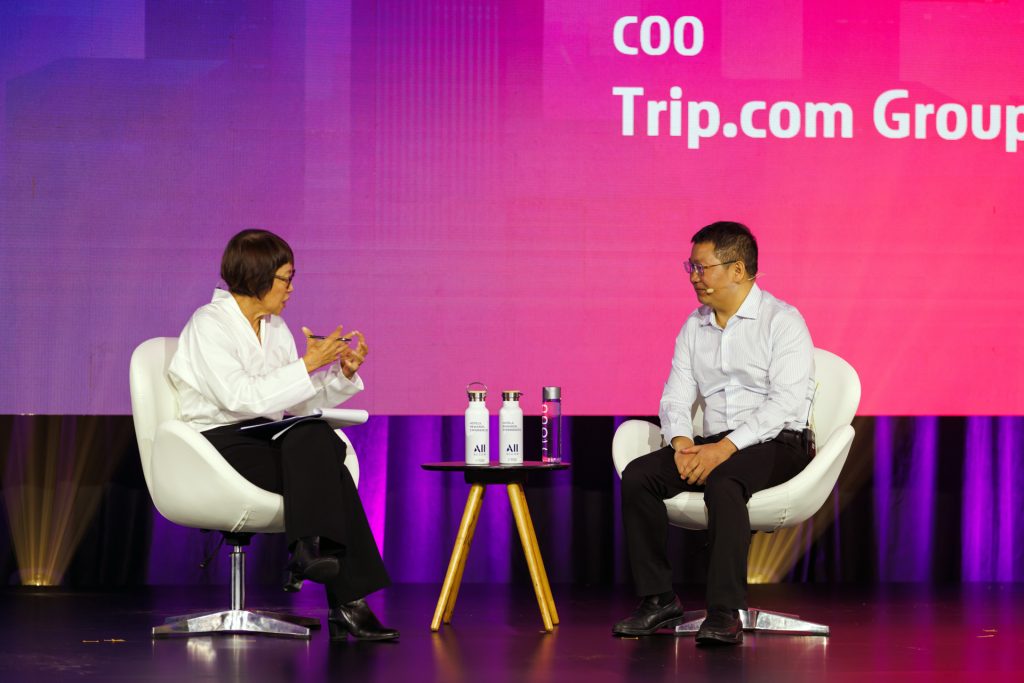
In a rare public appearance, Trip.com Group’s Chief Operating Officer Xing Xiong stepped out of his “engine room” to speak at WiT’s 20th anniversary conference.
A technologist turned leader, Xiong has spent over 26 years in travel, the last decade of which he has spent quietly shaping the infrastructure that powers one of the world’s largest online travel companies.
Calm, precise and deeply reflective, he spoke about navigating disruption, the limits of AI, and why human passion remains the most irreplaceable asset in travel.
Here are the key takeaways from his conversation with Yeoh Siew Hoon, founder of WiT.
The AI Age of Uncertainty – and Discipline
“Eighty or ninety percent of the time you talk about technology today, you’ll hear the word AI,” Xiong said with a faint smile. “It’s exciting – and nobody really knows where it will lead us.”
For Xiong, the current frenzy around AI is as much about fear of being left behind as it is about innovation. “Trillions are being invested because people are afraid. But there are too many unknowns,” he cautioned. “At our scale, resources are limited. So, it’s extremely important to make safe decisions – to put our energy into things with the best chance of long-term value.”
It was a reminder that even in a company as vast as Trip.com Group, focus and restraint are as critical as speed.
Value creation beyond commerce
At the heart of Xiong’s philosophy lies a simple principle: use tech to solve problems, and the commercial will follow.
Yeoh recalled his remarks from Trip’s own airline conference in 2024: “Whether you’re an airline, OTA or airport, it’s in everyone’s interest to create value for the traveller and the ecosystem.”
That, however, requires a shift in mindset. “The systems weren’t built for retaining or collaboration,” he said. “You can’t fix that alone. Airlines, OTAs, IT providers – everyone has to work together.”
True innovation, Xiong believes, is human-led and tech-enabled. “It’s a combination of both – the willingness to work together, the trust, putting the customer first. By the end of the day, technology is what enables efficiency and reliability, but the biggest beneficiary must be the traveller.”
The 1% mindset shift
When asked about the constant commercial tug-of-war between partners, Xiong was characteristically blunt. “We should not let that 1% commission bother the remaining 99%,” he said.
That single line summed up his worldview: fix the fundamentals first, and the margins will follow.
Solving for vibe, not just inventory
As travellers search for “vibe, not features,” Xiong pointed out that the answer begins – as always – with data synchronization.
He spoke passionately about the need to fix fragmented pipelines that make travel feel clunky. “People often underestimate how important data synchronization is. Without it, systems break down. We waste capital because we didn’t plan technology correctly at the start.”
It’s why Trip.com Group has invested heavily in solving what he calls “the invisible plumbing of travel” – the standards, connectivity and data flow that make the “connected trip” possible.
AI: Empowerment, not existential threat
While the world debates AI doom, Xiong is unfazed. “AI is just one of the milestones of human advancement,” he said. “It’s an empowerment, not a replacement. Customer needs haven’t changed – people still want comfort and to see more of the world. New technology just helps us serve them better.”
Unity as the next frontier
From NDC to low-cost carrier systems, fragmentation remains the industry’s Achilles’ heel. Xiong sees the solution in unification and collaboration.
“It looks like a simple technology problem,” he said, citing Trip.com Group’s work with Navitaire, “but it’s actually not. Airlines, aggregators, OTAs – many don’t talk to each other enough. We need new standards so that the whole world of travellers can have a smoother experience.”
Asia Pacific: Trip’s engine of growth
Looking ahead to 2030, when Trip.com aspires to be the world’s No. 1 OTA, Xiong was clear about where the growth will come from: Asia Pacific.
“This region has the youngest population and the fastest economic growth,” he said. “That’s where most of our investment and focus are.”
While China remains Trip’s biggest revenue contributor, China inbound – not just outbound – is emerging as a strategic priority. “We’re asking our teams to triple inbound,” he said.
Faith in human nature
When asked how Trip could help disperse overtourism, Xiong’s answer was unexpectedly humanist. “Travellers will do it themselves,” he said. “Information is easy to get, and people will want to discover new places by their own desire.”
While not everyone may agree and feel the problem may need some nudging on OTAs’ part – they have the data and reach– his answer reflects his confidence in curiosity – that technology amplifies exploration but doesn’t dictate it.
Leading as a technologist: Focus on solving problems
As a self-confessed engineer more comfortable in the engine room than boardroom, with systems rather than being in the spotlight, Xiong reflected on leadership.
“Technologists can’t provide much value if we don’t put our smartness towards solving our industry’s hardest problems,” he said. “Problem-solving is the central part of our role. And we must stay open-minded – because in a few years, we won’t be talking about AI. It will be something new.”
That focus on problem-solving and adaptability, he believes, is what keeps a technologist relevant.
AI can’t replace passion
Trip.com Group’s AI-driven customer service is legendary for its efficiency, yet Xiong was quick to credit the humans behind it. “The easier work is already taken over by AI. But the problems left for humans are harder and more valuable.”
He added, “AI doesn’t have passion. People do. That passion, that willingness to solve problems – that’s our biggest asset.”
On Chinese tech and the human code
Xiong sees Chinese tech innovation accelerating at the application layer, while still catching up in core software and chip design. But, he said, “in today’s world, there’s no East or West. Technology is open-source – it belongs to everyone. That’s a great thing for humanity.”
For the next generation of technologists, his advice was simple and timeless: “Be a better person. Be respectful, unselfish, and willing to cooperate. Skills are important, but human merits last longer.”
The future is smaller, more personal
Asked what travel experience might disappear in 20 years, Xiong predicted the end of mass group tours. “The next generation of travellers, even when they’re 80, will want small groups, customization, and to follow their own will,” he said. “The big group tours will be redefined.”


