



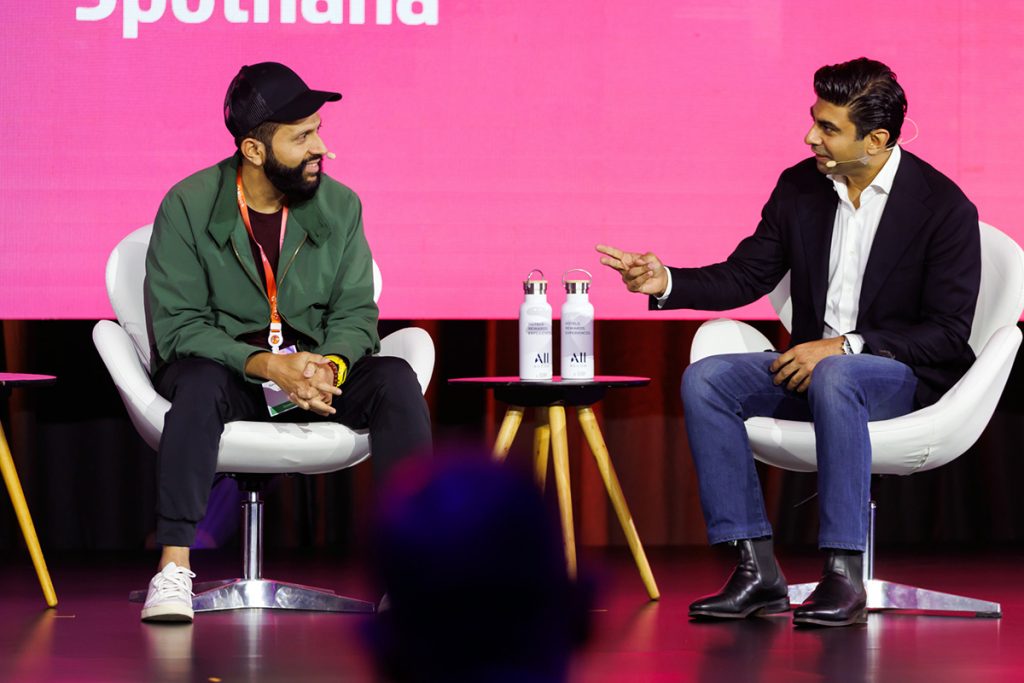
Half the room attending WiT Singapore raised their hands when moderator Pete Comeau of Phocuswright posed the opening challenge: Will the next 20 years give us tech we don’t see but feel? during the panel on “Founders & Futures: Milestone To Moonshot”.
It was a fitting provocation for three founders who are building that very future –invisible rails that let travellers move through the world with less friction, more trust, and a sense that the technology around them finally serves them, not the other way around.
On stage sat Joe Lu, the ex-Meta engineer who co-founded HeyMax; Sarosh Wagmar, the loyalty-hacker-turned-entrepreneur behind Spotnana; and Vikas Bhola, the former Booking.com executive now leading NeoKe. Between them, they’re re-architecting the travel experience from three angles – payments, infrastructure and identity – but all with the same creed: let the traveller reign.

Their starting points: Crisis, curiosity, frustration
For Joe Lu, the idea for HeyMax was born out of crisis. When Meta’s layoffs hit, he found himself surrounded by brilliant engineers suddenly benched, the kind of moment that rarely repeats in a career. They decided to build something together that felt useful and human.
HeyMax now funnels marketing budgets from brands and banks – loyalty points, perks, credits – into real-time travel spend. The secret is in timing: the traveller feels value right when they need it, without hunting for discount codes or juggling loyalty apps.
Sarosh Wagmar’s path began with curiosity, and a little rebellion. A self-confessed miles hacker who once exposed airline loyalty loopholes, he spent the next two decades learning the industry from the inside. At Spotnana, he’s re-wiring the plumbing of business travel, so buyers see one transparent price instead of 10 for the same seat. The goal: a platform that restores trust in pricing and creates visibility across a supply chain famous for opacity.
Then there’s Vikas Bhola, who, after years at Booking.com, hit his own breaking point at an airport queue in the post-pandemic chaos. That frustration became NeoKe, a company building a secure identity layer based on self-sovereign identity (SSI). The idea: travellers should carry their verified attributes – passport, visa, loyalty status – in one encrypted profile they control, trusted by airports, hotels and platforms alike.

Data is to deliver traveller value
All three founders answered in unison: the traveller owns themselves.
In their world, platforms and employers are merely custodians of data, not owners. The only sustainable model is consent-based – use my data to remove friction, show me the value, and let me say no.
That philosophy may sound idealistic, but it’s rapidly becoming essential in a world where every swipe, tap and trip creates new data exhaust. The future of loyalty and personalisation, they argue, depends not on how much you collect, but on how clearly you return value.
The new moats
If distribution and data were yesterday’s moats, tomorrow’s will look very different.
For Spotnana, the edge lies in turning travel’s “system of record” into a system of intelligence – unifying fragmented content and reasoning over it with AI.
NeoKe is betting on trusted identity at the edge, where cryptographic proofs move checks from the counter to the cloud. Within three to four years, Bhola predicts, 20% of airports will adopt SSI-style flows that verify identity without oversharing.
And HeyMax is chasing real-time value delivery, converting dormant brand budgets into context-aware benefits delivered at the exact moment of need.
Alignment, they all agreed, is the ultimate moat. If an OTA’s “agent” mostly optimises for its own revenue, travellers will eventually defect to agents that optimise for theirs.
Tech you don’t see, but feel
Invisible doesn’t mean absent. The trio’s version of “feelable tech” includes:
- Proactive care instead of reactive payouts – predicting weather disruptions or documentation issues and rebooking before the pain hits.
- Frictionless identity – one profile that moves from airport to hotel without retyping your life story.
- Transparent pricing – one itinerary, one trusted price, reconciled across content, policy and fares.
Their shared principles:
- Build for prevention, not reaction – unglamorous infrastructure is what endures.
- Publish your data ethics – if you claim personalisation, show the service delta, not just a higher price.
- Partner, don’t wall off – a true platform lets others create value on top.
Exits, trust & time
The conversation turned candid when asked about exits. None of the three wants to build for a quick flip. Their aspiration is to create platforms that carry others – customers, partners, employees – across the finish line.
For Spotnana, the long game is a public company. For all of them, it’s longevity: rails that still run when the founders themselves have moved on.
Their one word for the next 20 years? Trust.
What keeps them up – and gets them up – is the same thing: governing identity and data safely in an AI world and giving travellers back the one currency that matters most – time.
When asked for their moonshot pick, the stage leaned toward teleportation. Until then, they’ll settle for line-free airports.


