



“Don’t worry about the next 20, worry about the next six months”
Back in Singapore, after landing at 1am and walking my dog through tropical humidity six hours later, I found myself reflecting on the strange magic of travel.
Just 24 hours earlier, I had been in Seoul, pacing along the Han River in sub-zero winds – a crisp, biting reminder of just how physical travel is. Cars, planes, airports. Crowded gates, cramped seats, conversations with strangers. And at the destination, the sensory experience of mixing, mingling and munching with locals.
No amount of AI, no matter how powerful, will ever change the physicality of that.

A crisp wintry day by the Han River
And with Barry Diller’s voice still echoing from the Phocuswright stage in San Diego – his reminder that travel will always be a real-world business – I listened to WiT Seoul unfold with a heightened sense of contrast: the physicality of travel on one hand, and the digital shockwave of AI on the other.
Here are my key takeaways.
-
The Korean Market Is Living With a High-Level Hum of AI Anxiety
Korea, a country that has exported fantasy, romance and escapism to the world through its dramas, movies and music, is living something much darker at home: a pervasive anxiety about AI’s impact on jobs, identity and economic survival.
Of all the events WiT has held this year worldwide, nowhere did the anxiety feel as palpable as Seoul.
Serial entrepreneur Chester Roh, a Korean tech veteran who’s built five companies, taken one public and sold one to Google, issued the starkest warning of the day: “It is not the next 20 months or 20 years that are important, but how we live the next six months is crucial.”

Chester Roh, CEO, B Factory: “It is not the next 20 months or 20 years that are important, but how we live the next six months.”
For someone who has lived through every Korean tech wave, this wasn’t hyperbole, it was a plea. Roh described an unprecedented acceleration: “The speed of change now seems to be almost exponential… The changes that occurred over two years are now happening every two months.”
Three years since ChatGPT. Eight months since Claude Code. Frontier models released every few weeks.
In his words, clinging to ideas from even 30 days ago means: “You will have the strange experience of being trapped in the past framework.”
It was the quote that anchored the entire conference.
-
And Paradoxically, Anxiety Is Highest Among the Most Senior Leaders
Svetlana Kim, VP People at Wego, brought an unfiltered HR perspective: Yes, AI is eliminating roles – or more accurately, eliminating the need to hire.
“We ask for every role: can AI replace this?”
Her team automated 800 hours a month in finance – the equivalent of five full-time hires. And despite the company doubling in size: “I haven’t hired anyone for my HR team in two years.”
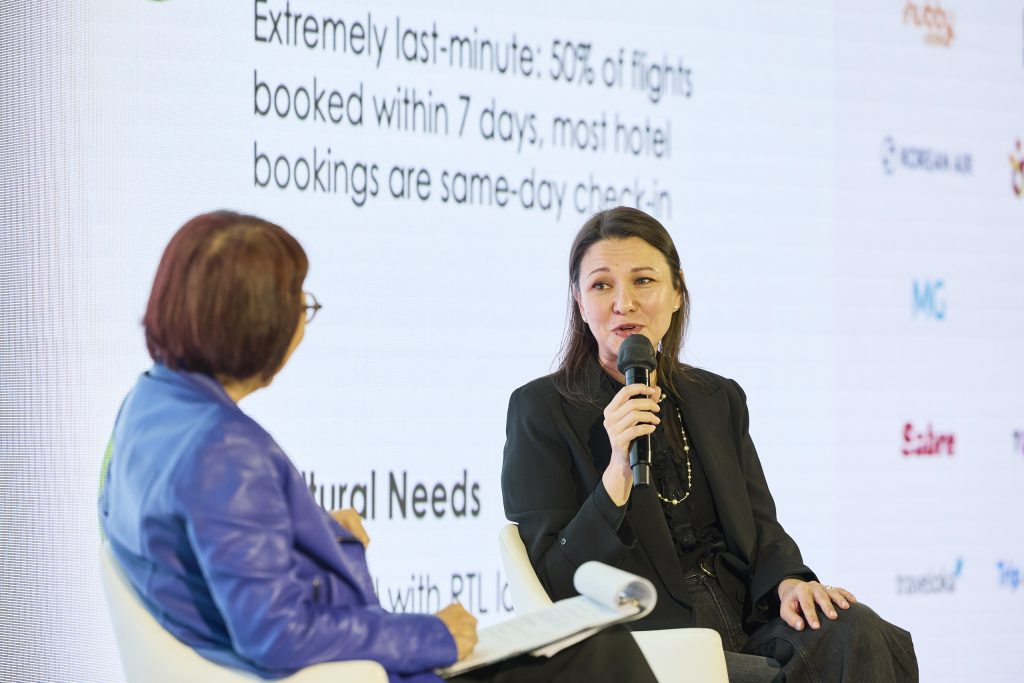
Svetlana Kim, VP of People at Wego: “Predictions say 80% of admin and junior roles will be automated. Yet senior leaders seem more anxious – maybe because they see it coming.”
When asked whether Korean AI anxiety was uniquely intense, she broadened the picture: “Anxiety is high across the world.”
But her sharpest punchline was this: “Predictions say 80% of admin and junior roles will be automated. Yet senior leaders seem more anxious – maybe because they see it coming.”
I could almost feel the consensus in the room.
-
Global OTAs Are Chipping Away at Outbound Share – Harder and Faster Than Before
The second anxiety thread running through WiT Seoul: Global OTAs are coming in strong, fast, and committed – and locals know it.
In a panel, Agoda, Trip.com, Booking.com and eTraveli Group revealed just how aggressively they’ve been studying and adapting to the Korean traveller.
Jason Kim of eTraveli Group captured the Korean traveller’s psychology in one perfect line: “Korean travellers are actually all four — planners, deal hunters, social explorers and luxury seekers… Just in sequence.”
They plan meticulously. Then hunt aggressively. Then check social media for bragging rights. And if the price is right, they upgrade.

Jason Kim, eTraveli Group: “A customer contacted us about a flight issue even before the airline announced it… They saw the news on Naver. They expect us to be faster than Naver News.”
Every global OTA on the panel described deep localization:
- Agoda switching from Google Maps to Naver Map
- Trip.com insisting on 24/7 Korean-language support
- Booking.com emphasizing frictionless resolution
- eTraveli Group warning that Koreans expect OTAs to be faster than airlines — and faster than Naver News
Justin Hong, General Manager, Korea, Trip.com, underscored the emotional core: “People want to hear a Korean voice when they have a problem. If a Korean answers 24 hours, they feel relieved. Everything must feel smooth, fast and worth it – frictionless resolution is crucial.”
Jason Kim shared this anecdote: “A customer contacted us about a flight issue even before the airline announced it… They saw the news on Naver. They expect us to be faster than Naver News.”

Justin Hong, General Manager, Korea, Trip.com: “People want to hear a Korean voice when they have a problem.”
-
And Yet, Korea’s Local OTAs Aren’t Backing Down – They’re Doubling Down on Cultural Advantage
If global OTAs arrived in Korea cautiously last year, this year they showed up fully armed.
Sunny Chang of TIDESQUARE put it simply: “Last year people said they didn’t have a Korea presence yet. Now they say: ‘We have IATA, we have a branch office. Here are five people from the team.’”
But local OTAs believe Korea’s cultural nuances give them a moat global players can’t easily penetrate.
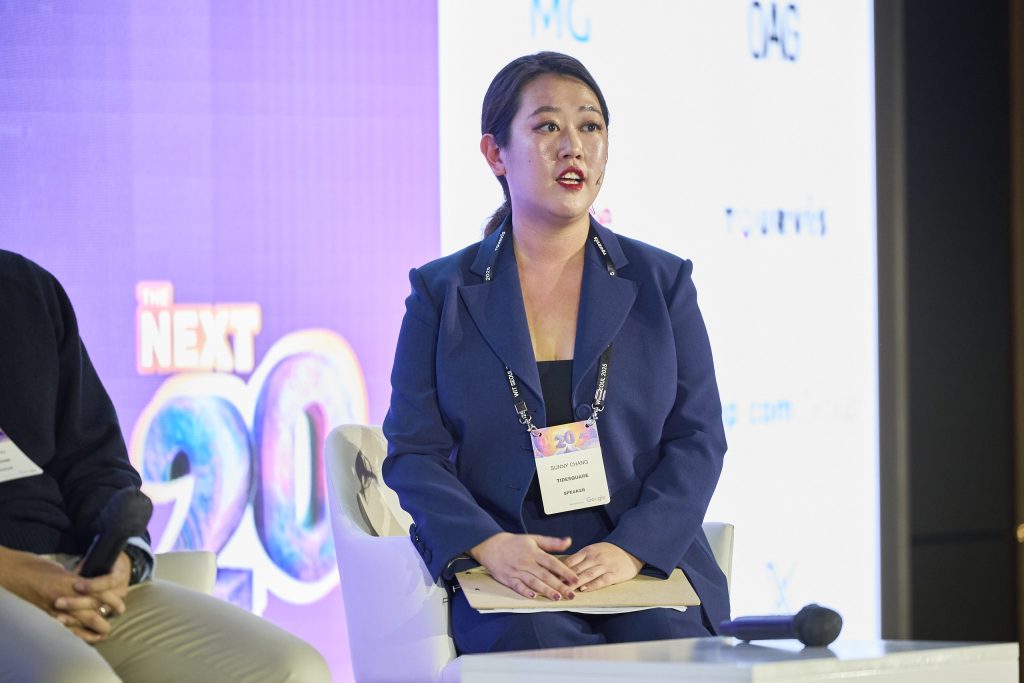
Sunny Chang, TIDESQUARE: “We have the second largest outbound market, we have the most demanding travellers which makes this a good testbed for product innovation, and K-culture interest gives us a good opportunity to go global and test what we have to offer to the world.”
MyRealTrip’s Jinmyeong Ju highlighted a uniquely Korean strength: Korean-speaking guided tours – an “unreplaceable” cultural necessity for many outbound travellers.
Tripbtoz’s Stanley Kim pointed out a shift from search-led behaviour to inspiration-led browsing – a funnel driven by short-form video, social validation, and K-content.
TIDESQUARE’s Chang aspires for a day when a Korean travel brand truly goes global, the way Trip.com has done. “We have the second largest outbound market, we have the most demanding travellers which makes this a good testbed for product innovation, and K-culture interest gives us a good opportunity to go global and test what we have to offer to the world.”
But they also acknowledge that AI giants like Google loom large. When moderator Tim Hughes of Agoda asked, “Does AI give Google a way into the Korean digital economy?”, all three panellists gave it a thumbs up.
Naver and Kakao – long considered untouchable – may no longer be safe. The Korean moat is weakening, and locals know the race is on.
-
NOL Universe Is Making the Boldest Bet of All: Travel × Events × Fandom
While many local OTAs are defending territory, NOL Universe – the merged super-platform of Yanolja and Interpark – is playing offense, not defence.
Its CMO Thomas Lee and CPO Chanhee Lee made one thing clear: The rebrand is not a cosmetic exercise. It is a repositioning of the entire Korean travel industry, by betting that the next frontier of travel is not travel alone – it’s travel fused with events, fandom, culture and live experiences.
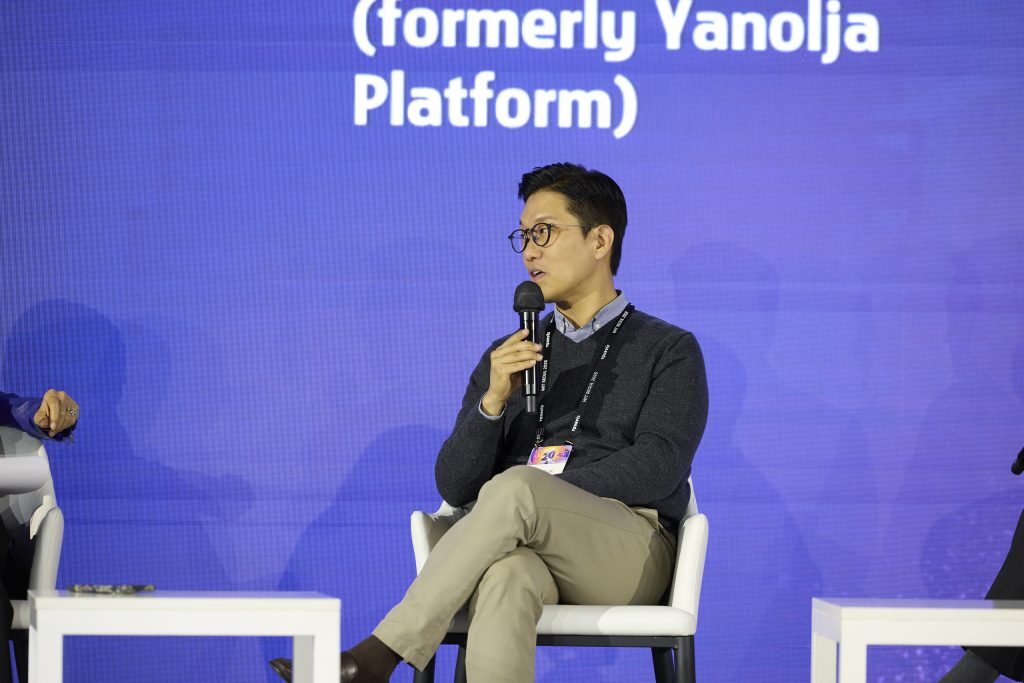
Chanhee Lee, CPO, NOL Universe: “We’re adding a completely different dimension: events and concerts. We’re still figuring things out.”
And whoever integrates that ecosystem best will win. NOL wants to own not just travel bookings, but the reasons people travel — concerts, sports, events, fandom, culture.
Chanhee described the ambition: “We’re adding a completely different dimension: events and concerts. We’re still figuring things out.”
The Korean fan-motivated traveller — the ones who fly for BTS, Blackpink, PSY — is their secret weapon.
NOL has already tested bundling concerts with:
- flights
- hotels
- tours
- local experiences
And they intend to go further by organising the events themselves.
From Taylor Swift in the US to BTS or Blackpink in Asia, concerts now move hotels and flights more than any travel campaign. And NOL wants to be the platform that captures the entire funnel.
-
Meanwhile, Aviation Data Shows Korea’s Sky Is About to Expand – Dramatically
OAG’s Mayur Patel brought a refreshing dose of optimism after all the anxiety.
His forecast: Assuming no major geopolitical shocks… “Seoul and Incheon could be the third largest market in the world by 2045.”
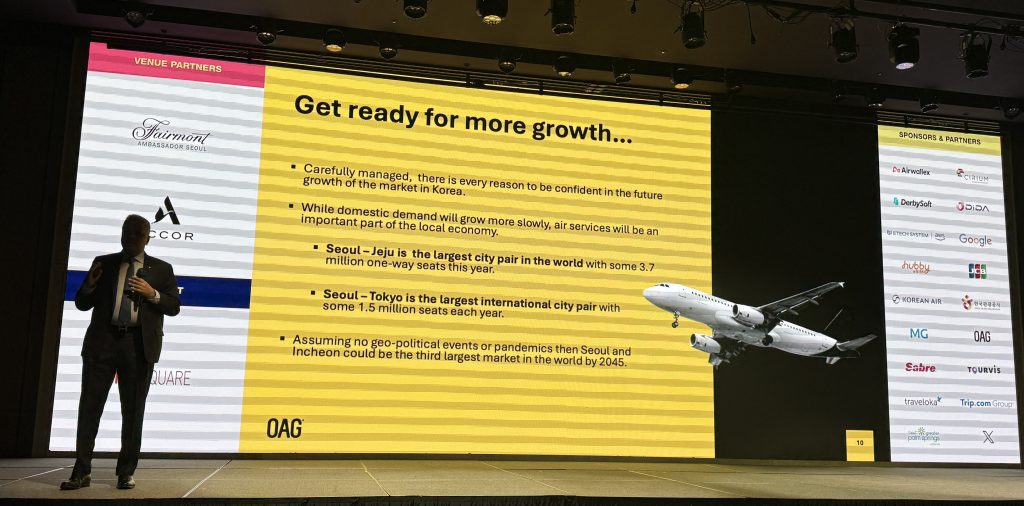
Mayur Patel, OAG: Assuming no major geopolitical shocks, “Seoul and Incheon could be the third largest market in the world by 2045.”
The reminders were powerful:
- Jeju–Seoul Gimpo: the world’s #1 domestic route for 15 years
- 3.7 million one-way seats annually on Seoul–Jeju
- 1.5 million seats on Seoul-Tokyo, now the world’s largest international city pair
- A merged Korean Air-Asiana poised to become one of Asia’s biggest international carriers
- Incheon’s 24-hour operations, new runways, new terminal and long-term expansion plans
- 199 aircraft on order for Korean carriers
For a country of this size, Korea punches far above its weight in aviation and it’s about to punch even harder.
-
A Drama Worth Following
If Chester Roh is right, the next six months will matter more than the next 20. But if Mayur Patel is right, the next 20 will be some of Korea’s fastest and most transformative years ever.
Between those two timelines – the urgent and the inevitable – lies the story of Korea in 2025: a market anxious, ambitious, volatile, innovative, irrepressible… and absolutely worth watching.
Better even than K-Pop Demon Hunters.


