
He started on Labour Day. May 1. “I still don’t know how that happened,” says Marcus Yong, laughing. Ten years later, Klook’s vice president of global marketing is sitting across from me, and the irony of choosing to begin his startup journey on the one day the world takes a break hasn’t been lost on him.
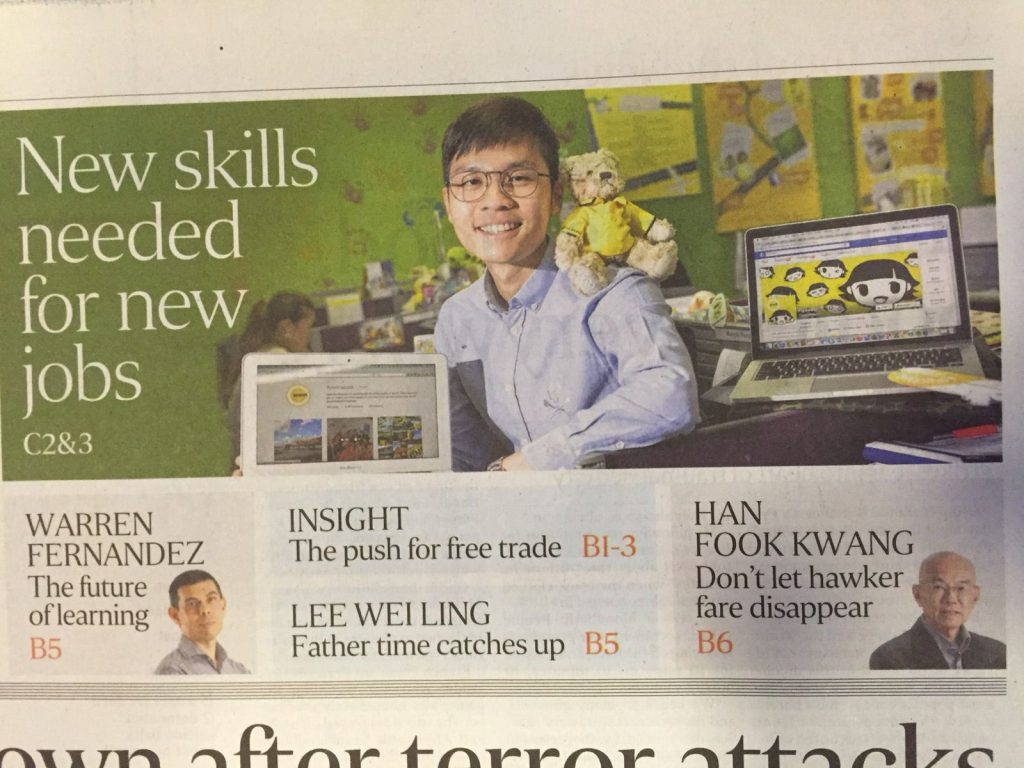
Back then, Yong was at Scoot, doing digital and performance marketing, young enough to be handed the social media brief because, as he puts it, “give it to the kid to do.” Young enough, too, to have been featured on the cover of the local Sunday Times as a poster child for Millennial jobs.
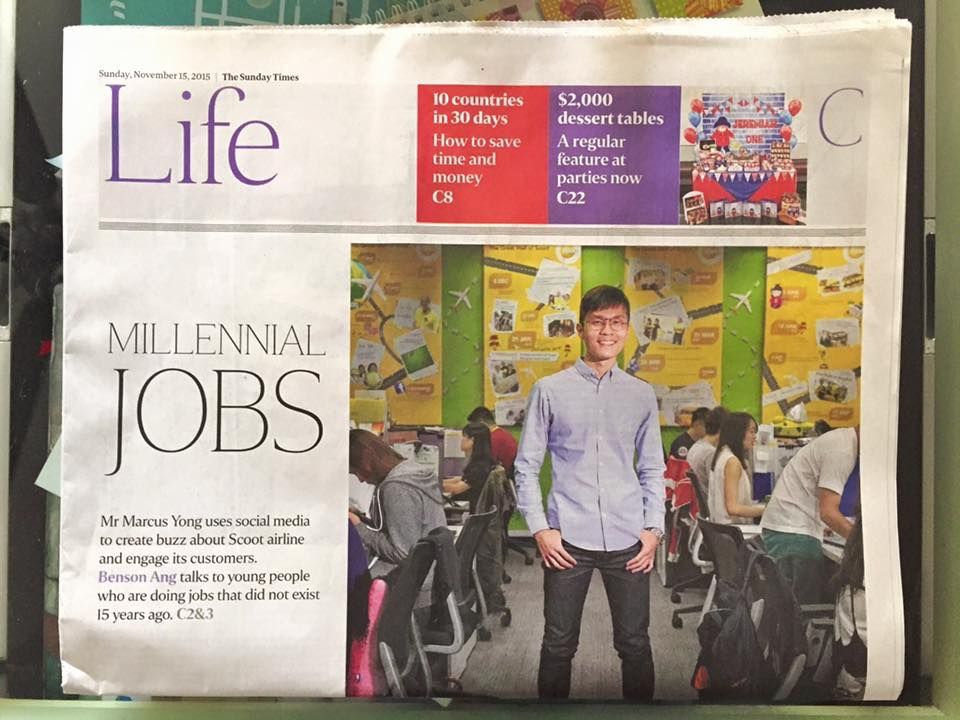
“Today, it’s AI jobs but back then – social media and digital were the new jobs,” he says ruefully.
Asked why he left an established airline for a startup, then about a year old, he said, “I’d never failed before. It sounded like an interesting proposition – experiences, travel. What’s the worst that can happen? Even if it doesn’t do well, I can tell myself I tried something, failed, got a bit of startup life.”
Turns out he got 10 years of startup life under his belt.
A book with many chapters
Ask him to describe the decade in one word and he says, “growth, as cliché as that sounds”.
“I liken it to a book. Every year is a different chapter.” The first chapter was about building the team, setting the culture, going out and convincing people to work with a company no one had heard of. Then came the fundraising years – SoftBank, hyper growth, the mentality of ‘if I double your budget, can you triple your growth?’ Then the pandemic brought everything to zero. Then recovery, path to profitability, IPO preparation.
“Almost every year, year and a half, is a different chapter.”
So what’s the next one? He doesn’t hesitate. “Operating at a much larger scale and growth trajectory, with AI as an enabler.” Perhaps as a publicly listed one, too?
AI: Sparring partner, workflow engine, and open question
Yong sees AI as his intellectual sparring partner. “As you get more tenured, more senior, it’s actually very difficult to find good intellectual sparring partners,” he says. “People who report to you are not going to spar with you that much. When you go out in the industry, people are polite. You can have nice discourse, but you’ll never go deep.”
AI, he says, fills that gap.
Beyond the personal, Klook is building agentic workflows – systems where humans become orchestrators rather than executors. The clearest example is video production. “In the past, you needed a human to shoot and edit. Today we are building workflows where end-to-end – from script to output to stitching videos together – every part is done by the agent, and the human just supervises and approves at different stages.”
But he’s honest about where they are. All videos are now assisted by AI, whether in concept development or scripting. The goal is videos created by AI, the full loop from step one to posting to analysis and feedback. “That is very much envisioned,” he says. “But we’re not there yet.”

He’s also candid about the limits. Still images, content strategy outputs, text – AI handles these well. But video, with its human faces, stories, and emotional arc? “It’s not that easy to stitch together.”
Asked about the trend in micro-dramas and how indie filmmakers in China were creating those entirely with AI, he says, “I think they’re quite entertaining. But after a while, they start to feel the same.”
In the business of travel experiences, where authenticity is the product, that sameness is a risk. “There’s a fine line between AI for efficiency and still being authentic. That balance is something we’re trying to strike every day.”
It’s a tension he takes seriously. If AI-generated content makes a destination look more dramatic than it actually is, and a traveller arrives to find reality doesn’t match the imagery, trust is eroded. “That fine line between what is authentic versus what is just dramatic, that’s something we have to gatekeep quite actively. Otherwise, it’s easy to go down the rabbit hole.”
Social, AI, and the flywheel
One of the more interesting arguments Yong makes is for social media’s enduring relevance in an age of AI-generated everything. The two, he says, are complementary, if you understand what each does well.
“AI is the left brain. It helps you connect, bring up information faster, do comparisons. But one thing AI is still unable to do is build trust. Social is where you bring in the humans, the content, the emotions.” Put them together, and you get what he calls a flywheel – AI for discovery and efficiency, social for the emotional resonance that actually moves people to book.
He adds, “If you’re talking to ChatGPT and it says check out this secondary city, you know about it. But you don’t feel anything about it. When you’re watching a YouTube video or a TikTok clip that showcases somebody unlocking something breathtaking, that’s very different from seeing it appear in words.”
The responsibility of pointing people somewhere new
We then touch on a subject close to Yong’s heart – the role of a platform like Klook in encouraging travellers to venture beyond the obvious. Tokyo, Osaka, Singapore – the content writes itself, but Klook has been intentionally pointing its creator network toward tier-two and tier-three destinations.
Problems can arise though when those secondary destinations are not ready for foreign visitors or the experience does not match the expectations set by the content. What happens, I ask, when discovery comes at a cost?
His response: “We do not showcase lesser-known destinations without making sure we have bookable supply there that we have curated, tested, and onboarded.”
For him, content and commerce have to move together. “We don’t send creators to a destination until the supply – tours, transport, activities, hotels – is live on the platform.”
The example he gives is Phu Quoc, Vietnam. Ten years ago, barely anyone knew it. This year, Klook is holding its global KreatorVerse event there. But before a single creator arrived, the business development team had to map the destination – identify the best activities, onboard local tours, secure transport options, partner with resorts. “There’s no one-size-fits-all. Some destinations lean heavier towards tours; others, like Hiroshima, are more about digitising the entry to a museum or using Klook Pass to get around.”
The micro-drama challenge: No one Asia
There is one challenge that Klook grapples with that no amount of AI or agentic workflows will fully solve, and Yong knows it – there is no one Asia story, this is a fragmented region of very different, local markets.
Klook positions itself as a pan-Asian brand, present across Southeast Asia, North Asia, India, the Middle East. “If you really think about how many legitimate pan-Asian global companies are out there, you can’t list a lot. They’re either very China-centric, very Korea-centric.”
Being truly pan-Asian is both an opportunity and challenge. For example, Yong says that when Klook explored the idea of producing a micro-drama, the question was: what visual style transcends cultures? “You either go anime, which is very Japan, or K-drama. Other than that, there’s very little that appeals to every market.”
From growth to sustainable growth
So, if growth defined his first 10 years, what will define the next 10 for him? His answer – still growth, you can’t run away from that, but “sustainable growth”.
“I don’t think the word growth will ever go away. There’s always something new to grow, a new market, a new vertical, a new category. But as a 12-year-old brand, we can no longer just raise money and chase growth at all costs.”
The question now is whether every dollar spent comes back as more than a dollar. “Whether you are a publicly listed company with shareholders and share prices, or a large company operating at scale, that’s the right way to go about it.”
Sounds pretty grown-up for someone who once took a leap on Labour Day.