
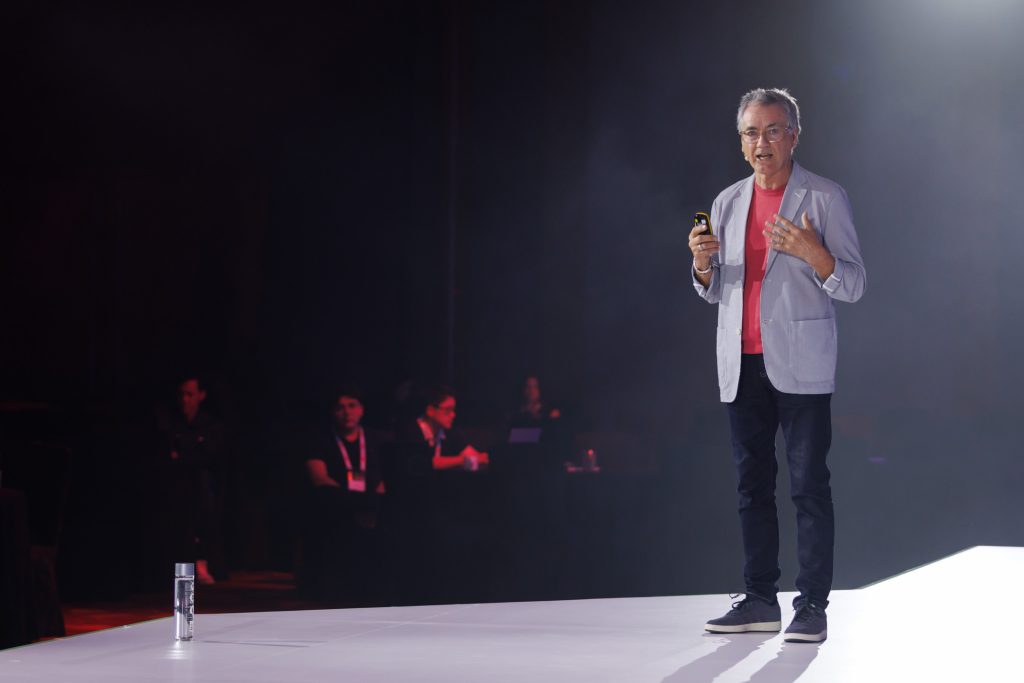
Viator founder Rod Cuthbert thought he’d confuse the WiT Singapore audience about AI and discovery. Instead, he talked himself and the room into calm.
Rod Cuthbert does not want to be the godfather of tours and activities. “Just for the record, I really hate that Godfather thing,” he told the WiT Singapore audience, seconds after being introduced as exactly that. “I wish it would go away.”
But if anyone has earned the right to ask where discovery goes next, it is the man who worked out what travellers should do once they get there. Cuthbert started Viator in 1995 and has watched discovery reinvent itself several times since.
From confusion to Zen
The “Discovery Provocation” began as a joke. A couple of months before the event, Cuthbert told WiT founder Yeoh Siew Hoon about a talk on AI and search he had just given in Australia. He opened it by admitting he was confused about the state of things and promised the audience would leave just as confused as he was.
It went over brilliantly. “Normally we try to educate the audience,” she told him. “Let’s try confusing them. That’ll be a good change.”
Then his state of mind moved on. Confusion turned into stress, and a nagging fear that things “could turn out really, really badly for me and all my friends in the industry.” The marketing programmes, the ways of operating – all of it “could be rendered old fashioned by the arrival of this new technology.”
A few more months, and he landed somewhere else entirely. “I’m relatively calm about it now,” he said. Then, with a nod to an earlier speaker: “I actually feel quite Zen about the whole thing, because I think we’re going to come through it okay.”
How did he get there? By looking back 30 years.

We have been here before
From 2000 to 2012, Cuthbert said, the industry lived under a monopoly. Google controlled the top of the funnel, in truth, all of it. “We just had to do what they wanted us to do.” So the industry got good at SEO, got good at SEM, and learned to live with “this monopolistic creature at the top of the funnel controlling how our customers got to us.”
Then, in 2007, the iPhone arrived. “It’s so small,” he said. “Hard to imagine that you would book travel, complex trips, on a thing so small.” Nobody understood the impact it would have.
But mobile did not take over in one clean sweep. It took five years for more than half of all travel searches to happen on a phone. It took 14 or 15 years before more than half of bookings did. “So we had plenty of time as an industry to get used to this new platform. It wasn’t an overnight thing, and we did that really well.”
Social media came next. Instagram had 300 million users by 2014 and began to shift travel from search towards inspiration. YouTube already had a billion. Travel is inherently visual; these were visual mediums. “It was just a terrific marriage.”
Then TikTok, which reached 500 million users within two years of its 2017 international launch and with it, the algorithm. Platforms no longer just answered what you asked. They knew what you wanted and “would feed you stuff before you even started thinking about it.”
By 2024, discovery was no longer all about Google. Google remained a major player, but it now shared the funnel with a crowd of others. “We as an industry adapted to that,” Cuthbert said, “and we prospered from that.”
Nobody came even close
Did anyone see that shift coming in 2012? WiT regularly asks the industry for its five-year predictions, so he asked Yeoh to dig out the answers from 2011 and 2012.
The verdict: “Nobody came even close.” Everyone had predicted the obvious. He was too polite to name names in a room full of the people who made them. “They weren’t anywhere near close to what actually happened.”
TikTok had not even been built yet. These were, in Donald Rumsfeld’s phrase, the unknown unknowns. Which is worth remembering before anyone claims to know exactly how AI will play out.
Searchers, dreamers and delegators
Which brings us to AI. Cuthbert walked through the growth curve: 100 million monthly active users in January 2023, 100 million weekly users a few months later, and now, by his count, around a billion people using it every week. “Clearly, this technology is amazing.”
It has also left many in the room worried about business models built on Google, TikTok, Instagram and YouTube. What happens to all those marketing programmes?
Search and discovery are moving to AI, he accepted. But is it moving so fast the industry cannot keep up, so fast it will be completely dominated? “Well, I don’t think so.”
His reason is that travellers are not one type. Some simply like the way search works. They like six tabs open or, as Expedia once told the industry, 29 sites. Others want to be inspired. They follow “that woman who goes to Greece every year” and has great ideas on the best islands, and when they go to Greece, they go to her.
And now there are people who love what AI does. They are prepared to give up control, the tabs, the reviews, the inspiration, in exchange for convenience and delegation.
“All of those things can coexist together, and they are going to coexist together,” Cuthbert said. “And that’s what makes me relatively calm.”

The spaghetti at the back end
Fine for discovery, you might say. But what about bookings?
Cuthbert stays calm there too, for a reason the room has heard before: bookings are hard. “That’s why there’s so many of us here, and that’s why there’s so many people employed in travel. Because the plumbing, what happens at the back end, it’s incredibly complex.”
There may be executives at AI companies right now plotting to take a big slice from the Amadeuses, Expedias and Booking.coms of the world and become travel companies themselves. “They are in for, I think, a very rude shock when they discover the spaghetti that is at the back end.”
That back end, he argued, is why things will not change as much as the industry fears. Discovery will fragment and multiply, as it always has. The hard part – making the trip actually happen –still needs the people who know how the pipes connect.
In a few months, or a few years, he suspects we will realise that our friends in Thailand had it right all along. The future of travel will be same same, but different.
Or as Cuthbert put it: “Sort of the same, but maybe a little different.”
Watch the full session here: