



At Phocuswright Europe 2025, a standout session hosted by WiT brought together three travel leaders with bold visions for three fast-evolving regions – Africa, the Middle East, and China. Bayo Adedeji, CEO of Wakanow; Ross Veitch, CEO and co-founder of Wego; and Gareth Matthews, CMO of Dida; shared how their respective markets are not just catching up but leaping ahead in digital transformation, traveller behavior, and platform innovation.
Africa: The next billion bookings
“Everyone should be excited about the African market because it has the youngest population in the world,” said Adedeji, setting the tone with demographic optimism. That youth-driven momentum is translating into surging demand during peak travel periods like Nigeria’s “Detty December” (the festive period packed with concerts, parties and celebrations” where “every hotel is sold out, every Airbnb is gone – we simply don’t have enough beds.”
Despite online travel penetration being below 5%, Adedeji views this as a greenfield opportunity. “That tells you the opportunity is just immense,” he said. Wakanow has since expanded to 30 countries – 12 of them outside Africa – targeting the African diaspora. “We’re making payment easy for our diaspora customers that want to shop us,” he explained. In the US, he said, the company surpassed US$1 million in transactions in under 30 days.
Still, Africa presents unique challenges. “Credit card penetration is low, fraud is high, and you’re fighting global competition,” Adedeji noted. But those very challenges have driven Wakanow to innovate. From allowing customers to pay in local currency even when transacting globally, to securing offline advertising real estate – “we just bought a bunch of roundabouts” – the company is fighting a two-front war: online and on the ground.
And when it comes to Gen Z? “They don’t shop like Gen X or millennials,” said Adedeji, who spun off a new platform, onboard.com, tailored to Gen Z behaviour – including one-click and soon, one-swipe booking. “It’s the simplification of the shopping that makes us attractive to them.”
Middle East: High spend, high mobile penetration, and a social edge
For Wego, the Middle East is a market of contrasts: small in size but heavy in value. “There are 60 million people in the GCC with incomes comparable to Western Europe,” said Veitch. “Travel frequency is higher and basket values are higher.”
Wego’s strength lies in flights and it’s doubling down. “We spent the last year building a next-gen flight shopping engine,” Veitch revealed. Inspired by the previous ITA model, acquired by Google, the platform precomputes data in memory to support faster, open-ended search queries. Layering AI on top of that architecture is the next logical step.
But accommodation is now firmly on the radar. “We’ve set out to contract every hotel in the region worth having,” Veitch said. Wego has also launched a bedbank to serve other OTAs, capitalizing on its vast regional network.
When asked about competition from global OTAs, Veitch remained unfazed. “We’re going deep. Super focused. Not rocket science, but powerful when executed well.”
Social commerce also plays uniquely in the Middle East. “There’s a lot of distrust of official media,” said Veitch. “Influencer marketing is bigger in the Middle East than anywhere else. People decide who to transact with based on social trust.”
China: Beyond recovery into the era of evolution
“Stop talking about recovery,” said Matthews of Dida, the Shenzen-based global wholesaler that started out with accommodation and is extending to flights and other verticals. “In 2025, we’re going to exceed pre-COVID numbers with 155 million outbound Chinese travellers.”
Europe, he noted, was firmly back on the radar of the more intrepid Chinese traveller, who are seeking deeper, more luxurious, and offbeat experiences. “A lot of that is driven through social media, not just for inspiration but for conversion,” Matthews said.
In China, platforms like Douyin (TikTok’s Chinese sibling) are powering travel bookings at scale. In 2024 alone, Douyin reportedly did $40 billion in travel transactions.
What works? Said Matthews, “Authenticity. Travellers want to hear from other travellers, not glossy ads. That’s why user-generated content and micro-influencers are so powerful.”
Dida is evolving in tandem. “Buyers want one contract, one API, and global access,” Matthews said. The company is focused on being the “best pure B2B partner” with dynamic rates, localized content, and AI-enabled personalization at scale.
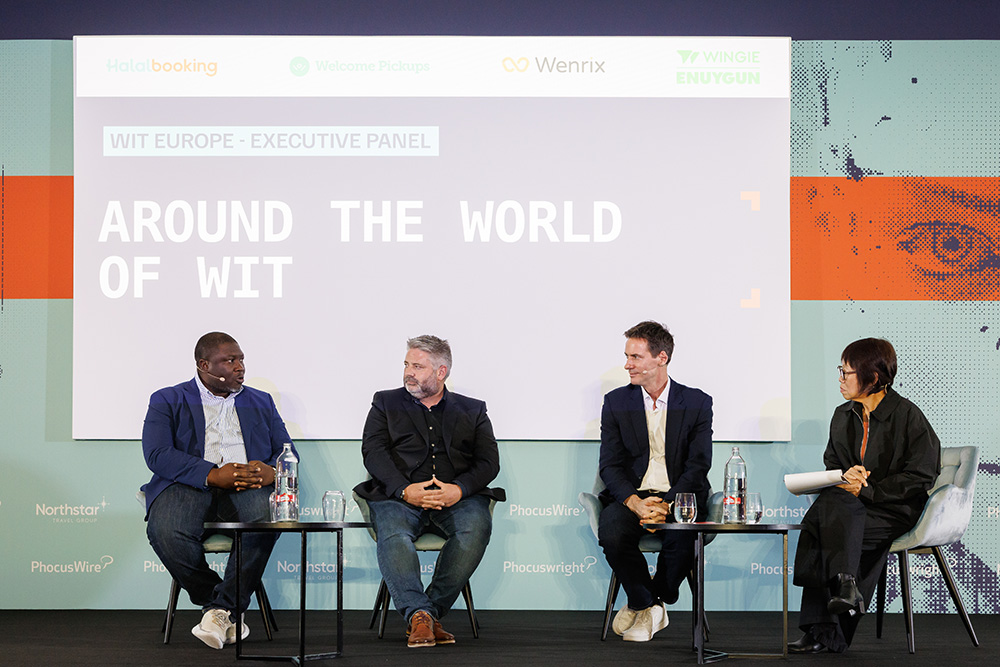
From left: Bayo Adedeji, CEO of Wakanow | Gareth Matthews, CMO of Dida | Ross Veitch, CEO and co-founder of Wego | Yeoh Siew Hoon (Moderator), Founder, WiT
Where they collide, and where they collaborate
Interestingly, the lines between competition and collaboration are blurring. Wego, for instance, partners with Dida for hotel inventory. Meanwhile, Adedeji said, “We have inventory from the likes of Dida, Expedia – from every major player.”
The shared sentiment was that the old playbooks won’t cut it. Whether it’s conversational commerce in Africa, mobile-first flight search in the Middle East, or social-to-sale platforms in China, each market is writing its own rules and increasingly exporting them.
As the panel closed with a playful “Would You Beta Test This?” game and reflections on what Gen Z would do if they ran these companies — “they’d fire me,” quipped Adedeji — the message was clear: the next generation of travel is already here. It’s younger, faster, more social, and more globally connected than ever before.


