MK Real Estate makes wellness play with RAKxa, and more to come
AT a recent WiT event, when Chris Hemmeter, managing partner of Thayer Ventures, a travel and hospitality-focused fund was asked what he believed the biggest change Covid would bring to hospitality, he said, “I think the whole world of hospitality, real estate and the monetisation of hospitality real estate is going to be the biggest fundamental shift – happening pre-pandemic but accelerated by the pandemic.”
His words came to mind when I met Vorasit Pokachaiyapat, chief executive of one of Thailand’s leading residential developers, MK Real Estate Plc, in Bangkok and he spoke about how MK was diversifying its portfolio from residences to warehouses and wellness.
In this interview with Bangkok Post, Vorasit spoke about how its foray into these two growth industries would impact positively the publicly-listed company’s performance. “EBITDA [earnings before interest, taxes, depreciation and amortisation] from non-real estate business last year accounted for 36% and will rise to 70% in the next few years, higher than our earlier goal of 50% due to the growing trend in the healthcare industry globally and e-commerce expansion in Thailand.”
The company plans to invest three billion baht in warehouses, and has prepared a one billion baht budget for housing business and healthcare ventures.

From left, Vorasit, Dusadee and Wsinee: Creating a fully-integrated wellness model, incorporating the best of East and West.
Its flagship move into healthcare and wellness is embodied in the RAKxa Medical & Wellness Retreat in Bang Kachao, a 50/50 joint venture between RX Wellness – one of its subsidiaries – and VitalLife Alliance, a subsidiary of one of Bangkok’s leading hospitals, Bumrungrad International Hospital.
It’s the first joint venture of its kind between a real estate developer and a hospital that blends hospital and hospitality and Vorasit sees the increasing blurring of lines between the two sectors.
According to the Global Wellness Institute, the global wellness economy was valued at $4.9 trillion in 2019 and then fell to $4.4 trillion in 2020, due to the pandemic. It predicts that the wellness economy will return to 9.9% average annual growth, with the wellness economy reaching nearly $7.0 trillion in 2025. It also projects that wellness real estate, a $225 billion market in 2019, would also grow and in 2020, wellness real estate continued to grow by over 22%, even as overall construction output shrank by 2.5%.
Its new report on the global wellness economy, published in January, forecasts that the global wellness tourism market will reach $817 billion in 2022 and soar to $1.3 trillion by 2025, the fastest growth rate of any wellness market through 2025. In 2019, the market reached $720 billion but fell to $436 billion in 2020.
The report also highlighted that wellness travel comprised 6.5% of all tourism trips in 2020 but represented 16.2% of travel expenditure as this segment typically spend more per trip as compared to the average traveller.
With wellness a booming post-pandemic travel trend, Thailand is well-positioned to capture its share of this market. According to this infograph from the Thailand Ministry of Foreign Affairs, Thailand combines its fourth place for tourism destinations with fourth place for Covid-19 performance and fifth place for health security. The government has declared its intention to position Thailand as a leading medical tourism hub.

Vorasit sees immense opportunities for a model that can offer a fully integrated experience and by fully integrated, he means an integration of Western scientific treatments with alternative therapies within a resort that blurs the lines between hospital and hospitality.
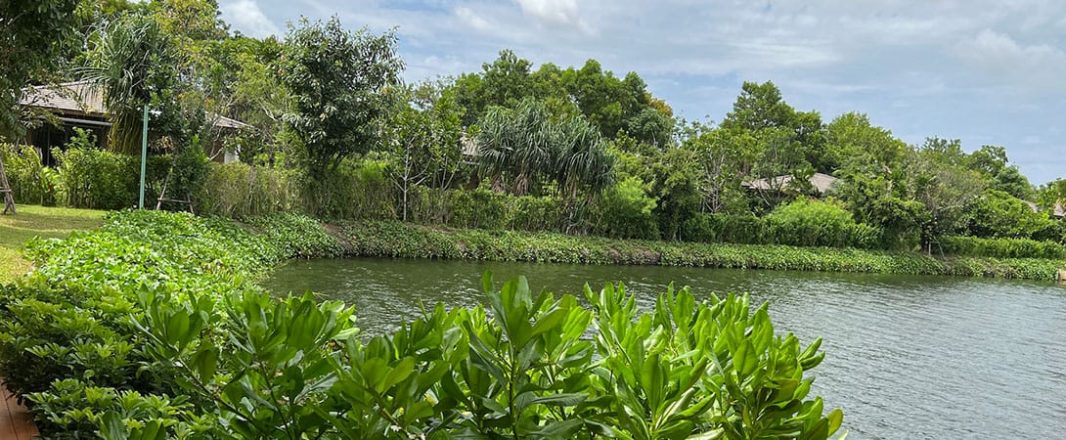
You see what he means when you take a tour of the resort. Set by the river, it feels like a tropical oasis and you’d think it was any kind of luxury villa resort except this is one you cannot check in and stay without a diagnosis by a doctor.
The mantra at the retreat is “Know yourself” and from that awareness, an integrated wellness programme is prescribed for you. There are doctors, wellness advisors, physiotherapists and alternative therapies practitioners on call to ensure you leave with a renewed sense of well-being.
Everything is designed to look as un-hospital-like as possible. The clinic looks and feels like a spa. There’s a wing with very modern and scientific-looking equipment that blasts you with oxygen, cools you down to Arctic temperatures and sculpts you while you lie still. There’s a colonic cleansing room where literally all you have to do is lie down and never have to get up to go, if you know what I mean.
There’s the alternative therapy wing that offers Thai, Traditional Chinese Medicine, Energy and Aryuvedic therapies with a total of 45 treatment rooms. And there’s a fitness area where you can get a physical assessment done on the latest equipment and a trainer and physiotherapist can then help you work on your weaker areas.

One of the garden villas, ergonomically designed and advised by doctors.
Beyond the treatments, the retreat sits on an 80-acre plot of land landscaped with 5,000 trees which reportedly cost 200 million baht (US$5.7 million). It was regarded important to have so many trees as the retreat sits in the island known as the “Green Lung of Bangkok”.
“We wanted to restore nature to the area and create a botanical journey,” said Wsinee Sukjaroenkraisri, strategic planning and business development. “It’s all part of the healing.”
The hospitality part of the retreat, with its 60 villas, is managed by Minor Hotels. Currently 27 garden villas are opened. When the partnership was announced, William E Heinecke, chairman & founder of Minor International, said, “At a time when customers are reprioritising their health, the hospitality industry’s pivot to wellness is no longer a trend but a necessity. Refocusing on health is happening on the community level too, making the arrival of pioneering concepts such as RAKxa all the more important.”
He added, “Sophisticated and well-versed in holistic therapies, today’s luxury travellers expect their wellness programmes to address health issues spanning the entire life cycle, rather than merely offer jetlag remedies.”
The retreat opened right before the pandemic, “not the best of timing”, smiled managing director Dusadee Tancharoen. But in some ways, it’s turned out to be a blessing in disguise.

One of the alternative therapy treatment rooms – TCM, Aryuvedic, Thai and Energy on offer
It had to turn to the local market for customers and launched a local membership programme which has been rather successful, said Dusadee. Priced at one million baht and 500,000 baht, the two levels of membership offer treatment credits with stays.
“It was a good opportunity to introduce our concept to the local market,” said Wsinee. And interestingly, while it had thought it would attract an older generation of clients, it found popularity with tech professionals, particularly those working in crypto, she said. “There’s a new generation of Thais who are more aware of their mental and physical well-being especially after the pandemic and they appreciate having one facility to come to for integrated wellness.”
With Thailand reopened, it is starting to see interest from foreign visitors, who book through agents specialising in medical tourism and wellness. But Dusadee wants to explore broader distribution channels. It is looking at which online channels it should work with as well as the right booking engines and technology to adopt to reach the global luxury traveller looking for an integrated wellness experience in Thailand.
Dusadee believes the time is right for RAKxa. “The pandemic has created a renewed awareness for health and well-being. Thailand has got all the right ingredients to be a global wellness destination offering the best of Western and Eastern treatments.”