
I was having lunch with a friend in executive search recently when she told me that I am the new black – meaning someone with my profile is currently in fashion.
Having waited my whole life to hear this, my ears perked up over quinoa salad and chicken breast. This kind of food is also the new black for people of my profile apparently, and so I must try and fit in.
She ticked off the reasons why I am in fashion. One, I am woman; two, I am Asian; three, I have an entrepreneur’s background; four, I have experience (a nice term for maturity, another nice term for old); five, I am a do-gooder, that is, I am associated with doing and supporting businesses that do social good.
She told me the biggest trend in executive search these days among global multinationals is to “find leaders who celebrate humanity”. That means leaders who are not driven by just profits but by doing good, whether it’s for the environment, local communities or society in general. Without generalising too much, she said there tended to be more women in this category.
Since she specialises in executive search in Asia, she’s also noticed a spike in requests by multinationals for leaders of Asian origin and those who have an entrepreneur’s background. With the words “disruption” and “digital transformation” on every big company’s to-do list, it seems the fashionable thing to do now is recruit outsiders and entrepreneurs.
Yes, an entrepreneur’s grit and an outsider’s ignorance are among the qualities global companies are looking for at the top.

Ben & Jerry’s Double Dip: How to lead with your values and make money.
Needless to say, she says it’s not easy finding people who, one, tick all boxes and two, want to work for big companies. “But the right person will be able to make a huge difference in society – imagine the resources she will have,” she says. I think she was trying to pitch me something.
Coincidentally, about the same time, I was given the book “Ben & Jerry’s Double Dip”, the story of the two ice cream men, Ben Cohen and Jerry Greenfield, on “How to run a values-led business and make money, too”, and their story, written in 1997, resonates well with current thinking.
Two guys who didn’t want to work for others decide to create jobs for themselves by selling ice cream and the book is an insightful and practical lesson on how you can imbue values into your organization from day one and institute them into everyday practices and processes, so that doing good is not something you think of after your company’s made money and you want to give some of it away.
Ben & Jerry were ignorant about ice cream – they only knew they liked to eat them – and they definitely have grit by the buckets, starting from zero to building a global empire.
At the HICAP Update conference in Singapore late March, Fraser Thompson, director of AlphaBeta spoke of how sustainability development goals will have a major influence on business over the next 15 years.
He listed 160 different goals from impact on tourism to racial and gender diversity, food waste innovation, heritage buildings, living wages and working conditions, plastic waste which he said is the new carbon. Half of all plastic waste comes from Asia and in terms of diversity, Asia has the lowest share of women on boards, he said.
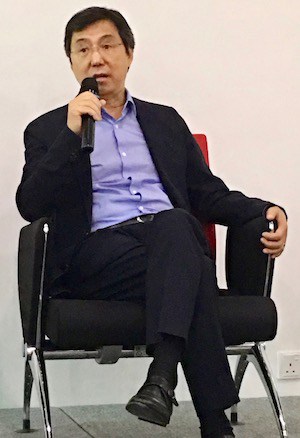
Edmond Ip: Asian-grown brands run by women entrepreneurs will move the needle on gender equality in the boardroom. (Image credit: Corinne Wan)
I had a bit of a fiery exchange with veteran hotelier Edmond Ip, chairman of Artyzen Hospitality Group, on stage at WIT Indie in Penang when I asked him qualities he looked for in a man and a woman and he said, as far as he was concerned, there was no difference to him between men and women. (His answers, by the way – compassion and reliability)
When I asked him why then there was still such a lack of women leaders in hospitality, the Hong Kong-born hotelier, rebutted, “Do you know how long it’s taken me as an Asian to get to where I am?”
(Ip worked his way up with Hyatt in Indonesia, Singapore and London to become VP Finance in Chicago. He then co-founded Banyan Tree Hotels & Resorts and spent 13 years with InterContinental Hotels Group in APAC and is credited with growing the number of IHG hotels in China from 30 to 250. He was lured by billionaire business woman Pansy Ho, daughter of Macau casino tycoon Stanley Ho, to launch Artyzen in 2014 as a new brand of hotels centred around local arts, culture and heritage for a new generation of travellers. The company also holds the CitizenM rights in the region.)
I nodded, saluting his 40 years of dedication and resilience. I recall what it took to become the first Asian editor of an English-language travel trade publication in Asia.
Ip said Asian-grown brands such as his, which are owned by women entrepreneurs, would move the needle fast.
In its latest report on “The power of parity: Advancing women’s equality in Asia Pacific”, McKinsey estimates that advancing women’s equality in the region could add $4.5 trillion to their collective annual GDP in 2025, a 12% increase over the business-as-usual trajectory.
One of three potential areas it identified for action is increasing women representation in leadership positions. According to the report, “Worldwide, slightly less than four women hold leadership positions for every 10 men in business and politics. In Asia Pacific, there is only one woman in leadership positions for every four men. In some countries in East Asia, there are only 12 to 20 women leaders for every 100 men.”

McKinsey estimates that advancing women’s equality in the region could add $4.5 trillion to their collective annual GDP in 2025, a 12% increase over the business-as-usual trajectory. (Image credit: Tomwang112/iStock-Getty Images)
It said that even in Australia, New Zealand and Singapore, three of the region’s more advanced economies, the gender imbalance is notable. “The Philippines … is the country in the world nearest to gender parity. However even there, only 15% of board members are women.”
On average in the region, the report said women’s representation on boards increased from 6% in 2011 to 13% in 2016, thanks partly to new regulations and corporate policies.
A McKinsey survey found three main barriers to women moving into senior roles – the “anytime, anywhere” performance model, “the double burden” of women holding down jobs while looking after families and the absence of female role models.
It is said change can only happen when it comes from the top and of course, when it hurts the bottomline not to do so. This convergence of growing social awareness – that businesses should be a force for good, not evil – as well as regulation and policies that address those barriers, I believe, will force change.

What’s your favourite flavour? Apparently it’s telling. (Image credit: Wikimedia Commons)
Back to ice cream and Ben & Jerry – when serial entrepreneur Wong Toon King, who gave me the “Ben & Jerry” book, asked me what my favourite flavor was, he jumped in before I could answer. “Don’t tell me you’re a Cherry Garcia girl,” he asked.
I nodded, indignant that I could be so predictable.
Wong, who started Singapore’s first Internet company, SilkRoute Ventures in 1994, and then went on to bring in the Ben & Jerry franchise to Singapore and sold ice cream for 10 years – which therefore qualifies him as a kind of ice cream fortune teller – said, “You’re in good company – it’s the favourite flavor of CEOs, Steve Jobs included.”
I am so glad I am finally in fashion, even in ice cream preferences.
• Featured image credit: virtustudio/iStock-Getty Images