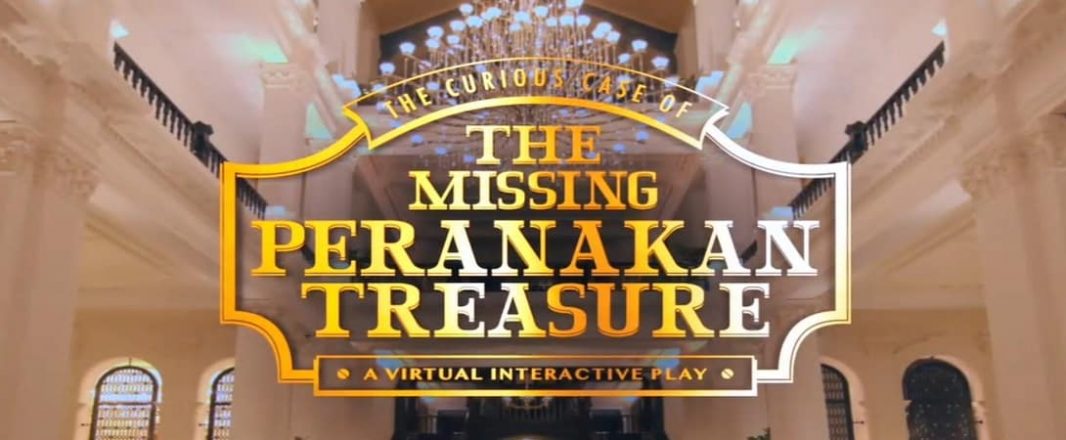
NOT new tech but new thinking. In the fourth episode of our Virtual Experience Makers series with GEVME, we speak to actor Hossan Leong and Derrick Chew, executive producer at Sight Lines Entertainment, and go behind the scenes of the making of The Curious Case of the Missing Peranakan Treasure, a virtual interactive play that is returning for its second run today.
The first paradigm shift, Leong tells us, was his readiness to consider virtual events. Being an actor, comedian, and all-around entertainer, he lives for live events, but after National Day 2020, an event he hosted, he found himself staring into a future that was devoid of live shows.
He reached out to Chew, who had previously raised the idea of creating virtual events using 360-degree immersive technology, and together they decided they would make it happen.

It is said that the Universe likes speed, and once Chew and Leong committed to the project, things happened, seemingly, with some serendipity.
Given the immersive nature of the experience, the venue choice was paramount. Leong tells us that once they decided on a Whodunnit mystery, he asked himself “Where do I set it in? Where would it be amazing for people to [say] ‘I want to be there. I want to watch it’. And I thought Raffles Hotel Singapore because everyone knows that brand.”
So, he came up with a synopsis, and brought it to Raffles, and as it happened, Raffles had a writer-in-residence doing a murder mystery at the same time and was happy to come on board if they could secure NAC funding to support the project, which they were able to do under the NAC Digital Presentation Grant.
With that in place, the creative work took off.

The first draft of the script was written in a fortnight, and the original song I’ll See You Again, was written in a mere 24 hours.
Shot in just 5-6 days on location, Leong credits the professionalism of the cast and crew for the fact that filming went so well despite the learning curve required to integrate the immersive technology.
Old technology, existing skills, new applications
Stressing that 360-degree technology isn’t really “new” tech anymore, Chew believes the challenge lies in “how we combine these different things to create or help us to facilitate what we want to achieve.”
Describing the process as “putting together a mix of theatre creatives and some of my film contacts, you know, like the sound recordist, you know, the audio poles, engineers. And also, the creative technologists”, Chew believes part of his role was bringing together people who already had the right skillsets, who then had to learn how to “collaborate and work together” with the new dynamics called for in the creation of a very different product.
Even though both men are experienced in theatre and film, post-production took on a completely different meaning in this case because the process is more complicated (involving animators, creative technologists, etc.) and timelines are interwoven.
Cutting a scene for example or making a minor tweak can result in a two-day delay while the entire scene is re-rendered.

Despite the complexity, the men believe the process works, just that a lesson for future productions would be to give themselves much more time in post-pro.
It’s a sentiment that comes through repeatedly; for Leong and Chew, the “pivot” to virtual was really about reframing ideas, rather than necessarily introducing completely new ideas (though they did plenty of those too!).
In marketing for example, successfully reaching out to audiences is still about understanding what motivates them and then framing a message that resonates with them. But given that the target audience for this virtual whodunnit was different from the usual theatre going crowd, that message had to be tailored to them.
Marketers need to balance costs with the frequency of messaging and are also conscious not to create message fatigue. All this holds true while marketing a virtual event too, except that a virtual event has a longer marketing runway, so these concerns play out over time.
Whether live, filmed, or virtual, productions must also make financial sense, and with so much free content already online, can virtual productions ever compete?
Chew approaches the issue as a producer, calling it marketing 101.
“I look at every project and ask myself, does it tick the marketing boxes? And by that, I mean… Who is this product? For? Who is my target audience? And what are they looking out for? What excites them? what interests them? What entertainment are they searching for? And if we can answer that, and we can create a message to match the market, then the adoption rate will be higher,” he tells us.
Of course, he admits, it helps that the production was novel, and they had powerhouse actors and their partnership with Raffles to add to the appeal.
Importantly, digital products differ from physical shows in that once the production costs breakeven, scaling is exponentially profitable, unlike in the case of extending a theatre run where venue, cast, and crew costs continue to add-up.
Another advantage of doing digital events is that the data they collect could change the game in helping them better understand their audience’s consumption patterns and preferences. Something that Leong jokes couldn’t be replicated at live shows because only about 10 people would ever fill in their feedback forms.
Have digital, will travel
Our guests clearly enjoyed producing The Curious Case, but don’t know if digital and hybrid will forever become a part of the theatre experience.
Leong says he “can’t really tell at the moment because people are dying to go back to theatre, which is great. You know, but with the reduced capacity in the audience, the theatre producers aren’t making money. It’s so hard, [so] I think for us, we’re gonna stick with going kind of virtual hybrid for now. And see how things pan out.” Adding that he expects “we’ll keep experimenting with it. Improving the product, and maybe the hybrid model will possibly work [even] as attractions are opening up as well.”
For now, they are launching what they call The Curious Case 1.5, which is a virtual treasure hunt to find a missing kerosang (Peranakan brooch) and tease a 2.0 version that they are currently conceptualising which aims to be truly hybrid, combining a virtual experience with an onsite one perhaps using live actors, or having self-guided tours using AR.

It’s a model that feels like it has almost limitless possibility, but Chew wants to keep things real, saying that whether IRL, virtual, or a mix of both, it goes back to the fundamental command to understand your audience. “I think it’s the interactivity and engagement… when they are involved in doing something – solving a crime and mystery, or when there are stakes involved, and they are playing it and being in it. I think that is where they fully are engaged.”
If engagement is what they are after, and having experienced The Curious Case myself, I must say that this time around, mission accomplished. Now to look for that missing kerosang.