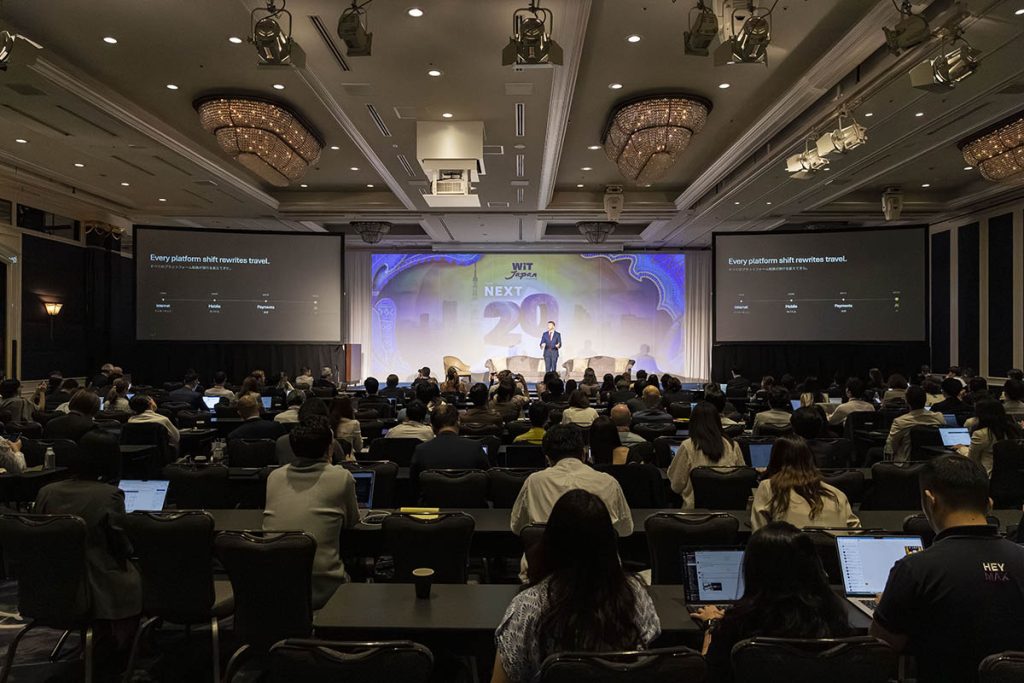
10 key takeaways from a presentation by Filip Filipov, CEO, OAG at WiT Japan
- AI is only as good as the data behind it.
Every platform shift in travel – internet, mobile, payments, now AI – has rewritten the rules. But unlike previous shifts, AI’s value is entirely dependent on the quality, accuracy and freshness of the data feeding it. The technology is not the constraint. The data is.
- LLM capabilities are converging – data is the differentiator.
The major AI models (OpenAI, Gemini, Anthropic, DeepSeek) are approaching near-equivalent capability. When the models are equally powerful, what differentiates the experience is the context and data flowing into them. Competing on the model is becoming a losing strategy. Competing on data is where the real battle is.
- Travellers have a trust problem, not a technology problem.
68% of travellers prefer booking with trusted brands. 66% still want the final say before AI executes a booking. The barrier to agentic AI in travel is not technical capability – it is the human reluctance to hand consequential, emotional, expensive decisions to a machine.
- The hard part of the travel journey is real-time operational truth.
AI handles inspiration and planning relatively well. The hard part – live pricing, actual availability, real-time disruptions, payment processing, what happens when things go wrong – requires data that is accurate, verified and updated by the second. This is where most current AI implementations fall short.
- Travel is the most dynamic data environment on earth.
130,000 flights daily. 10 million passengers. 8,000 planes airborne at any given moment. 190 billion prices generated every single day. In this environment, data that is one hour old is problematic. Data that is one day old is, in an AI-powered world, essentially useless.
- Errors amplify catastrophically in autonomous systems.
A single flight delay cascades into 48 rotational adjustments and affects 3,000 passengers. When AI confidently delivers wrong information into that system – as studies show it does approximately 30% of the time even in less dynamic environments like legal contracts – the consequences compound rapidly. Travel does not tolerate confident error.
- Real-world failures are already happening and are costly.
Air Canada was found liable after its chatbot fabricated a bereavement fare that didn’t exist. Zillow lost $500 million because its pricing algorithm used stale housing data. A single bad data input at Roblox caused $110 million in damages. These are not hypothetical risks – they are current-day consequences of deploying AI without robust data governance.

- Local data quality is not enough – the whole ecosystem must connect.
Airlines, hotels, airports, ground transport, rail – all depend on each other’s data. An AI agent that has perfect airline data but no visibility into baggage status, gate changes or ground transport delays will still fail the traveler at the critical moment. The solution requires industry-wide data sharing, not just individual company improvement.
- The interface will eventually disappear – the trip becomes one continuous thread.
The evolution runs from desktop to mobile to ambient: visual, voice, textual, live translation, all woven into a single unbroken journey from inspiration through planning, booking, flying, staying, moving and returning. Right now these are treated as separate systems that do not talk to each other. The future is a single continuous experience – but only if the underlying data infrastructure is built to support it.
- The industry must build trusted intelligence together. The path forward requires data that is accurate, fresh, verified, explainable and as close to real-time as possible – not generated by chatbots, not stale, not siloed. Filipov’s closing call was for the industry to move collectively from systems of record (isolated data silos) through systems of intelligence (connected, interpreted data) to systems of action (agentic workflows that actually execute on behalf of the traveler). That transition only works if the whole ecosystem – airlines, hotels, airports, OTAs, ground operators – builds it together.