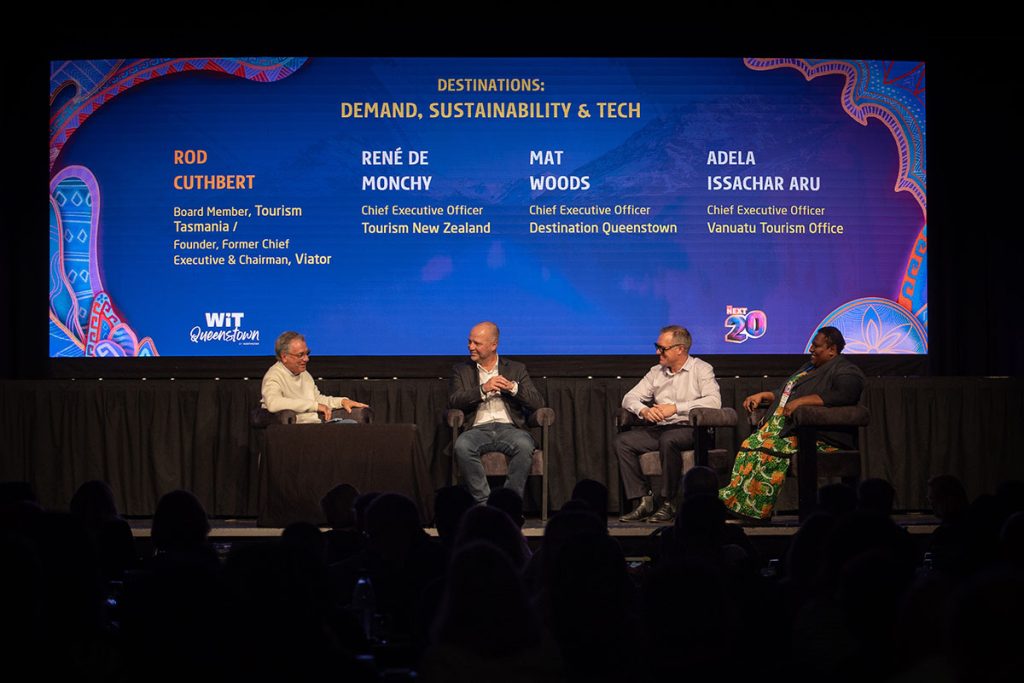
Rod Cuthbert opened his panel on “Destinations: Demand, Sustainability, Tech” at WiT Queenstown, with a confession: he’d asked his own AI system to name the world’s single best destination at marketing itself. The answer came back New Zealand, “by a country mile.”
The Tourism Tasmania board member and Viator’s founder, then framed the discussion as such. “Destinations and experiences are the beating heart of the travel industry,” he said. “Without great places to go, without great experiences to enjoy when you get there, the travel industry doesn’t really exist.”
How a country of five million wins the marketing game
His first question was to Tourism New Zealand’s CEO Rene de Monchy – how does a small country claim the top spot his AI system had just handed it.
De Monchy replied, “Size can be a challenge, but it’s also a strength. It enables us to be innovative.” He pointed to New Zealand’s tourism product itself as evidence of that innovation instinct: bungy jumping, jet boating, and the broader adventure tourism category the country effectively commercialised and exported globally.
Cuthbert challenged that claim, turning to Vanuatu Tourism Office’s Adela Issachar Aru, whose country’s land-diving traditions – ritual jumps performed for centuries as part of Pentecost Island’s cultural calendar – predate bungy jumping by a considerable margin.
Aru responded as diplomatically as she could, “New Zealand has gone about and done it right – it’s really positioned New Zealand as the adventure destination people think of. That’s a topic for another day.”

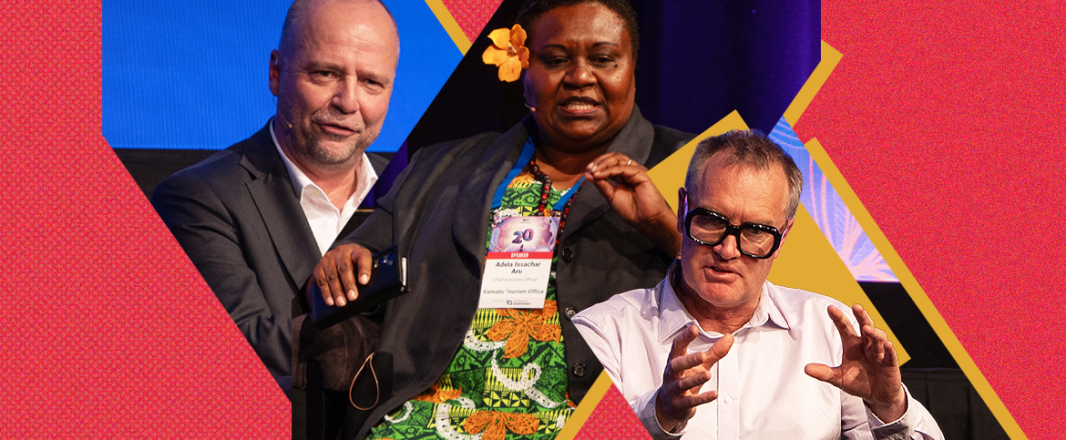
Adela Issachar Aru (right) said convincing airlines and hotel groups to commit capital to a small island destination is a constant, ongoing negotiation, one she described as managing relationships across more than 700 local operators simultaneously.
Queenstown’s problem is capacity, not overtourism
Cuthbert pressed Destination Queenstown’s CEO Matt Woods on the Barcelona comparison directly – protesters firing water pistols at tourists on the Ramblas, superglued Airbnb locks in San Sebastián – and whether that European tension is brewing locally.
Woods responded, “We don’t actually have an issue with overtourism. We definitely have capacity,” he said, citing the office’s own informal barometer: “We use the Fergburger index — the office is right beside Fergburger, and we can look down and see how busy town is.”
Queenstown’s real strain isn’t visitor volume but congestion: a airport-to-town drive that should take 15 minutes has recently been stretching to 30-45. “You don’t come on holiday to get stuck in traffic like that. And as a local community, we don’t want to be part of that either.”
To solve these issues, he said, Queenstown would rather innovate than restrict – “yes, we did poach bungy, but that’s because we like to innovate things”. He sees technology and smart demand management as the way tourism solves problems it partly created, rather than something to be capped.

Matt Woods (center): “We don’t actually have an issue with overtourism. We definitely have capacity.”
Vanuatu’s connectivity challenge
Aru’s destination faces a different challenge: 80 islands, but nearly all visitor traffic concentrated in the capital, Port Vila. “For us it starts with connectivity,” she said. Reliable aviation links into the capital, and onward to islands like Santo and Tanna, are the actual bottleneck to dispersal – compounded by the fact that Vanuatu’s own national airline “went sideways” roughly two years ago and is still rebuilding trust and consumer confidence.
An open-skies policy has since brought a wider mix of international carriers into the country, though direct connections to New Zealand remain absent. Aru was candid that convincing airlines and hotel groups to commit capital to a small island destination is a constant, ongoing negotiation, one she described as managing relationships across more than 700 local operators simultaneously, all recovering at different speeds.
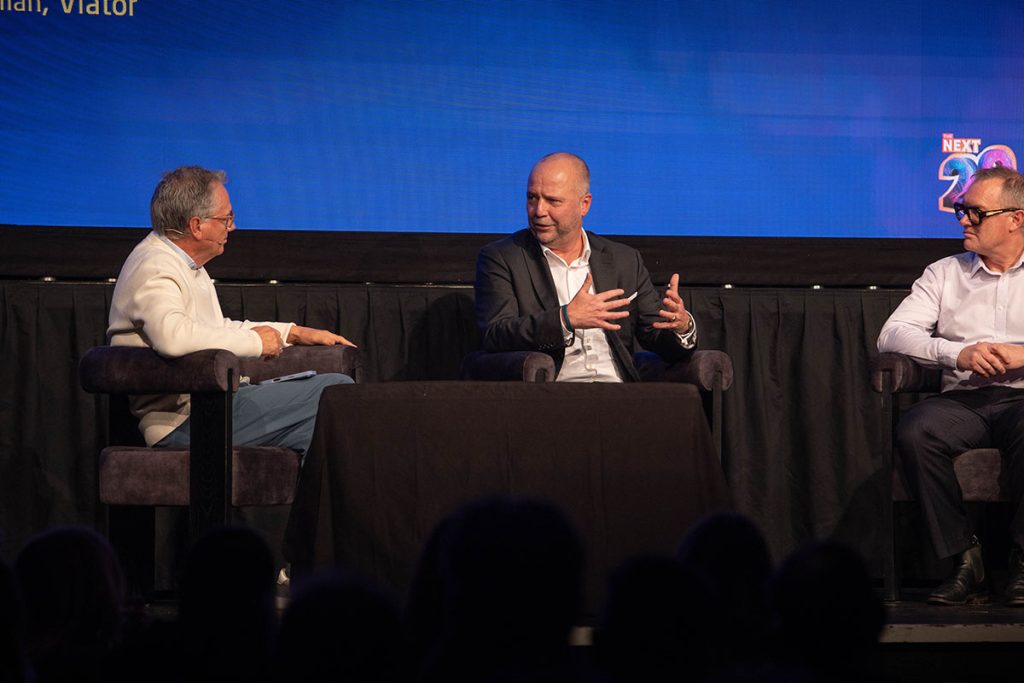
Rene de Monchy (center): “Size can be a challenge, but it’s also a strength. It enables us to be innovative.”
The shoulder-season opportunity, and busting the myth of a New Zealand winter
De Monchy flagged a concrete imbalance in New Zealand’s own demand curve: roughly 40% of the country’s tourism value is concentrated into just three months, December through February.
He sees an opportunity for spreading this out through hyper-personalised, AI-enabled marketing capable of reaching specific audiences with a message tailored to bust their assumptions.
The clearest example: American perceptions of a New Zealand winter, which bear little resemblance to reality. “It’s about busting some of those myths,” he said, pointing to early proof it’s working – March and April this year showing meaningfully higher American arrivals than the historical pattern, spilling demand into shoulder months.
A separate tailwind, he suggested, is Europe’s own increasingly brutal summer heat pushing travellers to reconsider “third-choice” destinations they’d previously deprioritized.
Two audiences now: Humans, and machines
The discussion then moved on what happens to destination marketing once AI search sits between a destination and its visitor.
Cuthbert raised a cautionary example from his own board work with Tourism Tasmania: tourists arriving at hot springs that simply don’t exist, generated by AI hallucination, overwhelming small local parks with visitors unable to find an attraction that was never real. “How do you keep official, accurate information at the centre of a system prone to inventing convincing nonsense,” he asked.
De Monchy said, “For as long as we’ve done this, we’ve prided ourselves on understanding our audience – the human consumer insight. Increasingly, we’ve got two audiences: the humans who want to travel, and the machines looking for information on their behalf. Making sure our information is digestible, discoverable and readable by both is one of the things we’re really focused on now.”
That means running workshops with regional tourism organisations specifically on AI discoverability and confronting real uncertainty about whether the familiar Google-to-OTA funnel holds, or whether new intermediaries such as OpenAI or Anthropic directly become the actual front door to destination discovery.
He said that research so far suggests AI is currently a planning tool more than a booking one, though he expects that gap to close quickly.
Woods cited Destination Queenstown’s own live example of the hallucination problem, discovered the same day as the panel: an AI-generated website advertising a casino in the Queenstown marina that doesn’t exist.
“How do we actually keep on top of that?” he asked, framing his core job as maintaining a single, unimpeachable point of truth that AI systems can be steered toward citing. He split the AI conversation into two distinct problems – efficiency tools that genuinely help operators versus search and discovery, which he called “really challenging right now.”
Asked, hypothetically, what she’d spend an unlimited marketing budget on, Aru didn’t hesitate: brand awareness, full stop. “So many times, when we’re travelling, people ask where we’re from. I say Vanuatu, and they say – where’s that?”
Getting into the top of the marketing funnel at all, she argued, remains the binding constraint before conversion tactics are even relevant.
Influencers: The new distribution layer
All three destinations are leaning into creator marketing, but for different strategic reasons. Tourism New Zealand’s most recent example was its Michelin Guide launch, which brought 36 international food and travel influencers into the country to generate content around the announcement.
Queenstown’s approach is more segmented: heavy engagement with Chinese KOLs, and a specific push around winter-focused influencers targeting the Australian market to reposition the region beyond skiing alone – wine, wellness, mountain biking – countering the assumption that a Queenstown winter means nothing but snow.
For Vanuatu, working with a comparatively tiny marketing budget, growing interest from influencers across North America, Europe and Asia functions as leverage it couldn’t otherwise afford: creators doing the storytelling the tourism office’s own resources can’t fully cover, said Aru.