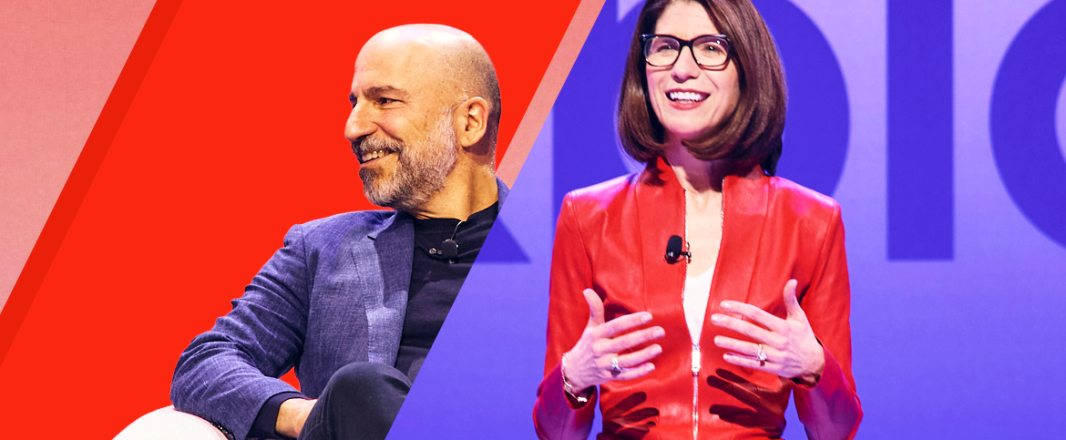
Uber’s Dara Khosrowshahi returns to the Explore stage to exchange lessons with Expedia Group CEO Ariane Gorin
It felt like it was almost always meant to be. Former CEO and now Uber chief, Dara Khosrowshahi back on stage at Explore with current CEO Ariane Gorin – the two having just signed a landmark agreement that, on hindsight, almost felt inevitable.
Between them, Alfonso Paredes, Expedia’s President B2B and Chief Commercial Officer, who negotiated the deal. And so he asked the first question – what advice would the former boss give to Gorin at this 30-year milestone?
Khosrowshahi was quick to respond. “Ariane doesn’t need any advice, she’s a wildly better executive than I ever was at Expedia,” he said.
However, he added, “When you have a company with the history and success of Expedia, there’s always a temptation to hold on to the present and the past. Don’t give in to the temptation to play defence. The minute you play defence, you lose.”
It was a message shaped by lived experience: the mobile era, which he described as “actually a headache for the company” in its early years, before it became core to everything. Meta search, now AI – each wave carrying the same lesson – run toward change, not away from it.
Gorin, for her part, offered a glimpse into the mentorship that clearly exists between them. “When you were still CEO of Expedia, I had a career decision to make within the company,” she told him, “and you said: Ariane, if your head and your heart don’t align on the decision, you’re not ready to make it. It’s such good advice – and not just for careers. For anything in life.”
Khosrowshahi smiled at the memory, saying, “Human instincts are quite powerful. Whenever I made choices I didn’t feel good about in my heart, there was something I was missing. If the heart wants to do it and the head says no, that’s just gambling.”
From former boss to business partner
Behind the reunion on stage was the very practical dimension – just weeks ago, Expedia and Uber announced a significant two-way partnership: Expedia is now powering hotel inventory inside the Uber app, while Uber rides are being integrated directly into the Expedia platform.
For partners attending the conference, it represents a new demand channel they wouldn’t otherwise have access to.
Gorin was direct about the commercial rationale: “We all know that people book in a lot of different ways – through corporate travel, through their airline, through loyalty points. The ability to create better traveller experiences in at least two of those was a great deal for us.”
Khosrowshahi framed it from Uber’s angle, noting that strategic planning– not just last-minute on-demand bookings – was always part of the ambition. “We had a question about whether we could get planning right. But our data showed that people who come to Uber do plan for their next trip.”
He pointed to the scale involved: over 100 million trips to and from airports annually, and 1.5 billion transactions happening outside users’ home cities. “There are a ton of travellers interacting with our app,” he said, “and to the extent that we can use that in our partnership and bring more incremental demand – that’s the point.”
The partnership was one of several announcements Gorin made from the stage. The conference also saw Expedia integrate CLEAR and CLEAR Plus into its app for One Key members, extending what Gorin described as “seamless travel from inspiration to airport.”
And in a move that signalled longer-term thinking, Expedia launched the Expedia Trails Fund, committing over $4 million in grants to rebuild trails and improve access to protected landscapes in the US, alongside a matching commitment to the All Trails Stewards Fund.
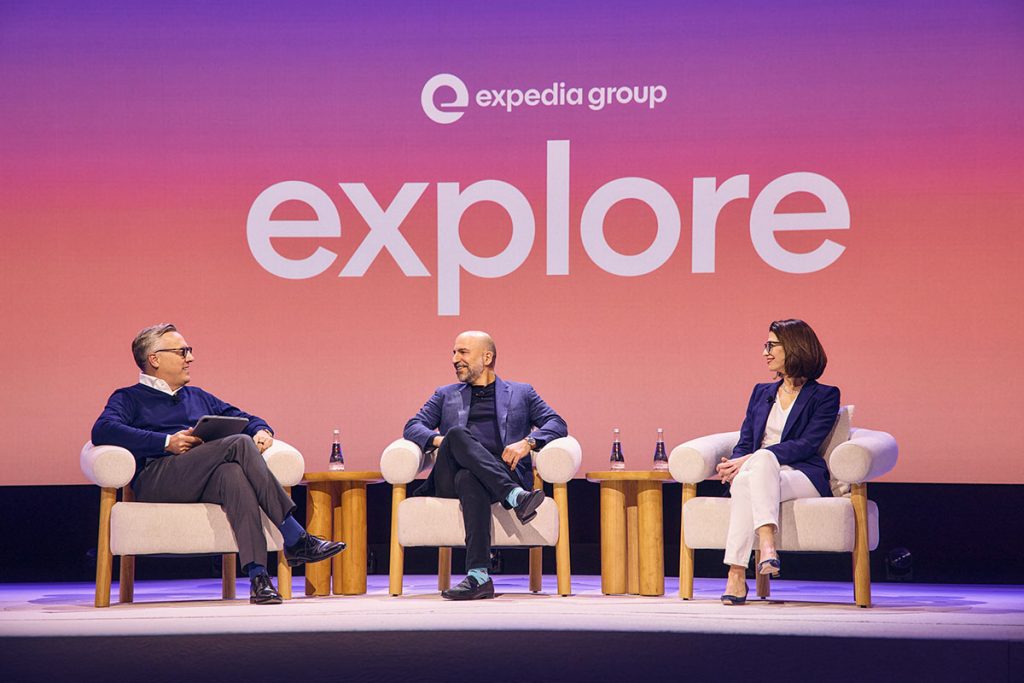
(From right) CEO Ariane Gorin, Former CEO and now Uber chief, Dara Khosrowshahi, Alfonso Paredes, Expedia’s President B2B and Chief Commercial Officer
On AI: The honest reckoning
AI was of course a clear theme threading through the conference, and it crept into the conversation.
In her opening address, Gorin had said, “We’re not using AI for the sake of AI. It’s about creating a world where every traveller has a smart, trusted guide in their pocket.”
She noted that traffic from AI-powered experiences currently represents less than 1.5% of Expedia’s total – “growing fast, but small” – while cautioning that under-investment at this moment would be a mistake regardless. “We don’t know how it’s going to play out. What we know is we need to experiment.”
Khosrowshahi was blunter still about where AI currently falls short on the consumer side. “For all of the promise, the consumer experience – other than going directly to ChatGPT or Claude – isn’t that great yet,” he said. “The magic of AI fundamentally changing the experience of booking travel or booking an Uber — we haven’t had that yet.”
At Uber, he said, voice booking has been introduced, and there are AI features that can identify a dish from a photo and assemble a delivery order from its ingredients. “But like eight people are using that stuff,” he admitted. “So it’s just not big yet.”
A telling story from Uber: Better to start from scratch than patch the past
Where both leaders expressed genuine excitement was on the enterprise side, specifically, AI-powered customer service. Khosrowshahi described a telling internal experiment at Uber: an initial attempt to have AI agents follow existing customer service policies produced poor results, because the policies themselves were a mess that human agents had always navigated intuitively. The breakthrough came when engineers changed the approach – instead of rules, they gave the AI agents a guiding principle: treat this customer well, and use your judgement.
“The early results have been extraordinary,” Khosrowshahi said. “These agents figure out context, how good a customer is, et cetera. It required us to throw away a bunch of stuff from the old days and completely rethink the process.”
His broader observation: “The power of AI to change how enterprises work is probably long-term under-hyped but it requires not automating 10% of what you do. You have to throw everything away and start from the ground up.”
Gorin echoed the point, adding a dimension specific to travel’s ecosystem nature: “If you’re a hotel partner or an airline, you’re trying to figure out the same thing. It’s often the same traveller. So as we each work on our own stack, how do we figure out together how to get to better traveller outcomes?”
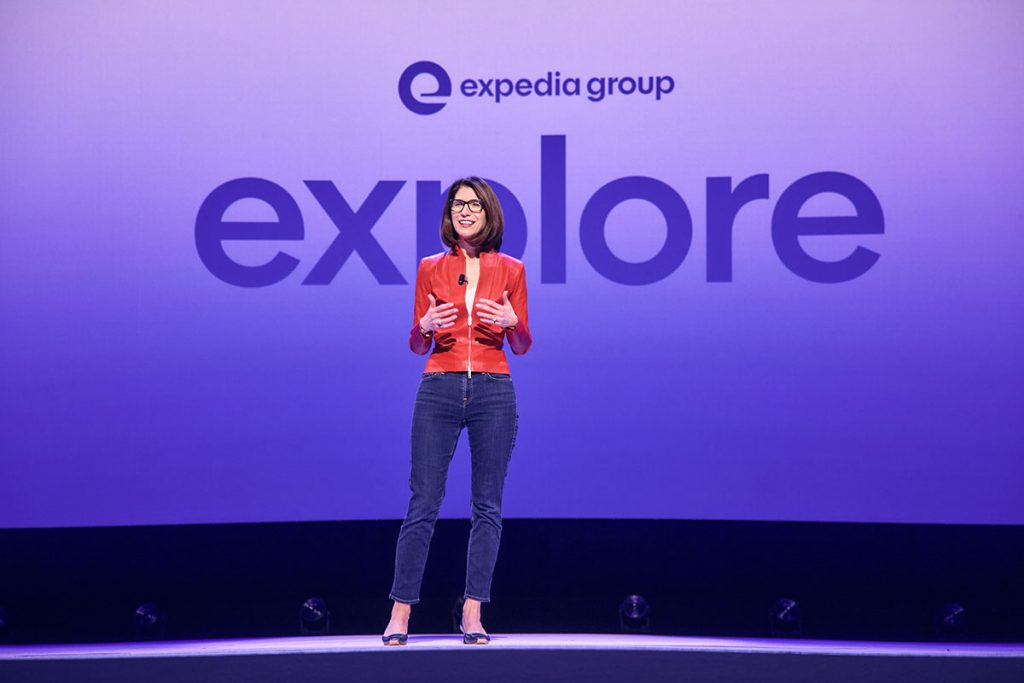
Ariane Gorin, “We’re not using AI for the sake of AI. It’s about creating a world where every traveller has a smart, trusted guide in their pocket.”
Trust, and the stakes of getting it wrong
Running through both leaders’ AI commentary was a consistent theme: trust. In travel, the consequences of a bad AI recommendation aren’t the same as a wrong Amazon delivery. “When something goes wrong on a trip, you never get that time back,” Gorin said. “That raises the bar for who travellers book with.”
She pushed back on the thesis that AI will disintermediate online travel agencies. Bundling and saving across multiple trip elements, she argued, is something “a long way away” from any LLM being able to replicate.
And she made a more human point: “People are happiest when they’re planning their trips. Sometimes they’re happier planning than they are on the trip itself. The idea that you’ll just delegate it – maybe for that weekly business trip, yes. But when you’re planning something that matters, you want to be part of it.”
Khosrowshahi, meanwhile, widened the lens to a societal concern. He noted that Google’s Eric Schmidt was recently booed at a graduation ceremony when he mentioned AI. “There’s a disconnect with society about what AI is going to do for regular people, not for companies,” he said. “I don’t know what the solution is but it’s a real trust problem.”
The big leadership question
In his final question to Gorin, Paredes asked Gorin what muscle she had to build fast that she wasn’t expecting, when she became CEO.
She responded, “It’s the ability to go in, identify where there are problems, find what’s getting blocked, and help the team unblock. You can have great strategy and set the culture but there can be blockages everywhere in the organisation. My job is to role-model: is something keeping us from moving fast? Is it organisational? Cultural? What is it? Fix it.”
It was, in its way, the same lesson Khosrowshahi had offered at the start: the enemy isn’t competition or disruption. It’s inertia – the temptation to hold onto the past and not run towards change.
Thirty years in, at what Gorin called “another inflection point”, the company that put travel on the internet, then in your pocket, is now asking what it means to put it in an AI agent, without losing the trust that took three decades to build.
That’s high table stakes indeed.