
Operators on ground say they are not seeing immediate impact however
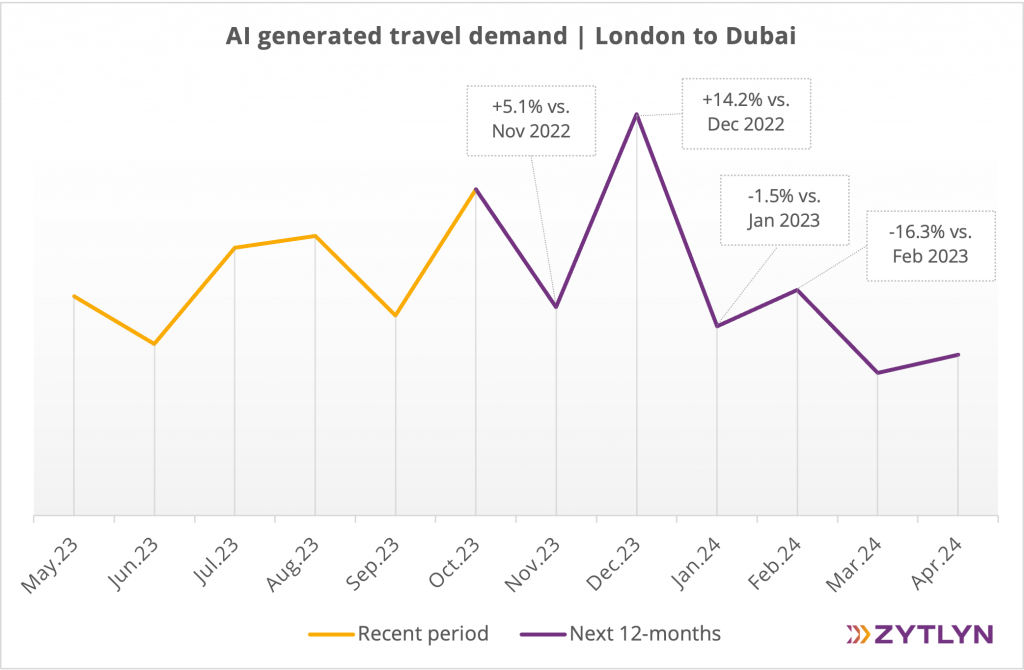
ZYTLYN Technologies, the travel prediction platform, says it is seeing a strong downward trend in the predictions of the next 12 months for travel demand to the Middle East region, generated by its AI platform.
Houman Goudarzi, whose startup was one of the finalists of the WiT/Phocuswright Global Startup Pitch 2023, was asked by WiT to predict what travel demand to the Middle East could look like in the coming months, in view of the ongoing Israel-Hamas conflict.
“We are seeing strong negative responses on some of the key routes into and out of the Middle East, for example the London-Dubai route is predicted by our AI platform to shrink (vs. same month previous year) by 1.5%, 16.3%, 39.3%, in January, February and March 2024 respectively.
“These are notable negative responses, as Dubai is usually a resilient destination considering its’ diversified inbound source markets. That said, this route is still predicted to stay above pre-pandemic levels in Q1 2024, with March 2024 predicted to be 12.3% above the same month in 2019.”
Added Goudarzi, “Unfortunately the following months in 2024 are predicted to shrink even further, while the Middle East outbound routes are predicted to shrink more than 50% higher than inbound markets. These predictions are generated by AI Machine Learning models trained with trillions of past and live aviation and travel data points used to train our AI platform, further complemented with a wide range of non-travel data points, such as macroeconomic factors, fixed and moving events, travel restrictions, health indicators to name a few. Our AI platform has a prediction accuracy track record of more than 95%.”
According to Juan Gomez, head of market intelligence, speaking at the Hotelbeds MarketHub Asia event last week in Bangkok, global outbound tickets slowed by 5% in the three weeks since Hamas’ attack on Israel on October 7.
In this Reuters article, published late October, Olivier Ponti, vice president of insights at ForwardKeys, said tickets to travel to Egypt decreased by 26% year-on-year, to Jordan by 49%, and to Lebanon by 74%.
Tickets for future trips to Israel dropped by 187% between October 7 and October 19 compared to the same period last year, the data showed. “Such a drastic reduction in travel demand is entirely anticipated, given the scale of the conflict and the ongoing humanitarian crisis,” Ponti was quoted.
Carlos Cendra from Mabrian, which offers data intelligence services for the travel industry, said, “We see a dramatic drop in the security perception in the destinations surrounding the conflict area. Jordan and Egypt have lost around 18% and 20% respectively in this score in the last four weeks, when compared to last year. But the effects are also evident in Saudi Arabia, losing around 4% in its security confidence index and even in the UAE, more than 2,000km away from the conflict area, we can see a security perception decrease. In such circumstances it is vital to understand the sensitivity of different markets towards the situation and set in place an efficient communication strategy in order to recover confidence as soon as possible.”
On the ground though, in the UAE and Saudi Arabia, operators contacted by WiT say they are not seeing much impact.
Stuart Crighton, CEO of Cleartrip, said, “We are seeing nothing unusual at the moment in terms of traffic or transactions out of core markets. This is peak time for the region and when you add in marquee events like COP 28, Riyadh Season and Dubai shopping festival, it keeps prices and occupancy at the high end and that is what we are seeing.
“Carrying this forward into Q1 24 is more a continuation of the same. In the same context Cairo has also been experiencing very high occupancy. This is partly seasonal but also a high influx of the world’s media are basing themselves there. There may be some impact (largely driven by duty of care policies) but that is not really our focus and leisure is masking any potential impact at this stage.”
Added Ross Veitch, CEO and co-founder of Wego, “Wego’s business is mainly MENA outbound and intra-MENA. Wego’s bookings, searches and revenue are all +50% YoY and about 20% about 2019 levels. People who live in the Middle East are travelling as per usual.”
Muzzammil Ahussain, CEO of Almosafer, said, “Almosafer has been witnessing sustained demand for inbound and outbound travel, and visitor arrivals remain steady as before. The significance of pilgrimage and spiritual journeys in the region is particularly evident in the rising demand for religious travel.”