
I first met Greg Schulze, the outgoing chief commercial officer of Expedia Group, over kaya toast in Singapore.
That detail matters, not because of the toast, though it is, objectively, one of the great breakfast foods of the world, but because it was the beginning of what would become one of my favourite relationships in this industry. (See interview then)
And now, 21 years after he first walked through Expedia’s doors, Greg is walking out – end of May is his last day, and this year’s Explore event in Las Vegas where we did this interview is his 20th.
Which is why, when I told him about WiT Singapore’s theme this year, “21: A New Beginning”, which we will mark on September 30-October 2, and watched his face register the coincidence, we both laughed at life’s impeccable timing and sense of humour.
Take away 21 from 2026 and you’ll realise that Schulze joined Expedia when most of us were still figuring out whether we trusted the internet with our credit cards. He helped build it into a company that, by his own quiet calculation, booked more than a trillion dollars in gross bookings over his tenure.
We had to say that a few times to let that number sink in. He seemed a little surprised himself.
But here’s the thing about Schulze that you understand only when you spend time with him – the number isn’t really the point. What he’s proudest of isn’t the scale. It’s how he got there. “I’m confident that Expedia was changed by what I brought every day,” he told me, carefully sidestepping the word “legacy” because “that sounds arrogant”.
He’s more about impact, personally and professionally, and that is what has guided his career from a manufacturing job in a factory to a data analytics role in Expedia – and which landed him clearly in an industry he loves to bits, not just for the life it’s given him and his family, but for the jobs it has created – one in nine jobs are created by travel, he says – and the good it does for the world.
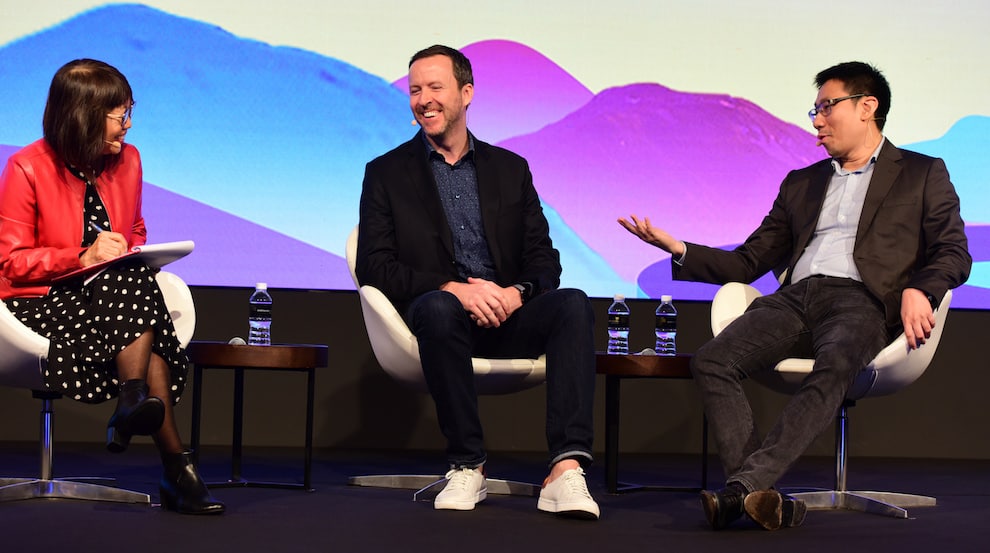
Greg Schulze and Traveloka’s CFO Henry Hendrawan speaking at WiT 2018
The ability to read a spreadsheet and a room
He started in analytics, supporting commercial negotiations, using the tools he had – rigour, data, an engineer’s mind for constraints and optimisation – and then something clicked. He discovered he could read a room – human emotions and dynamics – as well as a spreadsheet.
That the best deal wasn’t the one where you negotiated hardest, but where everyone walked away feeling like they’d won. He moved into commercial, led air partnerships, and spent the next two decades scaling that instinct across a global business.
The early airline negotiations, he told me, were the crucible – contentious, emotional, publicly combative. “I realised that the combination of my understanding of revenue management and belief in the power of relationships and understanding people allowed us to work through really difficult negotiations that were quite emotional and publicly combative,” he said, adding with quiet satisfaction, “and then to have remained friends with these partners all these years.”
Travel at the edge of something
He’s leaving at a moment that, as he acknowledges, feels a little like standing at the edge of something. The travel industry is navigating its most significant inflection point since mobile which “fundamentally changed the model, and it wasn’t just about a shift of where bookings happened, but it was really a change of customer expectations”.
“I believe AI is of the same magnitude or bigger, partly because of the computing power, and the velocity of development, but also this change in customer expectations, reshaping how all of us search and plan, and moving from lists and clicks to conversations and eventually to agent-led bookings and servicing.”
Then there’s the blurring of B2B and B2C – with airlines, banks and loyalty becoming significant travel distributors themselves – as well as experience-led travel especially people travelling for events and festivals. This, he argued, is not a fad but a permanent state of being.
Sports tourism alone now accounts for 10% of all travel spend. And yet, as Schulze pointed out with the pragmatism of someone who has survived 9/11, the 2008 financial crash, the rise of mobile, and a global pandemic: “At the core, people are still travelling and still looking to connect with people and places around the world.”
Planes are still full. The world may be ending, but apparently, we’re all flying to see it happen in person.
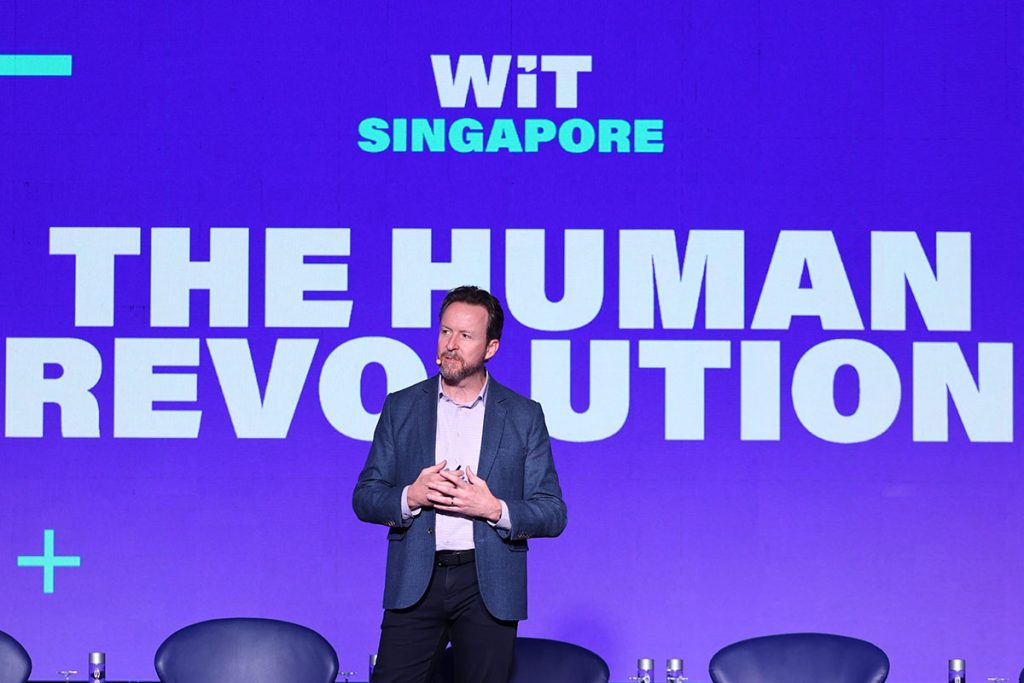
Greg Schulze headlining a session at WiT Singapore: Human Revolution in 2023
The meaning of identity
What struck me most in our conversation was how Greg has thought about identity – the thing so many of us wrestle with after decades inside one organisation. His identity, he insists, was never Expedia. It was shaped by Expedia, enriched by it, stretched by it, but it was always his.
“All of us are replaceable,” he said. “This is a business that will continue past me. And yet the relationships that we have, the experiences that we have, are important parts of our lives.” He leaves, he says, with pure gratitude.
His time in Singapore, by his own reckoning, was the highlight of his career. And the most unexpected part of it? The ending. Covid arriving like a full stop mid-sentence, his son graduating high school in a virtual ceremony, and a sudden departure that nobody had planned for.
“It was quite surreal,” he said. But then came the recovery and with it, a reminder that travel isn’t just resilient, it’s essential.
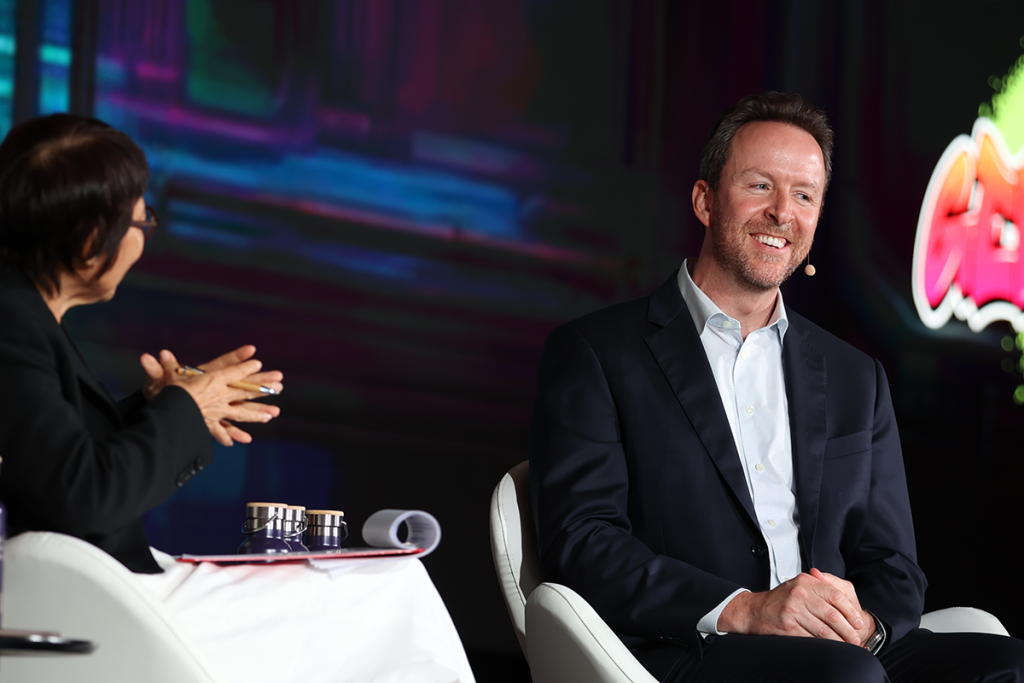
Greg Schulze discussing industry trends during WiT Singapore: Next Generation (2024) – he was recognised as one of our WiT Warriors last year, marking our 20th anniversary.
The meaning of being 21
Which brings me back to 21. At WiT Singapore, our theme this year isn’t just a number. It’s a feeling. Twenty-one is the age of liberation. You’ve got the keys. The world is open. You don’t quite know what you’re doing with it yet, and that’s precisely the point.
When I asked Greg what he was doing at 21, he laughed. He was studying engineering, working in a factory, about to meet the woman he would marry. “It felt like,” he said, reaching for the words, “the beginning of who knows what. And I felt entirely open, ready.”
He is, once again, entirely open and ready. He remains on Traveloka’s board, staying connected to an Asia he clearly loves and believes in. It was for his contribution to elevating Asia on the global stage as well as the industry at large that WiT recognized him as one of WiT Warriors last year on our 20th anniversary
He’s also thinking about two or three board seats where he can bring that rare combination of analytical depth and human instinct to bear at a critical moment for this industry. Plus, his daughter graduating college – it feels like life opening into its next chapter.
I asked Greg what he’d say to his 21-year-old self. He thought about it, and said: “Go work in travel, and travel. And be the person at work that you want to be in life.”