By Timothy O’Neil-Dunne, 777 Partners and Henry Harteveldt, Atmosphere Research Group
Unprecedented. Extraordinary. Incomprehensible. Ultra-Complex. Unrivalled. Sobering. We have exhausted the superlatives when it comes to describing, Covid-19, and its impact on the global travel industry.

So, what does the travel industry need? In short, a comprehensive, pragmatic, multi-layered, and adaptable health screening programme optimised for travellers and travel industry workers, especially airport and airline staff and airline passengers. Leaving the probability of a “spreader” on a flight is unacceptable. Thus, the SFP is a comprehensive system is designed to create a secure health ring around the air transportation system and eradicate the possibility of a person with Covid from entering an airport – let alone an aircraft – and potentially risk infecting others. What we need is to get behind a common set of principles and build momentum from there.
Overview
The economic devastation to the industry stemming from the virus has dwarfed anything seen in previous economic downturns including after 9/11/2001. Though industry trade groups have proposed recommendations none are comprehensive enough, ignoring that travellers use multiple travel services in the course of a journey. At travel’s heart sits the air transportation system. It drives most international travel and significant amounts of medium- and long-haul domestic or regional travel. Currently it is down 92%. Business travel is also down by a similar amount.
The industry faces three challenges it must take responsibility for:
- A) Ensuring the safety of its passengers and workers.
- B) Ensuring the impact of its operations is not negative on the communities it seeks to serve.
- C) Operating at positive economic rate.
There is only one way for the air transport industry to achieve these objectives: Developing a globally-accepted Safe Flying Protocol (SFP). This is not a trivial exercise. Getting consensus in the short term will be impossible. Setting a model through examples of Green Lanes (or Bubbles, Corridors, Bridges etc.) is practical and achievable. But we need speed and adoption.
An Overview Of The “Safe Flying Protocol”
The Safe Flying Protocol is straight forward. It consist of multiple elements. The key ones include:
- Health state level for each journey stage (A traffic light or level system)
- Travel bridges, corridors and bubbles for agreed inter-country arrangements
- Identification and level-setting of everyone entering the air transport system
- A “ring fence” for outbound, inbound, and connecting travellers and airline/airport staff
- A verifiable testing programme for travellers
- Health passports depending on the health stage of the origin community and airport
SFP can be easily implemented as existing functions of security and health exist. But they need to be enhanced and updated for Covid-19.
The Health State
SFP recommends the familiar, intuitive “traffic light” tiers of Green, Yellow, and Red to determine a person’s ability to work at the airport and, in for crew and passengers, to travel. Briefly:
- Green: A person has no detectable trace of the virus and can prove he or she has been vaccinated within the acceptable time guidelines. People with Green status will be allowed to work at the airport and, for crew and passengers, board the aircraft.
- Yellow: A person who has not detectable trace of the virus but requires a Covid test to confirm their health status.
- Red: A person who shows detectable traces of the virus, refuses to be tested, and refuses to be vaccinated.
NOTE: From a practical and expedient point of view Level 2 will likely be split into 2. Yellow and Orange. This is what has been already implemented elsewhere but is always subjective. The right of self-determination of the location remains. Thus, any country can (as they do today) arbitrarily determine that the risks to their inbound activity can be changed and mandatory testing and if necessary degrees of quarantine as it so determines.
The SFP will provide a consistent protocol to use at any airport. It will enable the development of interim travel “bridges” and “bubbles” until public health authorities deem Covid no longer poses a threat to public health in their specific jurisdiction. Its purpose is to build a “ring fence” for all airport and airline workers and all passenger outbound, inbound, and connecting crew and passengers. The SFP’s component will include:
- A scaled and easily comprehensible “health state traffic lights” at the start, end, and intermediary stops of the journey in all directions.
- Certifiable clean airports.
- Identification and level-setting of everyone entering the air transport system.
- Mandatory contact tracing for all airline and airport workers and passengers.
- A proven certification programme for individuals to be exempt (either proven immune or use of a verifiable, approved vaccine). Within this will be testing before arrival at the airport for passengers, crew and airport workers.
The SFP’s layers are intended to provide full verifiable protection of the air transport system on a real-time, dynamic basis. Its objective is to ensure passengers’ and airport and airline workers’ safety. At its core is a passenger who needs a Health Passport, a portable tool such as mobile app tool designed with the air transport industry at its core, which will capture an individual’s relevant health data as it relates to air travel. Critically, the SFP is designed so that any airport, anywhere, can create a safe “in,” “out” and “transit” (connecting) environment. This is a critical aspect to ensuring each airport (or part thereof), once certified, is a safe node both for its local community and within the larger air transport network.
Examination Of The Safe Flying Protocol

The Safe Flying Protocol has six foundational requirements. It must:
- Be secure.
- Incorporate universal, consistent, and mandatory identification and testing for all airline and airport workers, and for every traveller.
- Be cost-effective.
- Be constant and permanent.
- Incorporate agile and active management.
- Involve minimal disruption to an airport’s day-to-day operations, infrastructure, management, and budget.
At The Airport
The airport experience will be dramatically different.

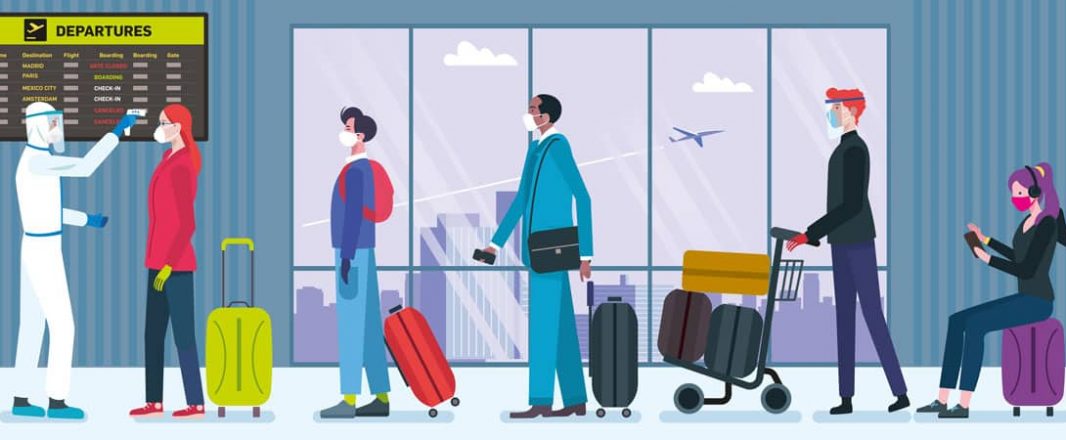
To minimise wait times and the room needed for a waiting area, it will be critical to use virus tests that can produce results within 30-45 minutes. While waiting for their test results, people will be sequestered in a secure waiting area. This represents a challenge but is practical and possible in most airport scenarios. Once better faster testing is made available then that can reduce this time and complexity.
On the aircraft

For the economic viability of the airline industry, the number of passengers on a flight must be as full as possible. The “as possible” means that if the passengers, crew and aircraft can be assumed to be safe then normal use of the aircraft as an economic asset must be the norm.
Once vaccines and mitigating therapies are developed, and there will be many, the Safe Flying Protocol must recognize that different standards can emerge and will apply. Again, the right of self-determination will apply and a country can choose to accept or not the vaccine of the remote country as being sufficient to permit bypassing the full security protocols.
At the heart of SFP is the ability to have the Air Transport System be safe for passengers, crews and their communities. Permitting only safe “Green” passengers, stops the spread of the disease and will be a major boost to global trade. We cannot afford not to do it. Getting started on a practical test in a verifiable sandbox is an urgent essential first step.
Authors:
HENRY HARTEVELDT, Founder, Atmosphere Research Group: Travel industry and consumer analyst, researcher and co-founder of Atmosphere Research Group, Henry Harteveldt is a travel industry thought leader, and companies of every stripe know that briefing him on the latest product or trend and getting his feedback is a mandatory item on their to-do lists.
TIMOTHY O’NEIL-DUNNE, Principal, 777 Partners: O’Neil-Dunne is an industry veteran with deep roots across the industry spectrum from ad agency to retail, GDS and airlines. He is a frequent contributor to WIT and has been present at every WIT Global event. He holds several patents in the airline and travel space. Currently he is part of 777 Partners a diversified holding company based in Miami.
• Featured image credit: Jesussanz/Getty Images