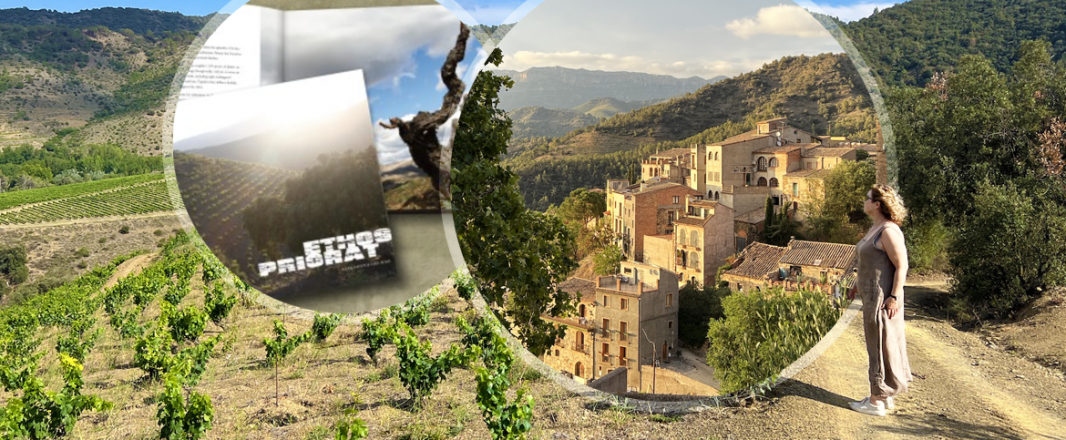
To be honest (and I’ve always been told to be wary of people who start their sentences with those three words but in this case, it’s sincere), I had never heard of Priorat until, well, this year when I started planning for my Catalonia holiday.
I had asked ChatGPT to recommend the top three destinations if “I love to trek and I love food”, and it suggested Spain, Japan and New Zealand. Given I was headed to Phocuswright Europe, Barcelona, it seemed a good opportunity to do the Catalonia Grand Tour or parts of it. The notion had captured my imagination when the Catalonia Tourism Board unveiled this new campaign at an industry event late last year.
I guess, not being a wine connoisseur, I can be forgiven for not having heard of the Priorat. It is a tiny but important wine-growing region, southwest of Barcelona and its red wines came to international attention in the 1990s. But other than the wines, I had read of its fabulous landscapes, its mountains and valleys and ancient towns and villages.
It seemed the perfect place to head to, after a couple of days by the sea in Costa Brava and Girona. (See Letter from Girona)
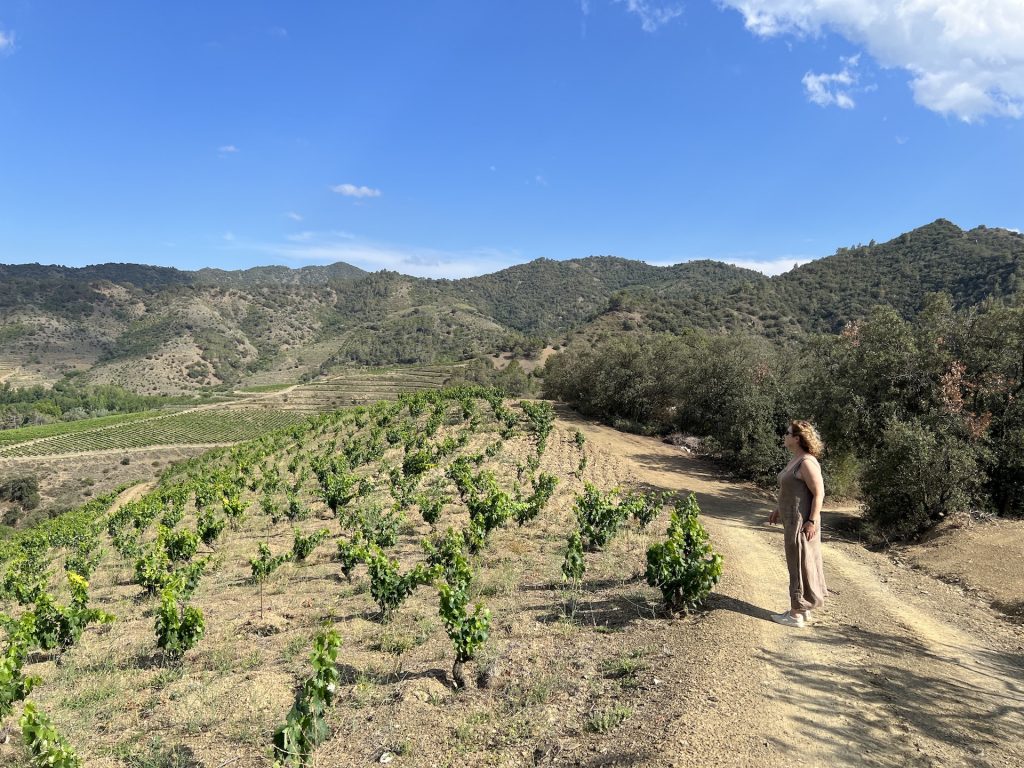
Elizabeth Hecker, author of “Ethos Priorat”, listening to the vines.
There was also another attraction – I happened to have an American friend living there, in a little village at the centre of the Priorat, population 134 humans though it looked more like 20. For someone like me, living in an urban, dense city, it’s hard to conceive of life in a village with so few people. I did meet some cat and a couple of dogs though.
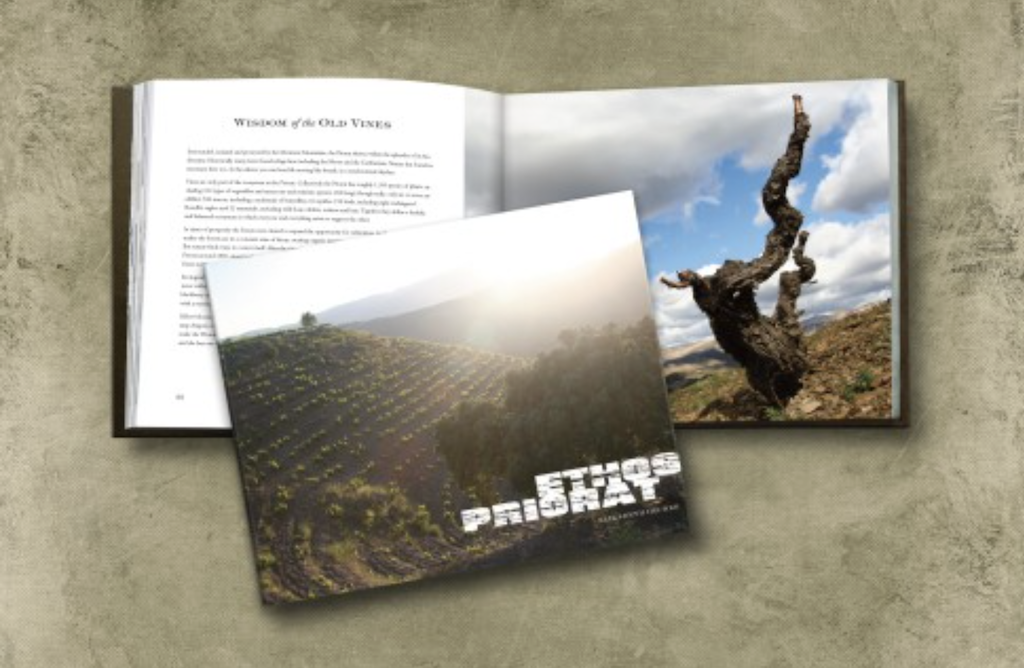
And Elizabeth Hecker isn’t just any person living there. She’s the author of “Ethos Priorat”, a book about the region published by Academie du Vin Library this year. It was a labour of love over 15 years, inspired by “time spent alone in the vineyard, the spirit of the people and memories shared by the elders”.
I am always fascinated by stories of people like Elizabeth, who leave an old life behind to start a new one in a foreign land, as far from familiarity as conceivable – perhaps because I wished I had the courage to do so myself.
Elizabeth worked as a designer/storyteller with wineries in Sonoma and Napa Valley, California. Her dream was to go beyond domestic wines and dive deep into different regions of the world. In 2003 she tasted a wine from the Priorat and it revealed a landscape in her head unlike anything she had seen before. She began visiting the region and some years later, bought a 200-year-old house and restored it.
For her book, she talked with the winemakers and elders of the region, spending time in the vineyards of each village, season after season. She took all the photography for the book including the landscape, the people and the process of grapes becoming wine, vineyard to bottle. “People came to recognise my little grey Peugeot out in the middle of the vineyards,” she said. “When the book was finally finished, it was so gratifying to see their faces when they recognised their land expressed in such vivid detail.”
So as you can tell, I was in extremely good hands – which I was grateful for during the drive from Cadeques to the Priorat because the road up and around the mountains of the province are narrow, steep and winding, and Elizabeth is as good a driver as she is with wines and food.
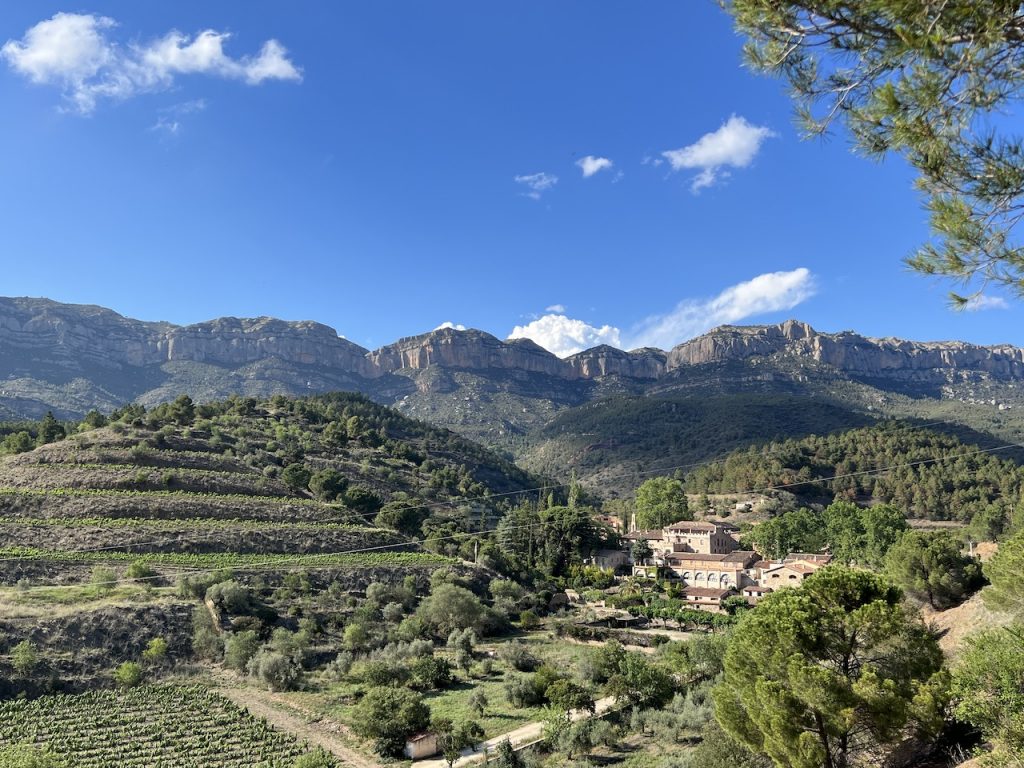
The Priorat – narrow, steep, winding roads leading to isolated villages.
I did wonder about drink driving laws in the area – I mean, what happens after you’ve done lots of wine tasting and feasting and there’s certainly no Uber on call here – but thought that’s too prosaic a topic for a place as grandiose as the Priorat where you hardly see any people, and you see only hills and trees until, at some point, you come across an isolated village on top of a hill.
Drive into any village and you come across people just sitting around, having a coffee or a glass of wine, talking and killing time. In cities, time kills us. In these Catalan villages, there’s lots of time to kill and what better way to do it than spend time with friends, chatting instead of looking down at our mobile devices.
In the village of Scala Dei, we met Neus Miro, whose family grows the olives for their own olive oil sold in the village shop. She spoke no English but welcomed us with a huge smile and warm embrace saying something like – “any friend of Elizabeth is a friend of mine” – and invited us to sample her olive oil and cakes. They tasted so good, I walked out with a couple of bags of goodies.
We popped into the Herbarium Scala Dei, which makes natural ointments and treatments for general health and well-being. It felt a bit like going into a TCM (Traditional Chinese Medicine) store except it smelled better. Their remedies are made from natural plants which they gather from the surrounding landscape. I also walked out with a couple of bags of ointments, which will hopefully keep me hale and hearty for the rest of the year.
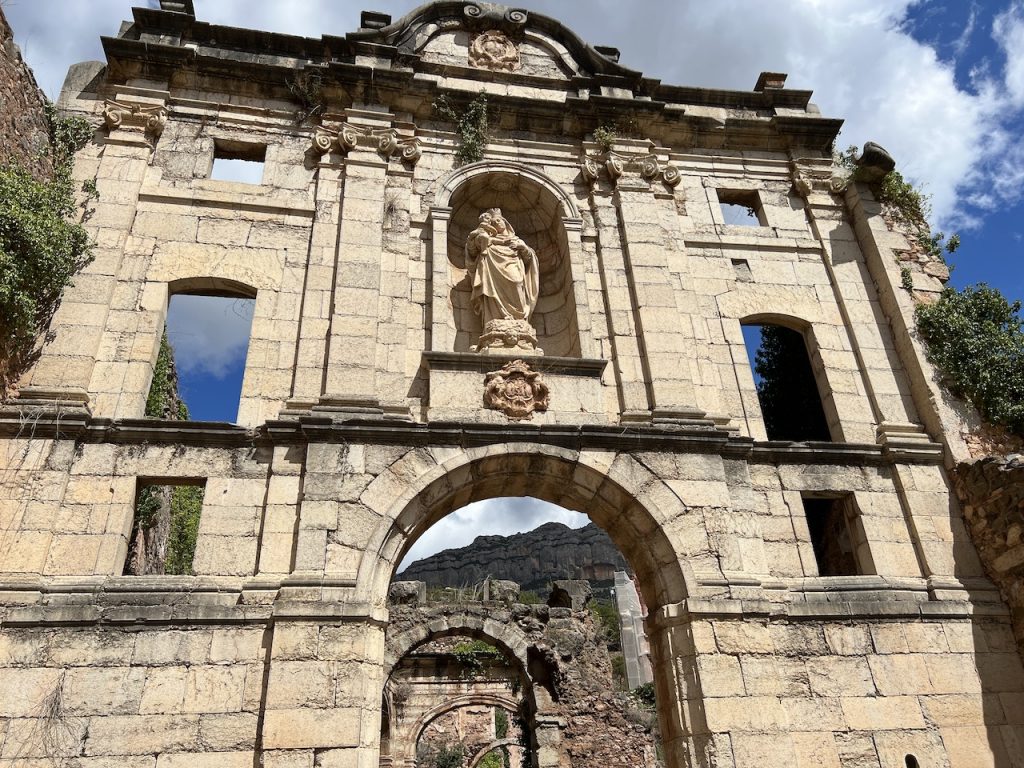
Scala Dei Monastery: Its presence defines the Priorat.
A visit to the Scala Dei Monastery in the north of the region is obligatory because their presence defined what is now known as the Priorat. Carthusian monks were invited from France in the 12th century to Christianise the region after a long occupation by the Muslim Moors. Folklore tells of a story of a shepherd who saw angels descending a ladder to heaven (Scala Dei means ladder of God). Over six centuries their dominion grew but near the end, so did anti-clerical sentiment. Finally they were forced to leave in 1835 leaving the monastery sacked and in ruin. But the government is hard at work renovating it back to its former glory.
I took in this story and imagined the evolution of life here, and the subsequent destruction, as I walked among the ruins. For some reason, the movie “Of Gods And Men” came to mind.
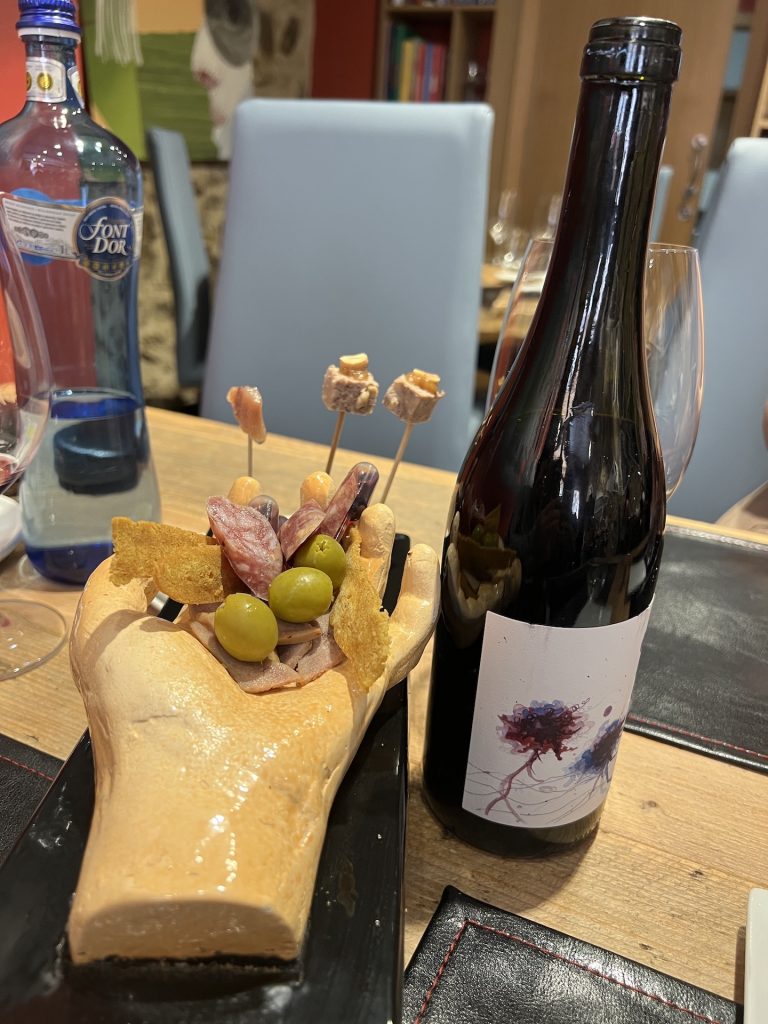
Brots, Poboleda: The mold of chef Pieter Truyts’ hand and the wine made by his wife.
Our next stop was Poboleda, which the Carthusians occupied when they first arrived in the region approximately 1194. They lived there while waiting for Scala Dei to be built. The village church still shows the faded stencil work from its glorious past.
And I cannot not mention the food – Elizabeth had booked us into Brots, a local restaurant whose chef and owner Pieter Truyts has gained gained quite a reputation for his food as well as the creative presentation. For example, appetisers are served in a mold of a hand and when we asked him whose hand, he puts his next to the mold – an exact replica. Easily one of the best meals we had in Catalonia and oh yes, his wife is the winemaker. The name of her wine is El Numeros Vermella (red numbers as in when you open a winery, you’re never in the black). You can tell this couple has a healthy sense of humour.
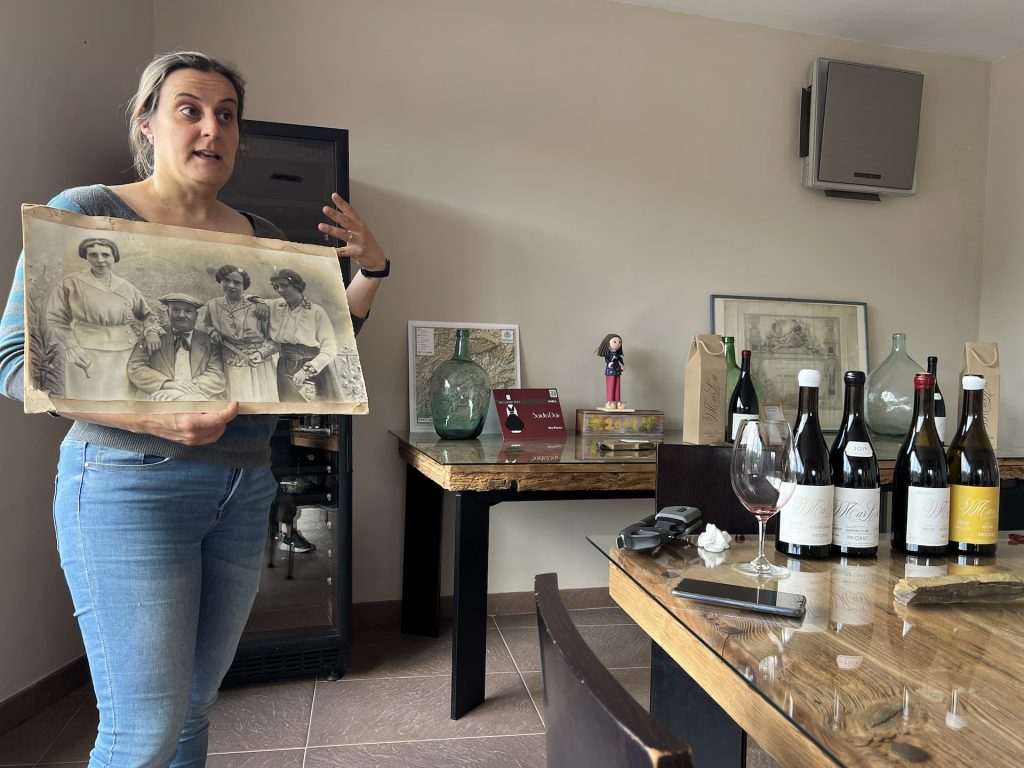
Sandra Doix Mora sharing the story of the women in her family, who were all winemakers.
I also learnt that the Priorat has its share of women wine makers. In Poboleda, we also visited a winemaker, Sandra Doix Mora. She is a fifth generation Poboledan who began her own wine label three years ago called “Marla”, the combination of the names of her two daughters, Martina and Laia. As she showed us her wine cellar, her daughters were running around as though it was their playground – which it is. “I want them to feel this is their home,” said Sandra, “and they can be comfortable working, playing, living here.” As her grandparents and parents did for her.
Suffice to say, we also walked out with a couple of bottles of “Marla”, autographed by Sandra, of course. One remains in my fridge, being saved for a special occasion.
I also met Marta Rovira Carbonell of the Mas d’en Gil estate at the southern end of the Priorat. The vineyards have been cared for by three families over the last 150 years. It is a family project but Marta, the youngest daughter of the current family, introduced biodynamic farming methods, is the winemaker and runs the entire effort, from vineyard to international sales.
You can read more about Sandra, Marta and other winemakers of the Priorat on TerroirTalking.com, Elizabeth Hecker’s website.
Having met these women, and I know I have barely scratched the surface of Priorat, I can understand what drew a woman like Elizabeth to the region and her compulsion to tell the stories of these incredible people who breathe life and soul into this land. She believes that “if you listen, the wine is talking”. We just need a little coaxing to hear it.
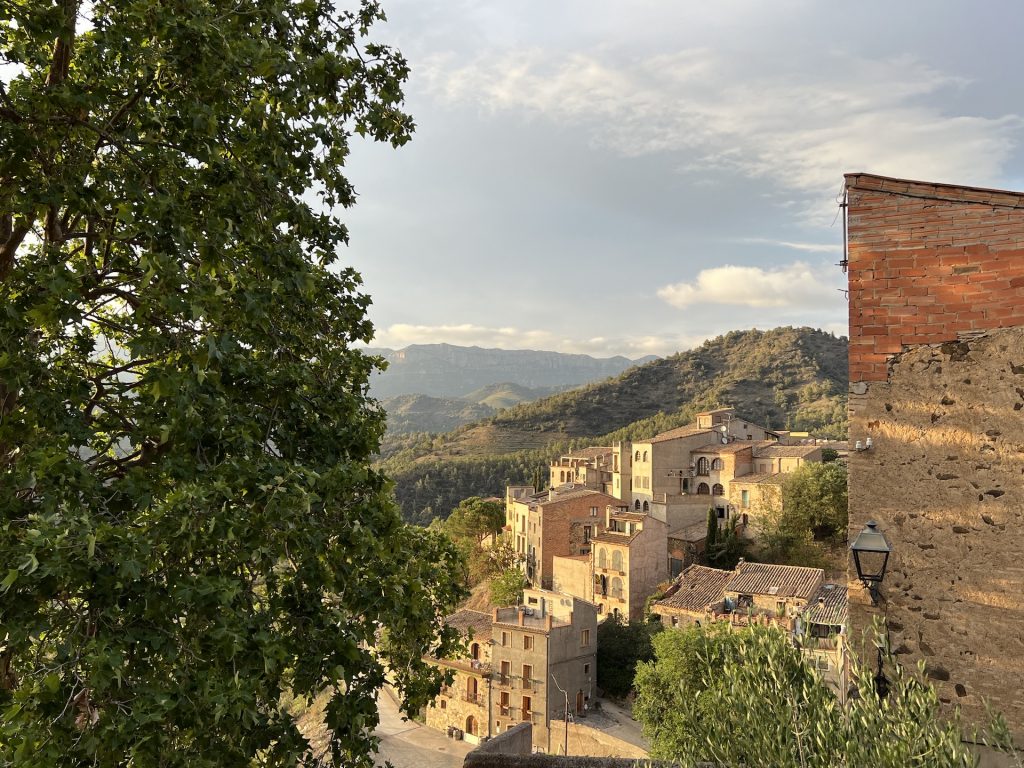
The view from Elizabeth’s house – full of silent moments.
Most of the times though, the Priorat is full of silent moments. The silence of the hills. The quiet of the villages. The serenity of the land. And you can understand why the Carthusian monks were drawn to the area all those centuries ago.
The only time the silence is broken in Elizabeth’s village is every 15 minutes when the church bell rings because in the olden days, time was told in quarters of an hour. Now with digital phones, it is not as necessary but apparently no one can figure out how to stop it and, in any case, the silence drowns it out after a while.
Listen, the Priorat is calling. Time to plan my next trip.