
Travelport Live in Sydney kicked off with two female “robot” dancers wearing suits that were more lit up than a Christmas tree, their robot-like movements a hint of where the discussions at the one-and-a-half day conference would be heading.

Futurist Ross Dawson opened with a broadstroke talk of a world in which robots and AI would rule and change management expert Malcolm McQueen closed with advice on how to bullet-proof your business in turbulent times as he painted a scenario of disappearing jobs, driverless cars and “unconventional competition”.
In between the two futures, the more than 350 travel agents, airlines and hotels attending the annual customer event grappled with how to cope with all the changes as Travelport executives shared their ideas on how the company was “Transforming the travel experience through technology”.
For its part, Travelport is saying goodbye to the GDS label and transforming itself into a platform whose goal is to deliver a personalised retail experience for its customers – a simple goal but highly complex to deliver as its enterprise architect, Centre of Excellence, Monty Doshi outlined the steps to get there.
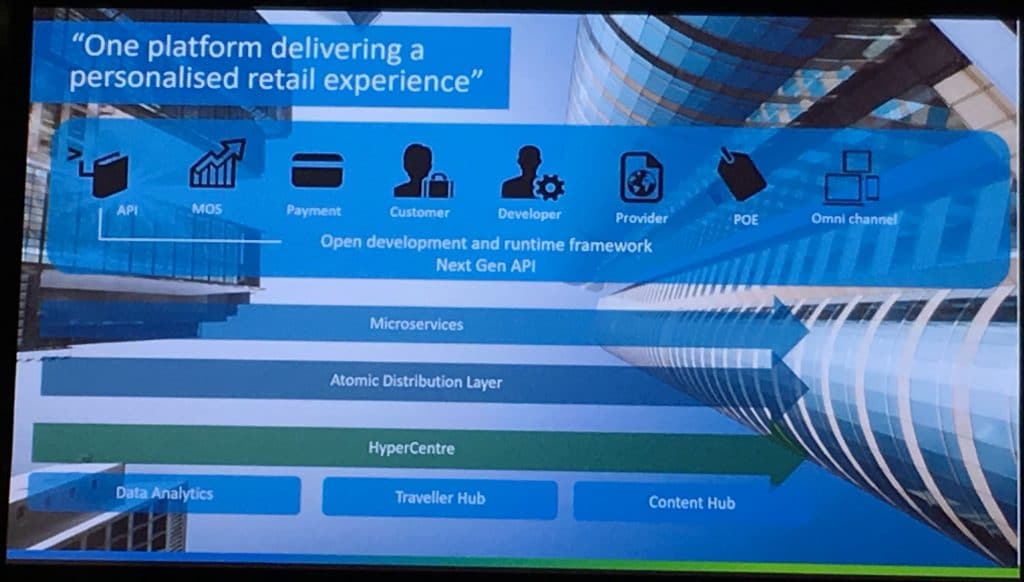
One area it is investing in is deep learning and predictive analytics to help its customers predict their customer behavior in turn, as well as help them capture more of the travel market as customers move online and, in Asia, to “mobile which is already yesterday”, as Blanca Menchaca, co-founder of BeMyGuest, said on one of the panels.
It is clear that AI and chatbots are the latest buzzwords preoccupying the industry and just as when mobile first appeared on the map and everyone wondered what to do about it, so is it happening now with the two related forces of chatbots and artificial intelligence. And just as with mobile, there is no doubt there will be winners and losers – except with each new tech wave, it happens faster and the divide between winners and losers or rather, big and small, will get even wider.
Both technologies need significant scale, resource, technical capabilities and investment for them to truly deliver on their full promise and it is hard to see how smaller companies can get on the bandwagon. As Steve Hafner, co-founder of KAYAK, noted at WIT last October, “Rise of AI is top thing that happened and that mattered in 2016. It’s getting even tougher to be a travel startup or to afford innovation. You simply need too many developers, on too many platforms, with access to too much data, to make a difference.”
The rise of chatbots is linked to the rise in messaging which is getting huger by the minute and guess which companies own those platforms? The big. Paul McCrory, head of industry vertical for Facebook, said that in the last four months, the number of messages on Messaging has grown from 800m to 2b a month. And sharing research, he said that 59% of people are more likely to transact with organisations they can message. “Forty nine percent of people prefer to message than talk on a phone. Nobody wants to phone anyone anymore – there’s the boring process of identification. Live chat is better but it’s not great because the history is lost. With messaging, the ID is there as well as the thread.”
He cited Qantas and KLM as two airlines that have made good use of the Facebook Messaging platform, and added this was a golden opportunity for hotels, for instance, to start a messaging feature to advise guests on what to do during their stay.
In Indonesia, Caesar Indra, senior vice president and business development, Traveloka said that the company, when it noticed a trend of customers checking flights and then starting chat groups on the Facebook-owned Whatspp, the predominant chat platform in Indonesia, to discuss plans, added a social messaging feature to its flight search. In Indonesia, of the 60% of travel bookings that are made online, 71% are on mobile, and Indra said consumers have higher expectations of what can be done on mobile and companies have to keep meeting those expectations.
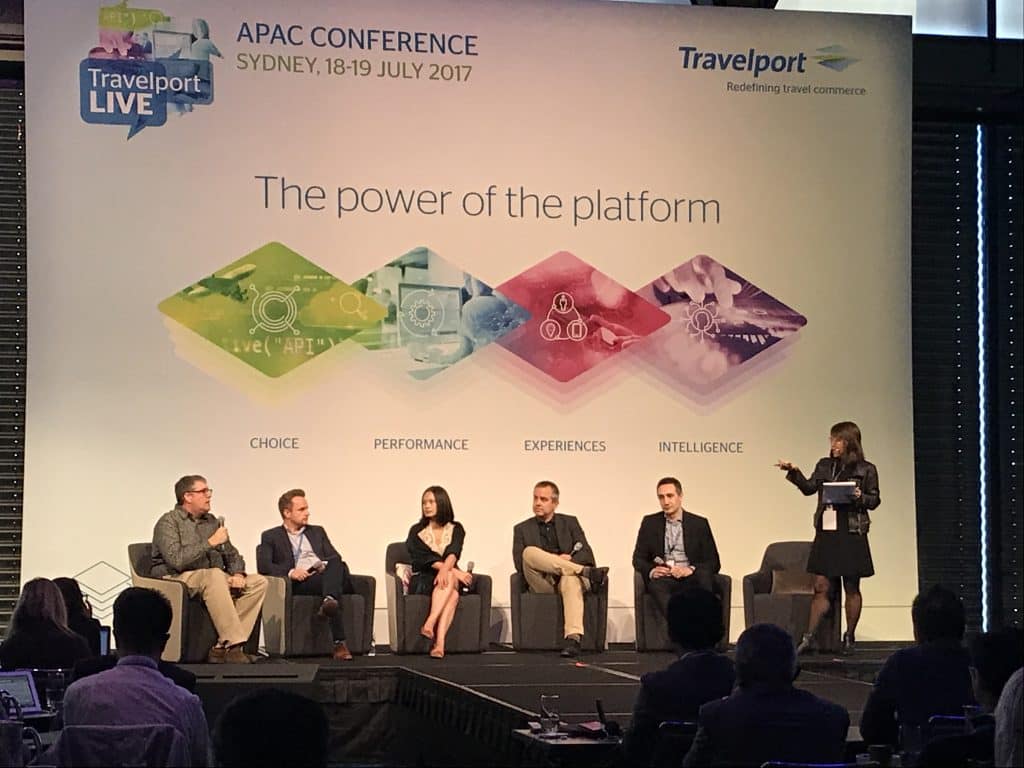
The AI and chatbot panel, from left, Gary Theis, Zumata; Paul McCrory, Facebook; Akemi Tsunagawa, Bespoke; Kurt Knackstedt, Troovo; Ross Fastuca, Locomote
On the AI and chatbot panel, Kurt Knackstedt, CEO of Troovo, said there would be continued shifting of booking away from browser-based interfaces and eventual elimination of manual processing of any part of the travel transaction. “The question we have to ask is, if bots take away 60% of our tasks, what are we going to do with that freed up time?” he asked.
Mezi’s CEO and co-founder Swapnil Shinde has been quoted as saying that its AI-powered chatbot is capable of automating more than 60% of the conversations initiated by travellers and then gathering availability, curating recommendations, and making reservations at the request of the traveller with limited human intervention.
Ross Fastuca of Travelport Locomote, which powers corporate travel, believes the new technologies have power to take away pain points in the business segment and as a business executive himself, virtual assistants are already freeing up time for him personally.
Akemi Tsunagawa, founder and CEO of Bespoke Inc, claiming to be Japan’s first AI-powered chatbot for travel and offering concierge chat services for hotels, expressed the concern that “everyone is going after chatbot but most of the time those aren’t done properly” and that this would lead to disenchantment among consumers.
Currently, the biggest use, most agreed, was in the area of customer service and freeing up of human intervention so that bots can deal with the simpler questions. Speaking to a chain hotelier on the sidelines, he told me they were investigating how to use these new technologies to cut down on call centre costs and offer a more efficient and consistent experience through machine learning. Yes, machines are definitely more consistent than humans.
Gary Theis, CTO of Zumata, agreed an AI/chatbot strategy would require significant investment and technical capability and said it was best for smaller companies to focus on a small subset of customers and data. “Take small steps and iterate.”
Tsunagawa said one key challenge was that it was unlikely customers would book trips, activities or restaurants over a certain price on chatbots and from what she’s seen with her own business, founded in 2015, the demand seems to more for customer service than transactions at this stage. So again the vicious cycle – how much do you invest in something that will not result in immediate returns financially?
Knackstedt said for agents, it was an opportunity to redefine what makes them valuable and relevant. So what are the other opportunities for travel suppliers? This is the list the panel came up with.
- Becoming “curators” of travel knowledge, content and services to guide travellers to great journeys
- Let robots to do what they do well and free agents to reinvent themselves
- Automation of conversations
- Both a revenue driver & a cost saver
- Cross-selling activities and transportation during trips
- Customer support post booking
Facebook’s McCrory however cautioned that “AI and conversational bullets are not a silver bullet” and companies should only invest in it if they had a particular pain point to solve. “Don’t go chasing after it just because it is the newest thing, there are other things to get right first.”
Like mobile – from the discussions around me, it was clear most have still to get mobile right and it is critical that happens before they can even think of layering on AI or adding chatbots.
So how do you bulletproof your business in turbulent times? Back to change management expert McQueen who gave three rules at the closing of the event.
- Dig the well before you get thirsty – don’t let your groove become a rut
- Focus on friction – figure out what are the things that irritate your customers and fix them because friction is where disruptors get a foothold
- Foster healthy paranoia – in other words, don’t be complacent
So it seems that even as we move to a world of chatbots, AI-powered robots, and deep learning, age-old principles and human common sense still apply. And oh yes, what are we going to do with all that 60% free time? Travel, I hope.