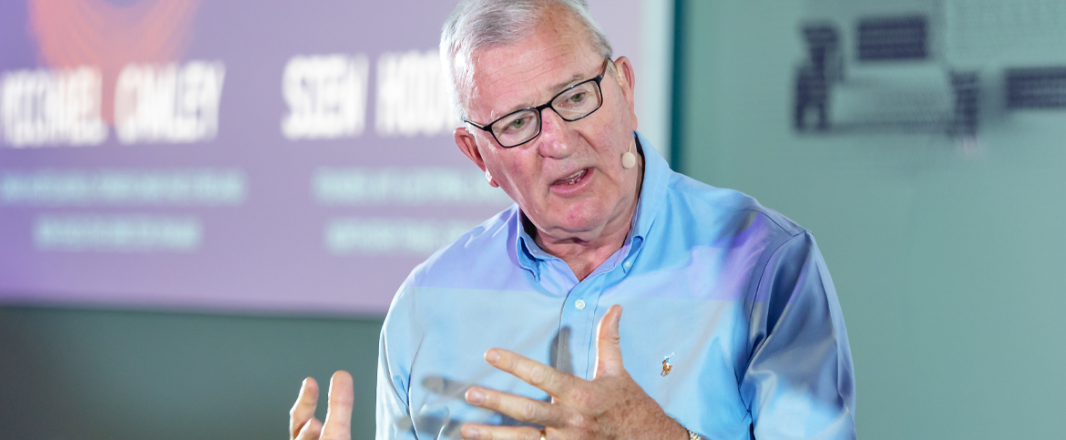
Michael Cawley may be best known for his long tenure as Deputy CEO and COO of Ryanair, but his thinking continues to influence not just aviation, but also how we see technology, regulation, and the distribution battleground in Europe.
In a wide-ranging interview at Phocuswright Europe, Cawley laid bare the Ryanair philosophy – relentless focus on cost, ruthless execution, and a refusal to be first-movers when it comes to technology. “Ryanair has a track record of never being a pioneer with any technology,” he said. “But we look at others, learn fast, and execute brilliantly.”
That playbook, borrowed from Japanese manufacturers of the 1950s, has made Ryanair Europe’s largest airline by passenger numbers. But now, it’s being rewritten for a world reshaped by AI and increasing regulatory scrutiny.
The AI dividend: Efficiency first
Cawley sees AI not as a shiny new toy, but as a critical tool for cost elimination and smarter customer engagement – two pillars of Ryanair’s DNA.
“We’re not going to be a pioneer in the use of AI,” he said plainly. “But we see huge potential. Whether it’s customer service or identifying cost centres that deliver no benefit, AI will debunk many of the industry’s conventional wisdoms.”
He gave a practical example: Ryanair has started communicating proactively with passengers when delays are anticipated. “Just by letting them know in advance, we’ve nearly neutralised the impact of delays on customer satisfaction. People can deal with uncertainty, what they can’t deal with is silence.”
Cawley believes AI will usher in a new era of efficiency across travel, not just in aviation. “If you reduce costs, people will travel more. That drives demand not just for tickets, but for accommodation, experiences, everything downstream.”
But when asked to quantify potential cost savings from AI, Cawley was evasive: “If I give you a number, it’ll be wrong. But we will maximise it over time. This is a long game.”
OTAs: From frenemies to frameworks
In classic Ryanair style, Cawley didn’t mince words when asked about online travel agencies.
“We don’t hate anybody,” he said. “We hate their behaviour.”
The airline has had a long and bitter history with OTAs, particularly with players like eDreams, which Cawley accused of “illegally advertising fares lower than Ryanair’s and tacking on hidden charges.” But Ryanair has since moved to license agreements with a number of OTAs, including Booking.com and Expedia— “as long as they keep to the rules.”
It was COVID that exposed OTA behaviour to RyanAir. When refunds were due, “we found many OTAs never passed the money on to customers. It became clear we could no longer tolerate a system where we didn’t even know who the end customer was.”
Now, Ryanair’s API-based licensing model aims to ensure transparency, data control, and better service delivery. “For us, the customer relationship is sacrosanct. If you don’t own the customer, you’re not in control of your brand experience.”
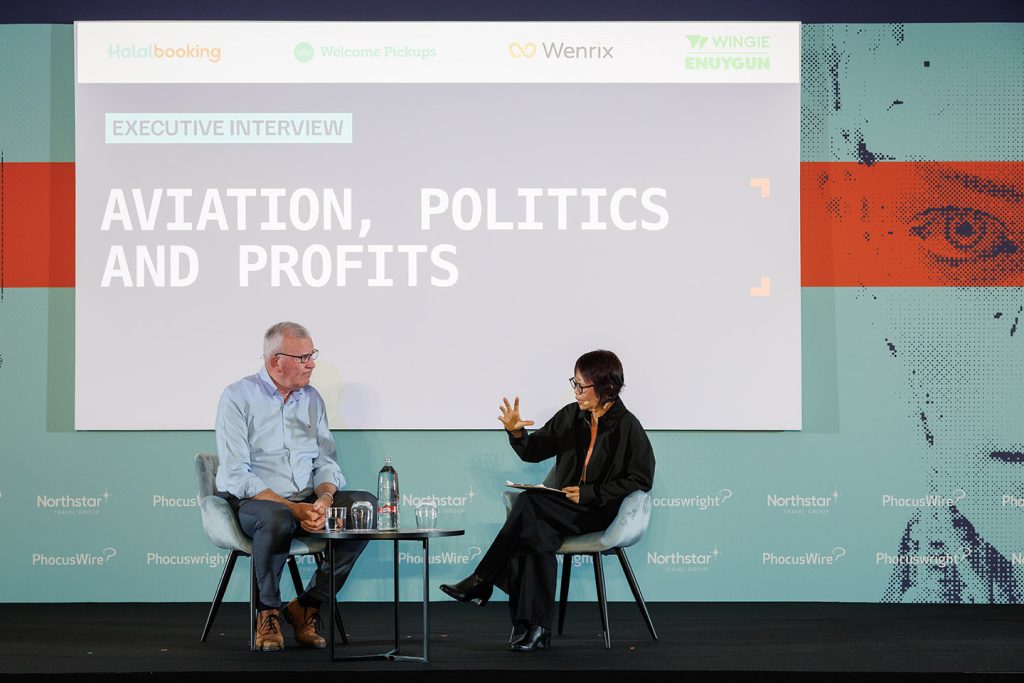
“Just by letting them know in advance, we’ve nearly neutralised the impact of delays on customer satisfaction. People can deal with uncertainty, what they can’t deal with is silence,” said Michael Cawley (left) at Phocuswright Europe
Regulation: A patchwork problem
Cawley was also candid about the political and regulatory challenges of doing business in Europe.
He praised the EU’s original liberalisation of aviation, calling it “one of the most economically productive decisions ever made.” It opened up underserved regions, redistributed wealth, and drove pan-European connectivity. But now, he said, that spirit is being eroded by “a generation of politicians trying to roll it back.”
“The Dutch government introduced a carbon tax that targets short-haul flights while exempting long-haul transfers via Schiphol,” he said. “It’s protectionism dressed up as climate policy.”
Cawley also highlighted uneven regulation as a risk. “We need a uniform regulatory regime. Otherwise, it’s discrimination – pure and simple.”
He drew parallels with current US border control policies that will dampen demand in travel to the US and are scaring off even legitimate travellers. “Even from Ireland, we’ve seen people denied entry to the US at the gate. That kind of uncertainty is a major deterrent to long-haul travel.”
The Next Generation of travel: Tech-savvy and experience-driven
Cawley, who had a seat on the board of Hostelworld and a current board seat in Ireland’s Health Service Executive (HSE), has had a front-row seat to changing traveller behaviours. He sees younger generations prioritising experiences over traditional sun-and-sand destinations.
“They’re more tech-savvy, more time-conscious, and more curious,” he observed. “They don’t want the obvious. They want the authentic.”
His belief in technology extends beyond aviation. He cited his investment in a peer-to-peer microfinance startup in Ireland that uses AI to lend responsibly to SMEs. “It’s a great model, supporting local economies while delivering returns. That’s the kind of innovation I back.”
If there’s a through-line in Michael Cawley’s worldview, it’s this: ideas are cheap, execution is everything. “There’s too much emphasis on the next bright idea,” he said. “It’s the persistence, the daily grind of getting better, that builds real value.”