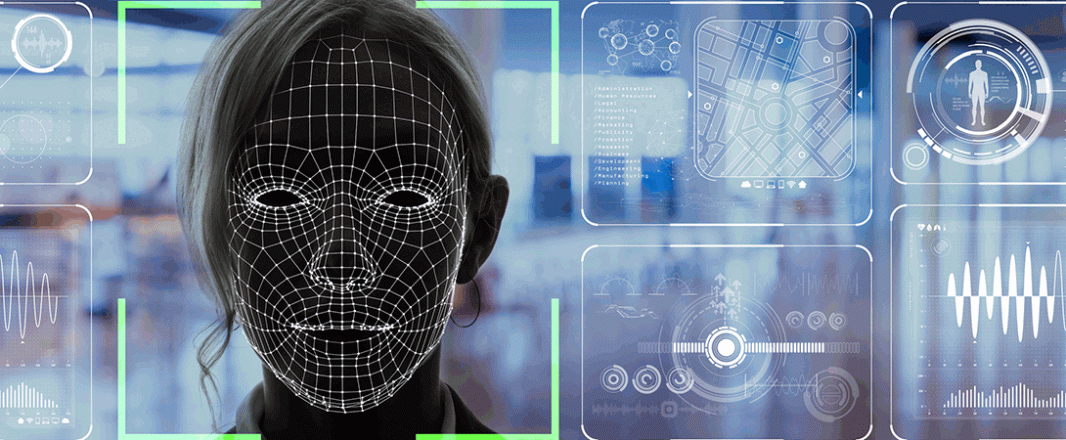
Everyone can now literally use their face to board an AirAsia flight at Senai International Airport in Johor Bahru, the low cost airline’s southern hub in Malaysia, with the launch of the Fast Airport Clearance Experience System (FACES).
The airline, which owns and operates FACES, proudly touts it as Malaysia’s “first airport facial recognition system with self-boarding gate”. The company has invested RM300,000 (US$77,000) into the system to revolutionise the way people travel.
Speaking at the system’s launch at Senai Airport on February 6 Aireen Omar, AirAsia’s deputy group CEO (digital, transformation, corporate services), said it is the first airline in Asia to have a simple seamless travel experience for its guests from check-in to boarding using the latest biometric facial technology without boarding pass.
“This initiative is part of our digital transformation strategy, which aims to make travel more seamless for our guests using cutting edge biometric identification technology, the first of its kind in Malaysia. It eliminates the need for travel documents at the gate and later at security checkpoints, which means this offers a very fast seamless and secure travel experience for our guests.”

Smiling FACES at the launch with AirAsia stewardesses (L-R): Md Derick Basir, CEO of Senai Airport Terminal Services Sdn Bhd; AirAsia’s Aireen Omar; Datuk Nur Jazlan Mohamed, Deputy Minister of Home Affairs; Datuk Tee Siew Kiong, chairman of Johor Tourism; Spencer Lee, AirAsia’s head of commercial (Image credit: AirAsia)
This is how FACES works: The technology uses camera to identify guests and enrol them as they approach a dedicated enrolment kiosk located at check-in kiosk area at the airport. They place their MyKad (Malaysian identification card) or chip-enabled passport in the document reader and look at the camera to create their biometric token. This allows them to proceed directly to their flight without having to show or scan a boarding pass or documents as everything is captured when they enrol their face.
Available for the airline’s guests aged 18 and above, the enrolment is a one-time process that takes less than a minute. Upon expiry of the identity document, guests will need to update the enrolment record with a new valid document.
Currently there is one enrolment kiosk and three self-boarding gates at Senai Airport.
“We hope this will be the starting point of something greater for the industry to promote more seamless travel into Malaysia, and that it will open up other airports to roll out this technology and revolutionise the way people travel with the goal to eventually incorporate Faces throughout the whole airport experience,” said Aireen.
The pilot project, which is in its first phase, is for domestic services from Senai Airport. It was implemented after a month of trial with 3,000 people using the system without encountering any problems.
Phase two will integrate FACES with the facial identification system currently used by the Malaysia Immigration Department for airport security checks (at passport counters and not in lieu of boarding pass or passports) so that passengers could check-in from immigration to boarding using just their faces.

Senai International Airport first in Malaysia to use AirAsia FACES (Image credit: Malaysia Airports)
Aireen revealed that the airline has started the trial for international routes namely Johor to Macau and Johor to Bangkok (Don Mueang International Airport).
She said AirAsia is keen to work with other airports in Malaysia to introduce FACES in the future, but did not give any timeline.
However, Deputy Minister of Home Affairs Datuk Nur Jazlan Mohamed, who officiated at the launch, added that his ministry would monitor the system to ensure it works before extending the system to other airports and rolling out the international portion.
“If implementation in Senai is successful we see no other reason why it can’t be introduced in other airports operated by Malaysia Airports Holdings Bhd (Senai Airport is privately operated). Then only we can talk about having arrangement with airport operators in other countries because we need to make sure system operate well within Malaysia, then it’ll be easier to negotiate with other countries to convince them the system can be rolled out to the rest of the world.”
With the recent leaks of millions of the personal data of Malaysians there is concern about the security of the data captured by AirAsia on FACES.
Aireen, however, assured that the passenger personal data would not be abused and would not be shared. Instead it is used only for self-checking and boarding, and will only be integrated with the Immigration Department for security purposes only.
Commenting on the launch Tan Sri Tony Fernandes, Group CEO of AirAsia and co-group CEO of AirAsia X said in a statement: “Airports are typically the worst part of flying. FACES marks our latest effort to make the on-ground experience more seamless and less stressful by using cutting edge biometric technology to authenticate guests. With FACES, your face is your passport, making it a breeze to clear the gate and board your flight.
Aireen said Senai Airport has embraced digital innovations successfully, and is the most automated AirAsia hub in Malaysia with full service facilities. It is the first airport in the country to implement self-service baggage check-in since 2015, and now it is progressing to FACES.

AirAsia FACES at Senai Airport will enhance passengers’ travel experience.
Datuk Seri Che Khalib Mohamad Noh, managing director of MMC Corporation Bhd, the owner of Senai airport, noted that with the introduction of FACES the airport expects passenger traffic to increase 16% to 3.6 million this year
“The initiative will further enhance our passenger’s travelling experience and airport operations’ efficiency, with faster security and screening processes, specifically to accommodate the growing number of passengers travelling through this airport.”
Using facial recognition at airports in the region to ease the boarding process is not new. Some airports in China already employ facial recognition in security checks. China Southern Airlines is the country’s first carrier to use facial recognition in June last year at Jiangying Airport in Nanyang city, Henan province. Passengers do not need a pass at check-in, as cameras verify their faces with their passport photos.
Baidu, the Chinese Internet giant, is providing its AI-enabled facial recognition technology to Beijing Capital International Airport to jointly develop a facial recognition system for verifying the identity of passengers, ready for implementation this year.
In Australia, Brisbane Airport began the pilot project using facial recognition technology last March in partnership with SITA and Air New Zealand – a first for the country. According to SITA, there has been a 70% reduction in passenger processing times for boarding and check-in.
• Featured image credit: chombosan/iStock-GettyImages