
“To be able to have automation and language models that enable a robot to engage with your customer? It changes the paradigm.”
As every sector in travel from tours and activities, to flights, hospitality and corporate travel undergoes massive change, the WiT Singapore 2023 panel on ‘Vertical Disruption’ asked a simple question: how are investors and experts thinking about their respective sectors and the changes ahead?
Moderator Pete Comeau, Managing Director of Phocuswright first set the scene with some context on deals across travel’s various verticals. “Looking at the top funded verticals, the biggest beneficiaries in the last 18 months globally are short term rentals and corporate travel.”
The short term rental category has been hot fuelled by companies like Airbnb going to the public market, as well as a lot of travellers opting to use that category during the pandemic. “In corporate travel, investors are looking at opportunities across payments, across shift-to-digital consumer first technologies. In Asia, corporate travel also increased in terms of share of funding, while in the short-term rental category actually went in the opposite direction.”
Due to the dynamics of Asia, bike and scooter sharing was a category that had the largest gains. “The car rental category is interesting and that one was probably skewed by a couple of companies in China that raised rounds focused on a hybrid car rental rideshare model.
“Across the globe, as well as in Asia, one of the categories that piqued my interest most is corporate travel. So globally, corporate travel represents double the percentage of funding over the last 18 months. And in Asia, the percentage of funding category jumped from 2% to 10%.” Corporate travel was of course one of the segments destroyed during the pandemic, he notes.
Corporate travel interest high
“I think that there’s a ton of excitement in corporate travel,” agrees Miriam Moscovici, Vice President, Research & Partnerships for BCD Travel. She attributes this to a lot of transition and a decent amount of friction in the market. “Those kinds of situations create a huge opportunity for players to come in and try to solve problems for us.”
She saw “huge opportunity for large enterprises” in the payment environment as well as in air distribution.
“We’ve got a huge transition going on right now in distribution and airlines,” said Moscovici, whereby carriers are taking content out of traditional booking channels and putting them into new ones. “This opens up huge opportunities for technology players to help traditional travel management companies serve their customers.
“There is still a big opportunity for what we call unmanaged or lightly managed business travel. So, companies that spend less than five or $8 million a year, the majority of those companies don’t manage business travel: they just sort of freestyle it,” she says. “So, there’s just big pockets of opportunities left in that unmanaged space and a lot of people want to get in it.”
Pain points that need addressing
Nicholas Cocks, Managing Partner of Velocity Ventures, who sees around 300 companies a year, says, “The areas that we’re focusing on at the moment are the biggest pain points in the industry. Coming back from Covid, clearly labour is a huge issue. I think the stats show that in South-east Asia alone, more than six million people left the travel and hospitality industry.”
All those that didn’t, had to be rehired and retrained, meaning labour shortages, particularly among the corporates, airlines and hotels.
“The second one would be trying to introduce sustainability themes for businesses, and third is changing distribution models: how distribution models are evolving, particularly with the rise of influencers, and how they’re able to reach consumers in a different way.”
For Lisa Katsouraki, Senior Vice President, Corporate Development for Etraveli Group, additional funding for the airline segment is likely to be a result of the purchase of products that help these businesses better manage issues such as volatility. “I’d be willing to bet that most of the investment under air, actually relates to what we now call FinTech products, or InsurTech, which makes a lot of sense coming out of Covid,” she says. “There are lower barriers to entry, patchy demand and issues that require fixing: and Fintech and InsurTech products can come to the rescue.”
Smaller companies being allowed to enter the market and find opportunities is also a feature of less economically buoyant times. “During such times when we have a downturn, it’s far less costly to actually try things, both from a startup perspective as well as from a company perspective – where they’re more willing to take chances and risks,” she says.
“All the greatest companies we’re now discussing today, like the Airbnb’s of the world, actually came about during the last recession. We really do need to see more things emerging and developing,” she notes. “It’s a good time to experiment and let’s try to experiment a bit further outside our zone of comfort. It’s surprising how little things have actually changed in the past 20 years.”
While fighting through legacy technology is an issue for many entrepreneurs, there is also a cultural element to it. “There’s a lot of inbreeding: you have a lot of travel people within the travel industry, and you’ll have huge network effects. So it becomes pretty difficult to actually penetrate that ecosystem,” Katsouraki notes. “And that’s why this is actually an excellent time in doing so – people are more willing to take chances, given the economic backdrop and what we just came out of.”
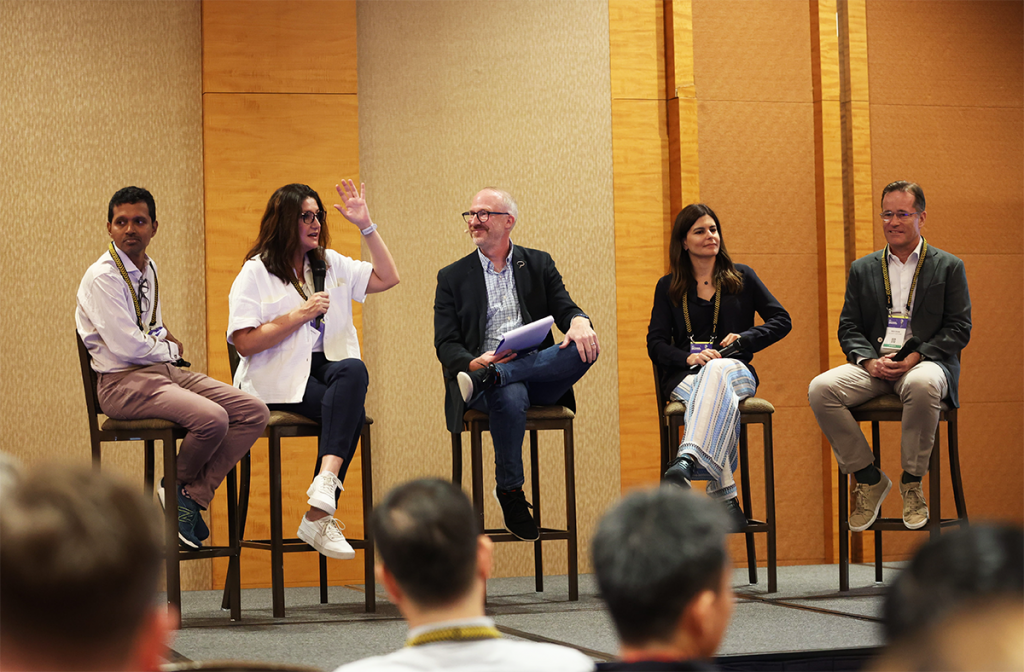
From left: Murli Ravi (Co-founder, Tin Men Capital), Miriam Moscovici (Vice President, Research & Partnerships, BCD Travel), Pete Comeau, (Managing Director, Phocuswright), Lisa Katsouraki (Senior Vice President, Corporate Development, Etraveli Group), Nicholas Cocks (Managing Partner, Velocity Ventures)
Look to hidden problems and “only raise money if you need it”
So, in an environment of inbreeding and legacy tech, how can some of these entrepreneurs can go about finding new opportunities? For Murli Ravi, co-founder of Tin Men Capital, the key is to go back to the key issues of whether there’s a need to be addressed.
“I often tell entrepreneurs, VC funding is not a reason for existence. The customer is the reason for existence. If your customers are funding your business, that’s the best position to be in. Don’t give up your equity,” he noted. “Essentially, I’m putting myself out of a job here”, he quipped. “But I think I speak the truth.”
His simple message: only raise money if you require the accelerant.
In terms of opportunities, it is often important to look behind the high-attention attention consumer facing brands, and look for those untapped opportunities hidden behind the scenes. “There’s clearly direct opportunities in direct travel itself,” says Ravi. “I also look at adjacencies. For example, we’ve come across companies that help airlines manage their inventory of planes. Is that a travel opportunity? It’s not directly linked to travel spend, but it enables that,” Ravi notes.
Listening carefully to customer problems is often a great place to start. He cites the example of an airline partner seeking a startup that could manage content they showed passengers, to enable its in-flight operations to be more efficient. “These things are not necessarily visible to the tourist or traveller, but really core,” he notes. “And while do these things come about in part because of cost pressures, it’s also, in part, because they’re enabling technologies which have come into play, which weren’t in place five or 10 years ago.”
Tin Men Capital also has a role called Head of Ecosystem, which works closely with startups. “This gentleman handles all of our outreach,” he explains. “Things like media, government, people who are adjacent and can support startups. And he provides resources to founders, not just within our portfolio, but even outside resources like, can you get AWS credits, or bulk rates on CFO as a service, things of this nature. That’s what he does, and I think it’s been really well received.”
Mistakes for startups
Ravi also advises startups on common mistakes to avoid. “First, choose the right board members. Just because someone invests doesn’t mean they have the right to a board seat: you can push back on it,” he advises. “If someone was very early in your company, and by putting $200,000 in happens to own 50% when you raise your series B, for example, it doesn’t mean they’re still entitled to a board seat. Take who you want.”
Likewise, too much money can lead to as many problems as too little. “I’d say maybe the most overarching mistake I can draw on, is a capital thing. Don’t raise too much capital too soon. It causes many issues. One is that potentially you end up spending more than you need to, and you get addicted to that spending mechanism,” he notes. “It potentially means too many cooks in your kitchen. I think it also leads to potentially laziness: whereby, ‘Look, I can try these five different experiments, and if they all fail, I don’t care’.”
Too much money in the bank doesn’t really set you up for good times. “You know, in the earlier examples of Airbnb, they tried a long time to raise money and I think that made them stronger.”
AI in second blossom to solve long-standing problems
While it is harder in the current environment to raise money, Cocks of Velocity Ventures says this is not necessarily a bad thing for the startup environment. “I think we’ve turned the corner in terms of fundraising. Over the last 18 months, it was a time where raising money was relatively easy, prior to Covid and in the early stages of Covid. It then became extremely difficult.
“Over the last just last few months, we’ve started to see more deals being done or investments being made. I think we’ve turned that corner. It takes a while in private markets for valuation adjustments to catch up,” notes Cocks. “Now investors are a bit more willing to make the bets that they’ve been asked to make.”
In terms of AI, Moscovici of BCD Travel says that after some wait-and-see, the time is increasingly right for some of these investments. “I think we’re in the second blossom with AI,” she notes. “The big difference now is that we can see just from the testing that we’re doing, that the technology is smart enough, we have gotten to the point where we can start to replace some human-agent based activities with bots that we designed. I think corporate travel in particular is ripe for that, especially given that 75% of the behaviour of a corporate traveller is already prescribed by the company’s policy and chosen providers.
“There’s a huge opportunity to start testing this in business travel. A typical booking takes five to eight emails, much more intensive than a live real-time phone call that lasts eight minutes. There’s huge opportunity for us to take these smarter bots, and automate some of this text-based work.”
For Katsouraki of Etraveli Group, while problems like invoicing need addressing, they could just as easily be solved by humans through a decision-based tree. “It’s crazy that we’re still talking about something that’s super new as a technology, for very old problems. I think the first task for AI will be fixing what we broke over the past years,” she says. “There’s a lot of friction on the supply side, much like we’ve seen on the demand side. And it’s becoming increasingly difficult for the end-consumer to be able to source full-content coverage. So, I really do think that one area for AI is to actually solve that issue.”
No new AI business models yet
For Cocks of Velocity Ventures though, the AI boom has yet to translate to startup pitches. And he doesn’t see this changing. “When this technology emerged 12 months ago, in its current form with Chat GPT, we thought we were going to get hit with a lot of founders coming in and building business models around AI Chat GPT and pitching ideas to us. It didn’t happen.
“What we saw was much more activity in our portfolio companies, of them using the technology to automate tasks and do routine stuff. So the impact for us of this technology has not been through a whole stack of really interesting new businesses built around it, but more in terms of efficiencies through the portfolio. I think the way we’re thinking about Chat GPT is that it’s more like email. It’s not a business in itself. It’s a great tool to help drive efficiencies,” he notes.
Moscovici of BCD Travel believes the impact will be in improving service quality. “The idea for a TMC to be able to have automation and language models that enable a robot to engage with your customer? It changes the paradigm. That allows us to tell our corporate customers: ‘You know what, contact us anytime you want to. Contact us 100 times a day to check on your flight.’ Today, they get a phone call that says, ‘Hang up and get on your online booking tool,’ she says. “Some clients ask us to force travellers to hold for minimum seven minutes, so they give up and hang up.”
A key future problem for technology and Web 3 to help solve will be around understanding consumer preferences, notes Cocks of Velocity Ventures. “At the moment, we’re all reluctant to have our data stolen by people about what we do and what we like,” he notes. “I think the control of that data is coming back to the consumer. What we’ll see is technologies that allow that to be shared in a way that the consumer controls. That will transform the consumer experience: because you’ll then only get what you’re looking for, matched for you and in a way that its timing suits you, and you won’t get hit with all this stuff that you don’t want.”