
CEO, Noredah Othman, is focusing on quality over quantity by tapping into the local MICE industry
As the fairly new CEO of the Sabah Convention Bureau, Noredah Othman plans to use her knowledge of the East Malaysian state from a previous career to achieve the company’s goals. Speaking at the recent WiT Indie in Penang, Othman reminisced on her long career in travel and the development of Sabah as a tourist destination. Her journey in the industry spans over 30 years, beginning with her early days at the Sabah Tourism Board and culminating in her current role.
Reflecting on her experiences, Othman emphasised the continuous learning that travel offers, saying “Travel is always learning. I learn something every time I get onto a plane and reach a destination.”
To understand Sabah’s role as a tourist destination, it’s important to acknowledge that the state was not always as popular as it is now. Located across the sea in East Malaysia, approximately 1630km from Malaysia’s capital of Kuala Lumpur, Sabah (and Sarawak) was not always easily accessible to travellers in the peninsula. A couple of decades ago, there were only a limited number of flights to East Malaysia due to a lack of demand.
So, what changed?
“In Malaysia, it’s always about political will,” said Othman, when asked about the transformation of Sabah over the years.
“For us in Sabah and the Sabah Tourism Board, for many years, nobody really looked at tourism,” added Othman. “Because, who cares? We were a “kayu balak” (logging) state. And then we became a palm oil state. So, who cares about tourism, right?”
“We were trying to make sure that everyone understood how tourism could benefit Sabah – how the community could gain from tourism by being local tourist guides. So really, it was the political will from one of our ministers that realised Sabah’s potential.”
Of course, one of the most important factors in Sabah’s tourism efforts was increasing air access – something that proved to be more complicated back then.
“For many years, we had a lot of challenges with very limited air access,” admitted Othman. “We always had to depend on our national carrier, there was no Air Asia yet. Yes, we are patriotic. We love our national airline, but they had limitations. We decided to think out of the box and work with airlines that were willing to step forward and take chances with us, like the Korean airlines.”
And indeed, Sabah did enjoy an uptick in inbound traffic from South Korea.
New trends in the market
Fast forward to the present – for the first quarter of 2024, Sabah saw a 30% increase in total arrivals and 74.3% growth in international arrivals.
Othman attributed these statistics to the rise in independent travel, particularly from China and Korea. “What’s very obvious post-MCO (Movement Control Order), is the number of FITs (foreign independent travel), especially from our key markets, China and Korea,” she said.
“China, as you all know, used to travel in groups and packages. But today, you will see a lot of Chinese families, even three generations, all traveling on their own, doing everything with their phones,” explained Othman. “Sabah Tourism Board is very active on WeChat and Weibo. We’ve always been very active and made sure that we were following the trends and also following the needs of the travellers – we go where they go, not they go where we go. We have to follow their needs.”
In terms of targeting quality travellers, Othman mentioned working with specific groups in China, such as photography clubs, to attract niche markets. “We’re trying to work with more clubs and associations in China to target specific groups that come for specific interests, not just islands and beaches,” she stated.
“We were sometimes ‘accused’ of always targeting mass tourism. But actually, we were targeting critical mass – those who could actually fill up hotel rooms. And of course, China was that opportunity, just like the Korean market.”
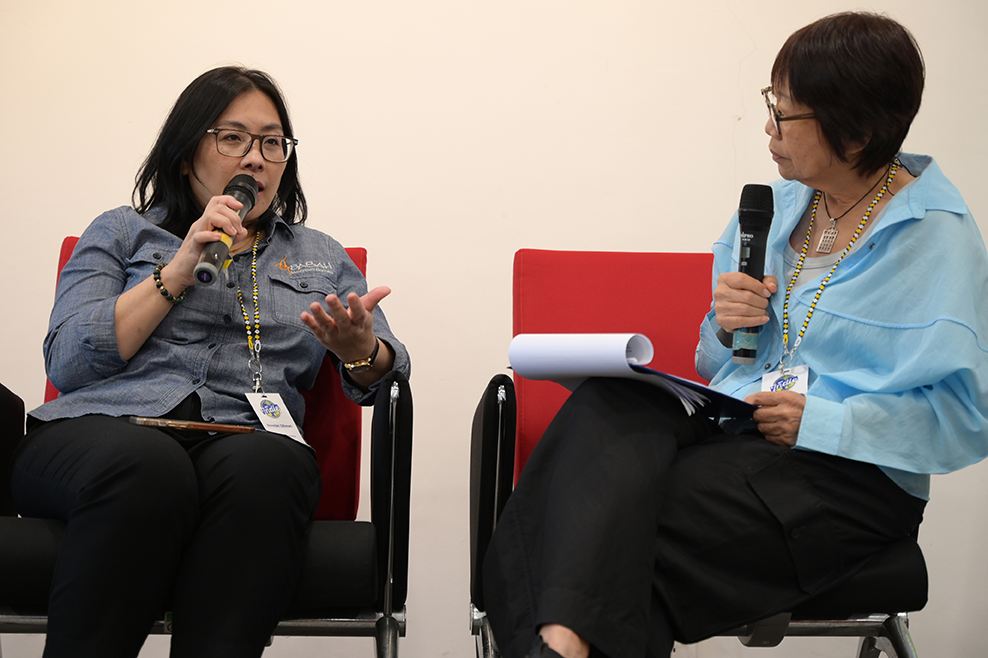
Noredah Othman: “We were following the trends and also following the needs of the travellers – we go where they go, not they go where we go. We have to follow what they need.”
Sustainability and conservation
Today, Sabah is one of Malaysia’s most popular destinations, drawing international tourists to world-famous attractions like Mount Kinabalu and picturesque towns like Kundasang. But, while a robust travel scene is good for business, new challenges have surfaced in the form of sustainable travel and overtourism.
Globally, there are now policies in place, such as those in Europe, that focus on travellers contributing to local well-being. Othman affirmed Sabah’s long-standing commitment to conservation, emphasising, “Sabah is lucky because we are probably one of the very few destinations that started conservation first, then tourism,” citing examples like the Sepilok Orangutan Rehabilitation Center and Kinabalu Park.
Othman elaborated, “We started our tourism product as conservation-first, and then we could only sustain the conservation through tourism.
“We still limit the number of people who can climb Mount Kinabalu. We still have a limited number of people that can go diving in Sipadan, a limited number of people that can go to the islands across the city. This has been continuously done, and I feel that it is sustainable, because most of our iconic tourism areas are all conservation.”
Technology, values, and opportunities
As the CEO of the newly established Sabah Convention Bureau, Othman also discussed balancing conservation efforts with the demands of larger-scale events, while making it clear that her organisation was confident with its place in the region. “We are not competing with Singapore or Bangkok or Shanghai. What we want to do for conventions here is to spread the economic value of the MICE industry into the local community,” she explained. “The bureau focuses on events that align with Sabah’s conservation values and local culture.”
“Our convention center can only have about 5000 people, it’s not about 20,000 people. We will go where we fit in. We don’t go for the masses.”
Othman added, “What we want is for people to understand that we have our conservation values, local values, our cultural values.”
When asked about staying relevant in today’s fast-paced, technology-driven world, Othman highlighted the importance of adaptability. “We had to adapt a lot, especially during the MCO. Even if you don’t know or don’t like tech, you still have to adapt to it,” she noted.
“As a growing economy, a growing state, we’d also like to venture into something more challenging, perhaps. If there’s tech, why not? Our state government emphasises agriculture, manufacturing as well as tourism. But where do we fit in? Where does technology fit in? And how far can we go? We’d like to explore and find out.”