
The hottest word on the block these days is blockchain. Even though it’s been on the periphery for a few years, it’s been in the shadow of the other hotter word, cryptocurrency.
But as the technology underpinning cryptocurrency, it’s been getting more attention of late.
Like everyone else, I’ve been trying to make sense of this and sifting the hype from the facts, and speculation from reality. And so far, the best article I’ve read on the subject has been this one.
I suggest you read it too. It’s the best explanation of what it is and what it could be, if it evolves the way it ought to in an ideal world.
The article speaks about the promise of an Internet 3.0 where we own our own identity and decide which parts of it to share with different bodies – which was the early, original “democratization” promise of the Internet.
But somehow during this period, Internet 2.0, as tech giants scaled, bits and pieces of our identity are now owned by gatekeepers like Google, Amazon and Facebook and we have to ask for permission to borrow back our own identity to share with others.
Writes Steven Johnson in the NYT piece, “The true believers behind blockchain platforms like Ethereum argue that a network of distributed trust is one of those advances in software architecture that will prove, in the long run, to have historic significance. That promise has helped fuel the huge jump in cryptocurrency valuations. But in a way, the Bitcoin bubble may ultimately turn out to be a distraction from the true significance of the blockchain.
“The real promise of these new technologies, many of their evangelists believe, lies not in displacing our currencies but in replacing much of what we now think of as the internet, while at the same time returning the online world to a more decentralized and egalitarian system. If you believe the evangelists, the blockchain is the future. But it is also a way of getting back to the internet’s roots.”
In travel, much has been talked about blockchain’s ability to disrupt intermediaries like the all-powerful OTAs.

Cryptocurrency – a hot word (Image credit: KeremYuce/iStock-Getty Images)
Douglas Quinby, vice president, research of Phocuswright, took on this debate in this piece.
“Recent and much-discussed travel industry articles – Winding Tree is the new kid on the blockchain set on disrupting Expedia, Powerful travel brands face uncertain future in a blockchain-led world and Blockchain will disrupt Expedia and Airbnb – continue to advance the anti-OTA rhetoric and engage the interest of travel industry brands eager to reduce their OTA commission expense.
“How will blockchain do this? Supposedly, the distributed, immutable blockchain database, or ledger, will enable sellers (hotels, airlines, etc.) and buyers (travellers) to execute contracts (bookings) without the need for a “trusted” third party. The key innovation in blockchain is the concept of decentralised and un-hackable trust. So, through the blockchain, the buyer can execute a payment or contract without the need of a trusted intermediary such as a bank, credit card, clearing house, or even an OTA, and thus without the fees typically charged by those gatekeepers.”
This week, “blockchain” got another boost in the publicity arsenal when Singapore Airlines announced that its frequent flyer programme KrisFlyer will launch a world-first blockchain-based airline loyalty digital wallet. This, it says, will help unlock the value of KrisFlyer miles to enable everyday spending at retail partners.
The digital wallet app is expected to be rolled out in about six months and will allow KrisFlyer membes like me to use ‘digital KrisFlyer miles’ for point-of-sale transactions at participating retail merchants.
The airline said that, following a successful proof-of-concept exercise carried out in collaboration with KPMG Digital Village and Microsoft, KrisFlyer will be signing up retail merchant partners, initially in the Singapore market.

KrisFlyer to launch blockchain-based airline loyalty digital wallet in six months.
Frankly, as a member, I’d rather see more recognition and perks extended to me during the inflight experience than more retail. Every merchant and her dog is pushing me more retail, do I really want more of the same from my preferred airline?
But it is clear that the SIA Group, at a time of intense competition and erosion of profits – it sank into the red with a fourth-quarter loss in 2017 of S$138.3 million, versus a net profit of S$224.7 million a year ago – has to be seen to be at the leading (hopefully not bleeding) edge.
It has signaled its intent to “significantly enhance the digital side of our business for the benefit of our customers. It is in line with our recently unveiled Digital Innovation Blueprint, under which we aim to be the world’s leading digital airline,” said CEO Goh Choon Phong.
Companies like Value Penguin have been quick to applaud SIA’s blockchain move, and believes more retailers will follow suit, including hotel chains and credit card issuers.
In this article, it says, “If done carefully, cryptocurrency-based loyalty programs could be a legitimate source of funding and operation improvements for these businesses. In particular, struggling consumer retail brands and hotel brands could leverage cryptocurrencies to renew their consumer appeal in face of competition from online players like Amazon and AirBnb.”
The benefits it puts forth are these: “For consumers, a loyalty programme that is based on blockchains could be more valuable than a regular miles rewards programmes for several reasons. Normally, rewards programs limit how members can redeem their points, with blackout dates and other limitations. Not only that, loyalty points also tend to depreciate in value over time due to inflation, changes in loyalty programs and even expiration.
“Instead, the newly proposed alternative has the potential to address both of these issues. First, they would be flexibly interchangeable with other digital currencies, programs or money. Secondly, the market could decide the value of these tokens, which would create the potential for value appreciation.”
It also has benefits for the companies, of course. “Traditional rewards programmess were effectively discount programs that cost companies a lot of money. For example, it would cost Singapore Airlines and extra seat every time a customer decided to redeem his miles for a free flight. This is a pretty big cost centre for Singapore Airlines, which carries over $700mn of deferred revenue due to the outstanding miles waiting to be redeemed.”
See chart
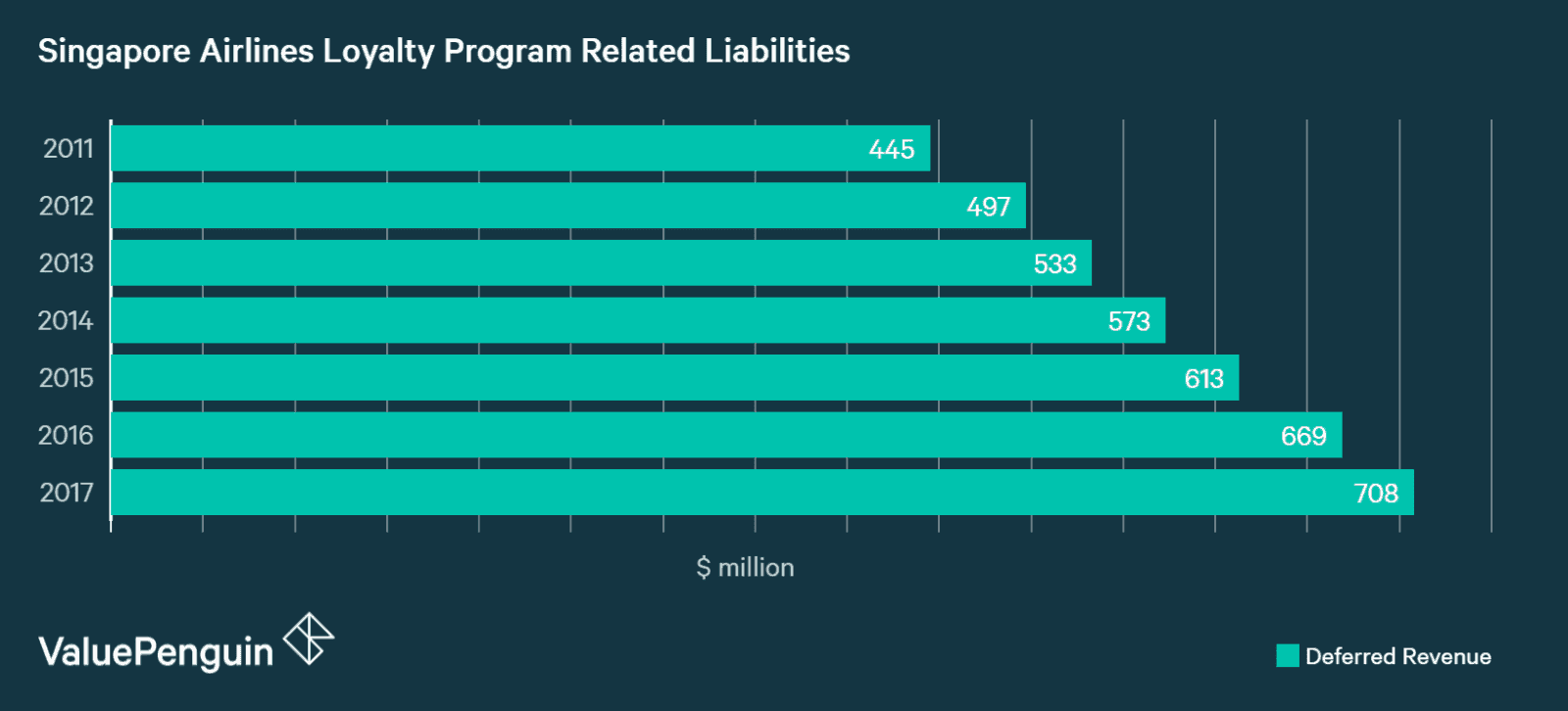
“However, that would no longer be the case with a blockchain based loyalty program. If a customer redeems 50,000 miles for a business class seat, for example, the company could then immediately sell the miles in the market for an equivalent amount of cash. This implies that the traders of Singapore Airlines’s “miles cryptocurrency” would be funding the company’s loyalty program (or a discount marketing campaign), reducing the firm’s financial burden to basically zero.”
SIA is not the only airline that is investing in blockchain technology.
Lufthansa and Air New Zealand last year teamed up with Switzerland-based start-up Winding Tree to build blockchain-based travel apps, as they look at new ways of distributing tickets and services to customers.
European travel group TUI has also developed its own blockchain-based inventory system for hotel bookings, and believes this is the way for it to reclaim its dominant position in travel distribution.
As with any new technology, much depends on the execution of it and how consumers take to it.
Last year, AI was the “buzzword” and it quickly became evident that it’s only those with scale, with masses of data, that can really harness it. So again, the big gets bigger.
“Chatbots” – automated text-based virtual assistants – was the other buzzword that got everyone chit-chatting about its potential to replace part of the human conversation. Facebook’s scrapping of its M chatbot proved that even a company with its resources could not solve the problem it was trying to address.
This Wired article said, “M’s core problem: Facebook put no bounds on what M could be asked to do. Alexa has proven adept at handling a narrower range of questions, many tied to facts, or Amazon’s core strength in shopping.”

Image credit: LinkedIn
I was listening to neuroscientist Dr Vivienne Ming (pictured left) talk about AI in her address on “Technology & Society” last week in Singapore and she said, “The only time a chatbot works is when it’s chatting with an idiot.”
So it’s not about the technology, it is what it is used for.
It is said customer behavior is the hardest thing to change and once we get used to something, it’s very hard to get “un-used” to it. But if it does make life easier and more convenient, and tap into our psyche in the right way, then we will shift behavior.
We can definitely expect more debate about blockchain in the months ahead. Right now it holds out the promise of a new, brighter future for travel retailers.
Let’s face it, they have been slower to embrace technology to transform their business and have allowed others to disrupt them.
So two decades after the arrival of Internet 1.0, Internet 3.0 could be their moment to get ahead of the curve as every new technology holds out the promise of leapfrogging.
In the meantime, they’d better be prepared for a lot of pain and, oh yes, getting tangled up in chains before it all starts to make sense.
• Featured image credit: Zapp2Photo/iStock-GettyImages