Gradual control of the Covid-19 pandemic and the willingness of Chinese tourists to hit the road again for tourism activities are behind the steady recovery in China’s travel market.
Coupled with this is the majority of Chinese consumers believe travel is still one of the preferred leisure activities.
These data in the recent Travel Trends Report by ITB China are based on a survey of 200 Chinese outbound travel agencies and travel companies, including interviews with industry experts.
The study notes that despite the uncertainties surrounding the travel industry amid Covid-19, China’s travel market sees a “restoring demand” for travel by Chinese tourists.
Over 40% of the agencies surveyed have received inquiries from consumers on outbound travel products. From May to June 2020 nearly 60% stated that their clients are interested in travel products, as well as actively buying pre-sale travel products.

The re-opening of cross-province tourism is also one of the reasons for the rise in demand for travel. Trip.com Group, in its Cross Province Travel Report, revealed 30 provinces and cities in China have re-opened for inter-provincial travel by July 30.
In tandem with the re-opening more than 4,000 travel agencies have launched domestic travel products on Trip.com platform, double the number before cross-province travel was restored.
“The resumption of travel agencies is a sign of a recovering market, giving consumers more choices for domestic travel,” stated the report.
The study found that since July 15 the number of people booking holiday packages through Trip.com has increased by more than 70%.
Group travel with full service is still the mainstream choice for people with 70% opting for it, while the remaining 30% prefer independent travel that comprises flights and hotels with preferential package prices.
However, the “new group” products in the age of coronavirus is different than before the pandemic as tourists now place more importance to safety and quality. The tours in the new normal are private and intimate with size averaging just three to five people.
According to the report, there is still significant demand for tours of between 10 to 20 people. But what is no longer popular are low-priced group tours, as tourists prefer to spend more money to upgrade their accommodation, flights, meals, tours and other services.
In terms of growth rate, tourists in developed cities such as Beijing and Shanghai are more willing to travel after the opening of trans-provincial tourism, with the growth rate reaching 1,201% and 721% respectively compared with before the opening.
Based on the number of orders for independent travel and group tour, Trip.com said the 10 most popular destination provinces are Yunnan, Sichuan, Guizhou, Guangdong, Hainan, Hunan, Zhejiang, Shaanxi, Qinghai and Gansu. For cities they are Sanya, Lijiang, Zhangjiajie, Guiyang, Kunming, Chongqing, Xining, Xi ‘an, Chengdu and Jiuzhaigou.
Holidaying with family is how Chinese consumers prefer to explore the country, accounting for 34% while 32% choose to travel with colleagues and friends. Married couples make up 19%, with 6% taking their parents with them and 9%. are independent solo travellers.
Those aged 19 to 30 make up the highest proportion of travellers at 27%, followed by the 31 to 45 age group (23%) and 46 to 60 (22%).
Customised tours in demand

Domestic customised tours are gaining popularity, disclosed Trip.com Group in its report looking at this segment. Orders from travellers in July through its customised travel platform increased 126% month-on-month. Personal customisation went up by 156% month-on-month, high-end customisation by 103% month-on-month and corporate customisation by 80% month-on-month.
The popularity of these high-end customised services despite their expensive price is because domestic tourists prefer the “one-to-one exclusive manager handling inquiries and high standard schedule configuration.”
The demand for customised travel is highest in Beijing with a year-on-year growth of 575%, followed by Tianjin, Wuhan, Shanghai, Nanjing, Shenzhen, Jinan, Guangzhou, Changsha and Taiyuan, with most of the demand increasing exponentially.
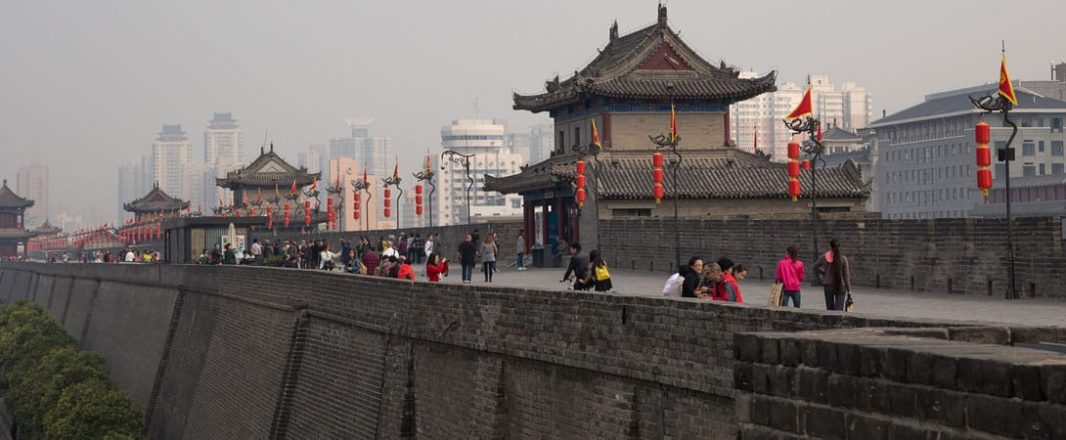
• Featured image credit (Xi’an’s ancient city wall and moat): vladj55/Getty Images