“By examining how different music styles and events influence traveller behavior and demographics, destinations can better understand spending patterns and overall impact.”
Earlier this year, we ran a few stories covering Taylor Swift’s significant impact on Singapore’s economy thanks to the surge in music tourism to the city-state. Aptly dubbed ‘Swiftonomics‘, analysts and financial experts all agreed that hosting an event as sought-after as The Eras Tour does wonders for the host city. But Swift isn’t the only one wielding the power to influence the economy. According to new research by The Data Appeal Company, other acts like Coldplay (who had their biggest concert in Malaysia in 2023) and entertainment festivals like Rock In Rio reveals that other major musical events are making significant contributions to local economies and the international tourism landscape in 2024.
The Data Appeal Company collects and analyses data from various Online Travel Agencies (OTAs), including major players like Booking.com and Expedia, to provide insights into travel destinations. This data, along with spending figures, is sourced from The Data Appeal Company’s core platform, D / AI Destinations. This study is based on studying the impact of these events-multiple dates concerts and music festivals- on local economies and tourism during the specified dates:
- Coldplay in Rome on July 12, 13, 15, and 16, 2024;
- Adele in Munich on August 2, 3, 9, 10, 14, 16, 23, 24, 30, and 31, 2024;
- Rock in Rio (a music festival) in Rio de Janeiro from September 13 to 15 and 19 to 22, 2024.
Economic impact highlights
According to The Data Appeal Company, these events not only attract large audiences but also drive substantial changes in hospitality and short-term rentals occupancy rates and prices. The following sections detail the economic effects observed from key events featuring prominent artists like Adele, Coldplay, and the Rock in Rio festival, showcasing their influence on the cities they visit.
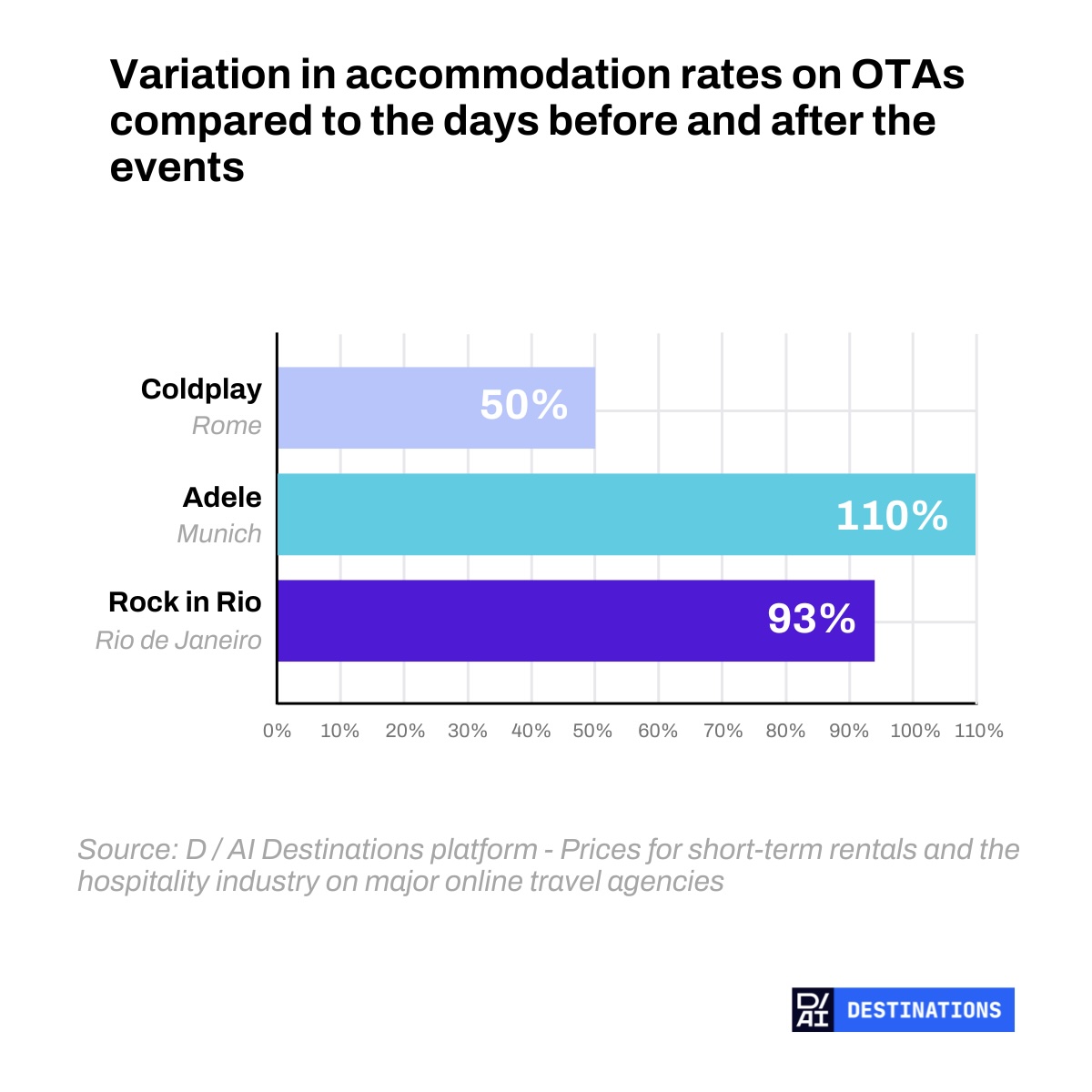
- Adele in Munich. Adele’s exclusive European performances in Munich, held at a specially constructed open-air arena at Messe München set to accommodate up to 80,000 people, are drawing crowds and driving up hotel prices. The events have already caused a significant increase in hotel rates by up to 110% when compared to weekday prices during August, despite the concert still not being sold out. These concerts are anticipated to have a substantial impact on the local economy, especially considering Adele’s potential pause in touring following these dates.
- Coldplay in Rome. Coldplay’s concerts in Rome have drawn approximately 70,000 attendees and generated an estimated spending of over €17 million. The audience size and spending highlight the widespread appeal and economic benefits of Coldplay’s performances.
- Rock in Rio. This remains a heavyweight in the global festival scene, expected to attract over 700,000 attendees. Despite varying OTA saturation, with many properties opting for direct bookings, the event has already influenced a 93% increase in accommodation rates.
Spending breakdown by event
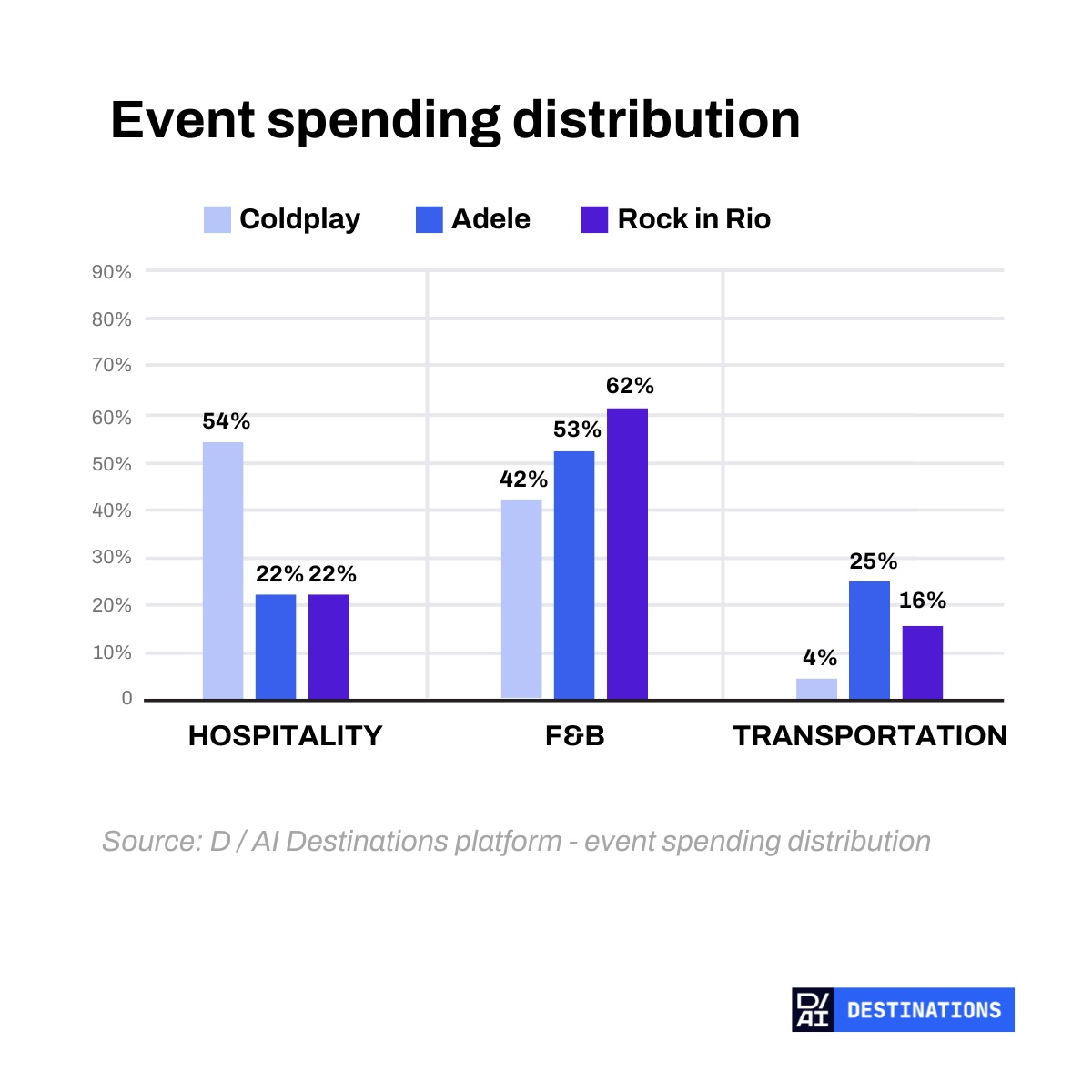
The data shows that fans of Coldplay allocate a significant portion of their spending towards accommodation, spending 54% on lodging. In contrast, attendees of Rock in Rio and Adele’s concerts spend a lesser percentage of their total spend on accommodation, with both groups allocating only 22% of their expenses in this category.
When it comes to food and beverages, data shows that Rock in Rio leads with attendees dedicating 62% of their spending to this category, followed by Adele’s fans who spend 53%. This indicates that food and beverage experiences are a significant part of the appeal for these events. Meanwhile, Coldplay fans spend 42% on food and beverages, indicating a relatively balanced distribution of spending between accommodation and dining.
The Data Appeal Company also revealed that transportation expenses vary among these groups. Adele’s concerts see the highest transportation spending at 25%, suggesting a greater need for travel among her fans, possibly due to the location or the specific nature of the venue setup. Rock in Rio attendees spend 16% on transportation, while Coldplay’s fans spend much less, at 4%, likely due to closer proximity of accommodations to the event venue.
Mirko Lalli, CEO of The Data Appeal Company, said that “This says a lot about how much tourist destinations should invest in an optimal calendar of international artist dates, now capable of attracting overseas fans as well. To do so though they need to capture data related to who attended, what they did and where they spent their money – in order to continually fine-tune and improve the benefits to the local economy when planning future events.”
Lalli added, “However, we must not forget that events of this scale can generate strong stress on residents and the environment, so it is crucial to manage them strategically and carefully. Sustainability must be at the center of every event planning and management initiative to ensure that these can continue to be a valuable resource for tourism without compromising the well-being of host destinations.”
The average age of visitors
In a similar study, Mabrian, part of The Data Appeal Company, conducted recent research on how the average age of visitors to Madrid and Seville varied during Taylor Swift and AC/DC concerts held in the same week (Swift in Madrid, AC/DC in Seville), compared to the same days last year. This analysis utilised the distribution of tourist reviews on social networks during these events. The findings showed that in Madrid, 26% of tourist conversations during the concert dates were from individuals under 34 years old, indicating a four-percentage point increase in visitors under 35 compared to the same period in 2023. In Seville, there was a significant rise in visitors over 55 years old, with a nine-percentage point increase compared to the previous year, as 17% of tourist conversations were from this age group.
Carlos Cendra, Partner & Director of Marketing and Communications at Mabrian, emphasises the value of these findings, noting the necessity for destinations to understand and leverage the nuances of musical tourism to optimise their appeal and economic benefits: “By examining how different music styles and events influence traveller behavior and demographics, destinations can better understand spending patterns and overall impact. This information is crucial for developing strategies to attract music shows that align with specific tourism goals. Moreover, tracking the reach of musical tourism is essential for making informed decisions about campaign strategies, channels, and formats to position a location as a musical destination, thereby attracting high-value travelers and promoting a more balanced distribution of tourist spending”.
Image credit: Wikipedia (Chris Martin, Coldplay), Seattle Times (Taylor Swift)