


Low cost flight startup develops five digital employees; meet Florence, its newest customer care agent
As a startup operating in the highly competitive and volatile world of third party low cost flight distribution, Atlas’ founder Mary Li believes the optimum way to compete is by using tech to become highly efficient and scale productivity.
In the past 18 months, Atlas, which celebrated its fifth anniversary last month, has built five “digital employees” named Athena, Brigitte, Carmen, Doris and the newest, Florence, as part of its partnership with Alibaba Cloud Global. Florence was launched at the latter’s event in Hangzhou in September.
Said Li, “AI is reshaping the travel industry in profound ways, and large language models are already transforming how travel is organised and delivered to customers.”
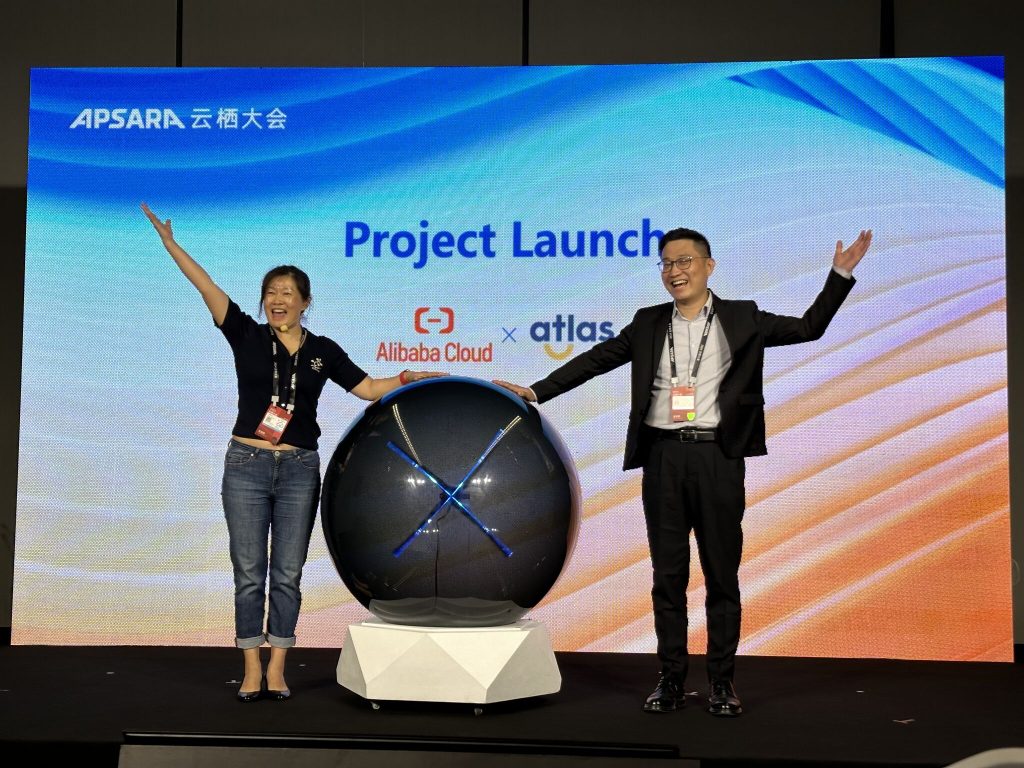
Mary Li and Kun Huang, regional general manager, South APAC, Alibaba Cloud, at the launch of Florence in Hangzhou
Florence, named after Florence Nightingale, the pioneering nurse who revolutionized healthcare, has similar aspirations to do the same for customer care. “Right now, Florence is responsible for streamlining Atlas’s internal customer service processes and making our work more efficient,” she said. “We are developing multi-languages so Florence can handle our global customers.”
Florence is powered by Alibaba Cloud’s Tongyi LLM and runs on the Bailian platform.
The digital employees were named by Atlas’ CTO Willow Yang and his team. Each has a parent – “one mum and four dads”, said Li, “who’s responsible for their upbringing. They are all in their infancy stage.”
Asked if each employee has a visual avatar, she laughed, “Don’t even go there, we had so many discussions about what each should look like and there were so many arguments – why should she look like that – that we thought it best we just stick to names.”
The different roles of each digital employee
Each of them has distinct roles. Athena is responsible for airline data quality. She monitors airline websites/algorithms to alert Atlas and its B2B partners if an API isn’t working or if there’s a website crash. She double checks the PNR to ensure the same name is used throughout the booking, so that the booking is 100% accurate.
“She also looks after trip protection in the event of airlines cancelling the bookings or payment issues so that Atlas can protect the passenger,” said Li. “Ordinarily, it can take 40 engineers to handle Athena’s different tasks.”
Brigitte is an “AI plus RPA (Robotic Process Automation)” platform that is used by the finance team to drive efficiency.
Explained Li, “All the manual work, Excel sheets, accounts, are driven by Brigitte so that finance people can focus on business rather than on internal processes. It’s very successful in finance now and we are looking to use her for repeat manual tasks.
“Usually, it takes two to three people every month, and 15 days of copying and pasting, and if you have more volume, you need more finance people – so this allows humans to do more interesting things.”
Carmen is a Quality Assurance agent that tests product releases by the tech team. “This is not new but we are developing Carmen to test for more complex scenarios,” said Li.
Doris handles manual ticketing fulfilment because no matter how good the tech, there will always be the one or two percent that will require manual handling. “Doris will figure out why, what went wrong and how to solve it, and she’s learning everyday, so she doesn’t make the same mistake twice. Doris can replace 60-70% of work involved in this process,” said Li.
Florence, in customer care, was the most challenging to develop, given the generic nature of today’s LLMs. “We failed a lot with her. We work in a vertical and every answer has to be specific. So we had to go deeper for accuracy and take responsibility for it.”
Asked how her team of 60 has responded to the five new employees, Li said, “They understand this is the only way we can survive and grow, how 60 people can do 600-people jobs? We can’t hire another 450. So I say, you focus on thinking. Thinking is your job, not typing.”
She said as a Plus-AI company, “we need to understand which are the AI-Plus companies we should work – OpenAI, Gemini, Meta, Alibaba Cloud. We need to understand what LLMs means to Atlas. We don’t need to invest in superior, advanced versions of AI, but deeply understand how AI can drive our business.
“We are only at the beginning of the journey.”
Heading into era of more competition and volatility
And it’s a journey that’s only going to get more competitive and volatile. “The internal processes are the ones we can control. External factors, like price competition, airline collapses, global economic uncertainty, we cannot do anything about except be prudent about how we manage our business.”
Like most intermediaries in the low cost flight space, Atlas was impacted by the collapse of MYAirline, the Malaysian low cost airline that went under in just over a year of operations.
“MYAirline took millions from agents. Thankfully, we weren’t that exposed, losing about $20,000 – but it’s still precious money for a startup. Our system monitoring had raised red flags when we saw how it was reducing its capacity in its network – and we took measures to mitigate potential losses.”
The collapse of Bonza in Australia also impacted the industry. “It happens,” said Li. “Low cost carriers operate on such small margins so the risks are high.”
At the same time, the giant OTAs are competing more aggressively in the flight space. “They still dominate. It leads us to think deeply about how we have to differentiate. In dealing with the OTAs, who want the cheapest fares, if we want to maintain a sustainable, long-term, value-driven business, what can we do? Do we play price? That’s a huge challenge in such a small margin space.”
The whole environment has also become tougher due to softening demand in Europe and volality of air fares and exchange rates. “In the past, air fares might fluctuate by 10% over a year, now it can happen within two weeks.”
Despite these challenges, Li, for whom Atlas is the third flight startup, said, “I still believe in flights, it’s the only thing I know, and I believe there’s a big space for Atlas. We have to figure out whether we can do everything a little better than others and transform this competitive sector into an ecosystem. We want to compete on price too, but how can we be profitable and sustainable?
“How can Atlas build a more affordable team to manage end-to-end efficiency – how can we keep our team at 60 people – and take on more business? How can we use tech to manage cash flow? How can we minimize our internal costs so we can compete on external pricing?
“How can we build foreign exchange risk control, with access to the most competitive foreign exchange rates?”
To address the latter issue, Atlas has signed a partnership with Citi to develop a payment solution for LCC travel sellers, which locks in real-time foreign exchange rates and employs post-settlement processes. “It allows us to secure favourable rates while mitigating the risks of currency fluctuations.”
Li is optimistic about what technology and AI will do for travel. “People can go to more interesting places because tech and AI can expose more fun places to everyone. AI can bring down language barriers, people can travel more freely and bravely. It doesn’t matter how they buy, who sells what, what matters is that.
“Everytime I watch Xiaohongshu, Little Red Book, I am so proud Chinese travellers are using AI to understand the world. My team members, everywhere they go, use Kimi AI Chatbot to give them information about places they visit. They are no longer afraid of language barriers.”


