
Startups from China, Taiwan, the Philippines, Taiwan, Nepal and Israel took to the stage at the WiT Bootcamp held in conjunction with WiT Singapore 2018 conference last month to share their stories and the state of the startup ecosystem in their countries.
In the second part of the report we highlight Israel and Nepal.
Israel: Standing tall in the global tech startup stage
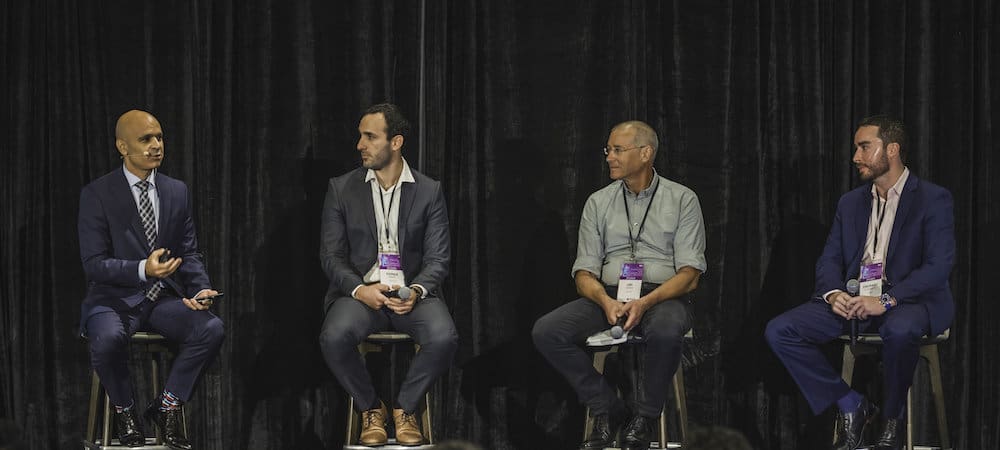
Israel panel: (L-R) InnoVel Travel Tech’s Rom Hendler, Optimove’s Tomer Imber, Wishtrip’s Uri Keren, Trustifi’s Zachary Schwartz (Image credit: Shoot My Travel)
Israel may be a small country with a population of just 8.5 million, but it is making waves in the tech startup world. Tel Aviv’s “Silicon Wadi” is ranked highly among global top technology hubs, and is considered to be second only to California’s Silicon Valley.
Here are some interesting “world” facts about Israel’s tech ecosystem. It is the world’s highest venture capital per capita, has the world’s highest number of startups per capita and the world’s highest R&D investments as % of GDP (4.2%), and is the world’s #3 in NASDAQ-listed tech companies after US and China, which means they are very successful.
The country is also the world’s second most innovative nation, making it the first port of call for global organisations looking to innovate. There are currently 350+ multinational R&D and innovation centres in Israel.
In revealing these data Rom Hendler, founder & CEO of InnoVel Travel Tech, the moderator for the Israel session, said many of these companies started as pure tech companies such as IBM, Facebook, Google, Cisco.
“But in the last two years there was a big movement of non-tech companies coming to Israel to look for technology – banks like HSBC and Barclays, food tech companies such as Coca Cola and Pepsi, lifestyle like Nike and more. This is because they understand that even traditional brick and mortar are going through disruption, and if they are not they know they will eventually.”
Additionally, Israel’s is also “rich” as it has 7,000 startups, 100+ accelerators, 18 government incubators, 70 VCs (14 international) and 200 angel and microfunds. The environment and talent are behind these large numbers.
The country boasts a collaborative environment where startups help one another even though they may be competitors. Talent is cheaper than in other markets, specifically Silicon Valley, attracting companies looking for international expansion even if Israel’s geographical location is not the most strategic.
However, Hendler clarified that Israel is, by no means, a “cheap market” – just that talent is much more expensive in other tech hubs like in Silicon Valley.
The more affordable talent is what attracted New York-based Trustifi to do its R&D in Israel. A cyber security platform, it is based around Israeli military technology and provides SaaS (software-as-a-service) solution that protects businesses from email vulnerabilities and compliance risks.
Zachary Schwartz, vice president of strategic alliances at Trustifi, explained: “We are US based but our CTO and CEO are Israelis, so we have insight into the Israeli marketplace that most US startups don’t have. What we see is the price of acquisition for talent in the US far exceeds that of the price of developing talent in Israel – whether it is for cultural reasons or for educational reasons or even for military training you have to receive before joining the work force. We can get the same level of talent in Israel at a much lower cost than in the US.”
In the US, the salary for a cyber security full start developer is around a minimum US$150,000 a year, but in Israel it is about US$66,000, he disclosed.
Israel’s small market size could work against it as some investors may not be interested in a startup that sells only in the Israeli market. So how do startups work around it?
Optimove, which started business 10 years ago, does not find this to be a problem as its customers are mainly local clients who have remained with the company since its formation. The company enables brands to maximise their customer value through personalisation, and has an innovative platform called CDP (Customer Data Platform) that combines data, analytics and communication channels to personalise communications.
Tomer Imber, APAC director of Optimove, said that when the company started local clients were the easiest to find as it was bootstrapped (still is), and in those days the gaming industry was really developed and has an online approach. These local clients have remain good customers until today.
“As a bootstrapped company we don’t have the luxury of testing out any markets. Since we started we have made a lot of improvement to the products and new developments.” The company has now expanded its client base to more than 300 brands including retail, financial services, apps and others.
WishTrip, a social platform that allows tourists from all over the world to create and share their tourism experiences and a business platform that connects tourism destinations and local businesses with tourists, is happy to sell in the local market too.
Uri Keren, Wishtrip’s chief revenue officer, said as Israel is an international destination for tourists the company is helping local travel providers create, share and monetise local experiences. The company is looking to expand globally. It now has experiences in 80 countries and its app has over 400,000 active users.
Schwartz said Trustifi does not sell into Israel as a direct market. “In my role to acquire new partnership we actively look for technology partners like Optimove or WishTrip to not only expand our client base but also for the reach they have, and to integrate directly into their technology.”
When asked to describe the strongest point about the Israeli tech ecosystem and its worst, these were their answers:
Strongest: “Not afraid to fail”, “try until we succeed”, “talent market”
Worst: “We’re not afraid to fail”, “sometimes we think we can so anything we want”, “far from target market and time zone”.
On the advantage the ecosystem has over Silicon Valley, their responses:
Optimove’s Tomer: “Israel is a country that doesn’t only have startups, we also have agriculture, low tech and other industries. The technology within the tech ecosystem empowers innovation.”
Wishtrip’s Keren: “Silcion Valley is driven by big players, VCs and corporates while Israel is just two guys meet and have an idea and then say let’s work together.”
Trustifi’s Schwartz: “Get the best for your buck over Silicon Valley.:
Nepal: Getting a foot in the startup door

L-R: Marissa Trew, content & marketing, WiT, moderating the Nepal panel with KGH Group of Hotels, Resorts & Travel’s Rajan Sakya and Avendy’s Saujanya Acharya. (Image credit: Shoot My Travel)
Nepal, the tiny landlocked country sandwiched between India and China with a population of about 29.7 million, is known more for its sherpas, mountaineering and trekking than for startups
The startup policy environment in Nepal is still in a very early stage. While young entrepreneurs with seed money are able to develop startups they find difficulty in scaling up their business due to restrictive policies, accessing international investor funds, attracting international players to the country and expanding internationally. However, these challenges have dampened the zeal of entrepreneurs who want to carve their niche in their country’s small but significant travel market.
Nepal’s travel sector is a golden opportunity for startups, as tourism is the mainstay of the country’s economy. It saw a 300% jump in tourist arrivals to an estimated one million this year from the 300,000 in 2015 when it was hit by a devastating earthquake. The average length of stay for visitors is 13-14 nights, envy of destinations trying to attract tourists to stay longer.
KGH Group of Hotels, Resorts & Travel, Nepal’s largest hotel chain, is doing its part to nurture startups in the travel segment. Its CEO Rajan Sakya said as part of its CSR work it has created an IT platform for people worldwide to connect with Nepalese who wants to develop a startup, as well as to help them set up the business as the process can be tedious. It is also approaching the government to give tax holiday for a couple of years to new startups, and hope to attract overseas Nepalese to return home to start businesses.
“The population of Nepal is about 10 million, and three million aged 25-45 are working abroad. In the worst case scenario, if only 1% come back to set up startups there will be 30,000 startups. We’re expecting this 1% to do something within the next couple of years,” is the optimistic outlook Sakya has for the country’s startup scene.
However, he acknowledged there are problems facing people who want to return to Nepal to start a company – lack of infrastructure to support them – which was what led KGH Group to set up the IT platform.
“The eco system is young, so we have to develop infrastructure for them when they come back,” said Sakya.
When asked by moderator Marissa Trew, WiT content & marketing, if travel service was a hot field of opportunity just for startups in Nepal or more of a universal opportunity, the latter was the answer from Saujanya Acharya, co-founder of Avendy
“It’s more of a universal opportunity. When travellers go to a foreign destination they want a personalised experience and this is possible when you are talking to another human being; that’s the crux of it as it makes the experience very personal.”.
Avendy, based in Dubai, is a travel service that connects travellers with local experts based on their queries, localising travel experience globally.
Explaining why the company is not in Nepal, Acharya said capital restriction by Nepal’s central bank is one reason why many Nepalese are starting companies outside the country while cultivating business within the country.
“We cannot take the dollar or income out of the country with capital restriction. We cannot use credit cards to buy trips or rent out a room on Agoda. Foreign investors must invest over US$50,000 to have ownership in a company. So if you’re graduate fresh out of college and want to build a prototype, and want to raise US$30,000 it is very difficult to get it in Nepal, so they need to go to an investor but they can’t attract foreign investors because of the US$50,000 ruling.”
He added that this difficulty with online payment is also a massive hurdle and a hindrance to investments.
Acharya stressed that 95% of its operations is in Nepal despite its Dubai base.
Another reason is it is easier for the company to expand internationally from Dubai, as there is not a huge market in Nepal, and “we believe, like Israel to a certain extent, we have to look outwards due to market size,” he added.
The huge migrant population working in Dubai and the Expo 2020 in Dubai are also good opportunities for Avendy to extend its reach and business.
Brain drain is also a major problem as many Nepalese seek education overseas, said KHG Group’s Sakya. “To attract people to return to Nepal, other than offering educational incentives, there is a need to create accelerator, pre-accelerator and incubation programmes in the country, and give them the motivation to build businesses in Nepal,” is his suggestion.
Avendy’s Acharya said a positive development in this direction is the initiative by ASEANTA (ASEAN Tourism Association), in collaboration with a few educational institutions in the country, to introduce an accelerator programme this year. “It was a huge success and we hope it will be carried on”.
On how startups can instil investor confidence, the answer is to “just keep pushing and grow the startup in size to get the interests of local investors.”
What is encouraging is a domestic investor culture is growing, Sakya revealed. “It’s a young movement, started about three to four years ago. We are seeing local people investing in small companies, and I hope this will grow,”
The Nepalese startup ecosystem currently may be small and fledgling but with the zeal, passion and ideas of the country’s entrepreneurs, Nepal may just take its place among developed tech hubs in Asia in a matter of years.
Featured image credit: peshkov/iStock-Getty Images