After a year of intense travelling, it seems fitting to end my letters with a missive from my home island of Penang. If there’s one place that has been transformed by travel, this is it.
In my lifetime, I’ve seen it go through what I call the three ages of tourism – the first wave, that of the Westerners seeking their island in the sun, the second, that of fellow Asians seeking good food (mostly) and now, the third, the new breed of independent travellers, driven by social media, after food (mostly), heritage and the new word “experiences”; digital nomads, driven by a desire for a new kind of work-life culture; and retirees, looking for a second home to enjoy their golden years.
To take it through the fourth wave, the state government is working on putting together a 10-year tourism masterplan to see how tourism, heritage, culture and arts can come together and align its tourism industry with the Penang 2030 action plan.
Themed “A Family-focused Green and Smart State to Inspire the Nation”, the action plan aims to “increase livability to enhance quality of life, upgrade the economy, empower the people to strengthen civic participation and invest in the built environment”.
Speaking of civic participation, I was thrilled that when I was there, social activist and graphic designer Chaz Maviyane-Davies happened to be in town and was giving on a lecture on “Creative Defiance: Graphic Design For Social Change” at the Penang Institute.

Not many people know this but Penang has the reputation as “the island with the activist attitude” with a strong consumer movement dating back to the 60s. Maviyane-Davies, who hails from Zimbabwe and now lives in the US, first got involved with the Penang consumer movement in the 80s when he was asked to create work for the Consumers Association of Penang.
Actually to call Maviyane-Davies a graphic designer is doing him a grave injustice. This is a man who’s fought grave injustices his whole life and he fights them through design. (His impressive body of work can be viewed here.)
Introduced by prominent social activist Dato Anwar Fazal as a man who’s lived a life of “creativity, conscience and courage”, Maviyane-Davies said, “I wanted to see how design would fit in the fractured world and communicate through creativity by turning constraint into opportunity and not the self-indulgence of my discipline.”
Speaking of his work through the years, he said, “I wanted values and conviction to be embedded in my work to address social and ecological blemishes. It’s never been easy but therein lies the challenges of creative defiance.”
He’s certainly addressed a lot of blemishes – racism, ecological disasters, political rhetoric (Trump figures quite a bit in his work) – and raises awareness around social issues such as loneliness and consumerism in a world “where technology imitates intimacy” and “where we are consumers, not citizens”.
His work and his words got me thinking about what I feel will be the big themes for 2019.
1. Loneliness, grumpiness and disenchantment with big tech, big data, big bullies
The late Dame Anita Roddick once said that whoever could cure loneliness would be able to build a great business. She was right. Social networks like Facebook, which do take away loneliness, have built huge businesses out of the human condition but ironically, they are creating even more loneliness and other social anxieties today.
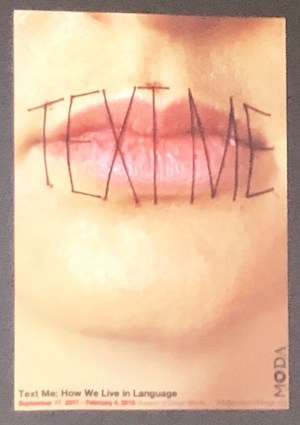
“Text Me” – to address a world where “technology imitates intimacy”.
If you are not part of it, you are out of it. And even if you are part of it, then you can also be out of it. It’s not as inclusive and friendly as they’d have us believe. And with all the negative publicity around how these big tech companies are not as “do-goody” as they’d have us believe, there’s growing disenchantment with big tech, big data and big bullies.
There’s one piece of Maviyane-Davies’ work called “Collateral Damage” where he visualises the smartphone as a mousetrap. Another “Text Me” shows a girl’s face with her lips sewn up.
The thing is, how will we respond? Are we willing to stay in the mousetrap? Do we have a choice?
Of course, we have a choice. A friend of mine decided to quit Facebook and Instagram about a year ago – he had built up a huge fan base by “gaming” the system to prove a point and then found he was getting increasingly grumpy and angry with the things he was seeing and reading on his social feeds, and so decided to go cold turkey. When I asked his son how his father had changed, the reply was, “He’s less grumpy now.”
Governments recognise loneliness as a societal problem. This article speaks about how half a million Japanese are suffering from social isolation and how the UK has appointed a minister for loneliness, the first in the world, and gives ideas on how to create more connections in cities.
I know many property developers and entrepreneurs who are trying to address this by reimagining living and working places. “There’s a real interesting interplay between real estate and the creation of new kind of living and working spaces, beyond co-working,” said a VC friend who will be focusing on this opportunity in 2019.
Prediction: The love affair with social media will continue but we’ll migrate to more closed groups and messaging will evolve into their own “worlds” of communication, content and commerce, and models in Asia will lead the way.
2. Don’t put tech first, put the work first

(Image credit: g-stockstudio/Getty Images)
When I asked Maviyane-Davies if technology had changed the way he worked and his creative process, he said, “What I have to say has not changed. I am not against technology but as I get older, I look at issues through a wider lens. You now have the ability to reach more people but it’s harder to target. So do you increase the number of people you reach or do you do the work? My thinking is, do the work and hope people get to see the work.
“As artists, it’s to find a different way to talk about the world than anybody else.”
So don’t talk about the number of followers you have – this article about this rock star, Threatin, who faked his fame and fooled millions – should be a good warning. Talk about your work, differently.
And be prepared to work even harder. Don’t believe that tech makes things easier, it doesn’t. The number of startups I can count (or rather lost count of) who think the idea they had was so simple and could be executed easily and then get caught up and tangled in the execution … and then find they actually have to build something real and tangible offline before the online world works in your favour.
Catching up with a VC who manages a diverse portfolio of tech startups, with two in travel, I asked him, “So what’s your outlook on 2019?” His reply, “S… will happen and s… is already happening.”
Prediction: It’s going to be a super tough year for startups – those trying to raise money and those who have raised money. The few big ones, which have raised billions, may have become too big to fail but in their trail, there will be loads that will be squeezed. Flight to profit will happen. So, do the work.
3. Find something to care about, do not be indifferent

(Image credit: KeongDaGreat/Getty Images)
It’s easy to be apathetic in a world where we are all so comfortably numb in our urban lives. Want food? Get it delivered. Want a ride? Tap for it, and whine about the high fares. Want a friend? Add. Want more likes? Like in return. Want a movie? Stream it.
What’s there to care about?
But like Maviyane-Davies said, there’s so much in the world to care about. “There are so many things I want to work on. Yemen, it hurts me and finding the best way to address that is difficult. I have to find visual metaphors that people are familiar with. Ninety percent of my work that you see – there are 100 ideas before you get to the one.”
In travel, there’s much to care about.
At Explore 18, during the “Women In Leadership” session, we were all asked to make a pledge on what we would do to support this initiative. On the board, I read, “I will interrupt less.” “I will listen more.” “I will set aside time to mentor.” Mine was “to build a bridge between travellers and local communities”.
Need not be big things, just little steps that lead to incremental change.
Said Maviyane-Davies, when asked how he measures the impact of his work, “I can’t quantify the impact of my work. There’s no one poster that can change the world. You can communicate what you believe in the world and it’s up to us, citizens, to change the world.”
Less Prediction, More Wish: More companies will embrace a cause. “Women In Leadership” seems to be in fashion right now among the big travel companies. “Sustainability” is another, starting with reduced use of plastics, the big theme for 2018 spilling into the new year. These initiatives will move beyond slogans and will become increasingly local in their outreach and execution.
So, it’s up to each of us in travel to change travel for good. They do say that the years ending in 9 are significant – a turn of the decade – where something fundamental shifts as we get to the noughtie years. Post-search, post-social, post-mobile, post-messaging – what’s coming?
The general consensus, when I speak to most industry leaders, is it’s going to be a tough year – budgets will be squeezed, capital will dry up which may not be a bad thing, there will be more angry actions throughout the world – but one thing we know, the more misery and loneliness there is in the world, the more people will need to travel. We just have to ensure we address those motivations well.
So here’s to a great 2019. As tough as it’s going to be, we’ll ride it out together.
Happy New Year.
• Featured image credit: oatawa/Getty Images