



Each of them was a previous Startup of the Year pitch winner at WiT. Since then, they have each gone on to build amazing companies, helping to bring even more global attention to this new Asian century.
Now, as the WiT Singapore preview noted, each is now preparing their bid to “take it to the next level – the future is truly theirs to grab, the story theirs to write.”
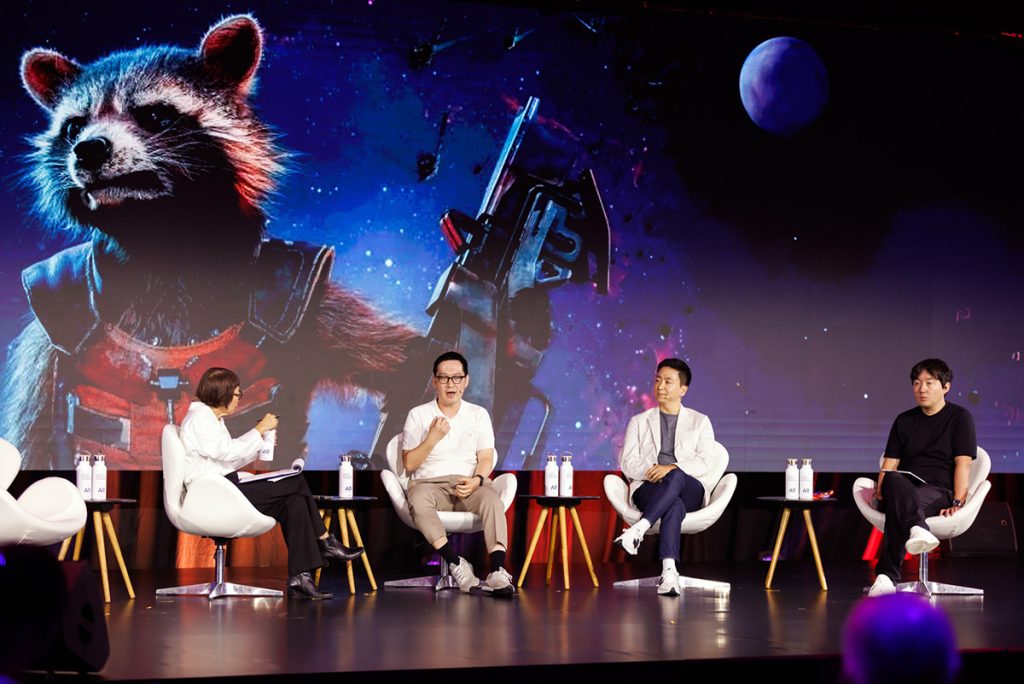
And thankfully, when it comes to Donggun Lee, Takaya Shinozuka and Jiha Jung, the three founders and CEOs gathered on the Marina Bay Sands main stage, they were also three left-field leaders, with an eye for as many cheeky asides as they had insightful takes on the future of Asian travel.
As WiT founder Yeoh Siew Hoon observed, all three of these travel young guns were at the time, gifted with the label of being the ‘next big thing’ in the travel industry.
“The three of you stood on the WiT stage as startup winners: Takaya, you won in 2013 with Relux, which was a marketplace for luxury accommodation in Japan, especially ryokans.
“Donggun, you won at WIT Japan a year later for your tours and activities marketplace for Korean travellers.”
“And Jiha, you won at WiT Seoul in 2018, for what you called an ‘OTA 2.0 model based around social and user-generated video content.’”
So she enquired, what were the major differences between the founders who pitched the WiT floor back then – and those who returned to Singapore in 2025? And more pertinently, what did they now see in store for their companies, and Asia travel, in the years to come?
The Seoul survivor who bet big on company culture
For Donggun Lee, Founder & CEO of MyRealTrip, despite the thrill and opportunities of winning at WIT Japan, for a tours and activities marketplace for Korean travellers, the immediate priority, at the time, was to find his feet in the travel industry.
“At the time, as a founder, my top priority was securing sustainability – so survival was a very important issue – and my key role as a founder was to get funding from the VCs,” recalls Lee.
How then, would he summarise his journey? “I would say, ‘Rome wasn’t built in a day’. As a founder, you have to admit that if you want to create a great thing, like your own Roman Empire, it takes a long time,” he notes. “It has already been 13 years since I found this business.”
Yet at last, he says, the company has finally gained some room to breathe. “Since last year, we are making a profit. So currently, as a founder, my key role is to map the picture for the next decade.”

So what does will picture look like? In short, Lee sees a world amplified by automation – where humans roam far and wide.
“AI is redefining our galaxies,” he notes. “We are using a lot of AI technologies to increase our internal productivity and increase our quality of customer experience. But I still believe travel will play a key role for human life, even in an AI age – and I plan to build a galaxy whereby AI technology helps people travel a lot more, not less.”
In 2025, Lee’s home market is now the second biggest outbound market in Asia. For a population of 28 million, Koreans accounts for 48 million trips per year. While MyRealTrip started out selling tours and activities, it has since moved to full-OTA status, adding flights and hotels too.
“You’re now swimming with the big sharks, because Korea is so competitive,” observes Yeoh. “How are you competing with the global OTAs now?” For Lee, in many ways the real test has been less about competition, and more about patience and grit.
“It has already been 13 years, and now we’re making a profit. My ultimate vision was to be a local player based in South Korea, doing outbound business very well, plus domestic and inbound. Last year, I started our inbound business, focused on medical tourism. It’s just a start: but I think for me, the ‘big shark’ is more one of satisfaction.”
He sees ahead of him, a big opportunity to leverage on his country’s global reputation for beauty and transformation. “Every South Korean high school student wants to go to medical school to be a doctor – and smart medical students want to major in aesthetics,” he quips. “There’s a huge opportunity in aesthetics, plastic surgery or the dental cleaning market. So my big bet is focusing on inbound business, especially aesthetic tourism.”
In Korea’s highly automated, super-competitive travel market, much can be copied. Yet one aspect that will protect MyRealTrip’s IP, Lee asserts, is the care it has put into talent and team spirit. “I think one thing they can’t copy is our company culture. I usually hire people very carefully, and with high standards – and we really have a culture of ownership. Our employees, act and think and execute like founders. I think that’s the thing other companies can’t touch.”
Compared to founders in markets like the US, what is one thing about being an Asian founder that outsiders may not understand? “I think the ecosystem in Asia is a little bit different from, the US, for example,” Donggun notes. “It is not easy to make a quick exit. Being a founder in Asia means you should invest a lot of time, and you should be patient.”
Powered by Punk Rock spirit, driven to share his freedom
For Takaya Shinozuka, CEO & Founder, Reiwa Travel, being different in a sea of sameness has never been an issue. In his younger years, he shared dreams of entrepreneurship with an early obsession for punk rock – something that helped him weather a conformist culture in Japan, and an ultra-individualistic environment in America.
So how, Yeoh asked, has Shinozuka changed as a founder? “This is my second startup,” he reflects. His first, Relux, was only focused on the luxury Japanese travel market, a platform that proved too narrow. “So my vision now is pretty big: because for a startup, the vision really matters to a company’s growth,” he notes.
That said, having a bold vision does make his working days sound fairly intense. Shinozuka finds parallels between his work, and that of Jack Bauer, the fictional star created by Kiefer Sutherland in the TV drama, 24.
“It feels like, every minute of every hour, something new happens. Like, every day or every week, there’s something happens I need to fix. Then even after we fix some problems, the next one happens – and the next is always bigger than the previous one,” he smiles.
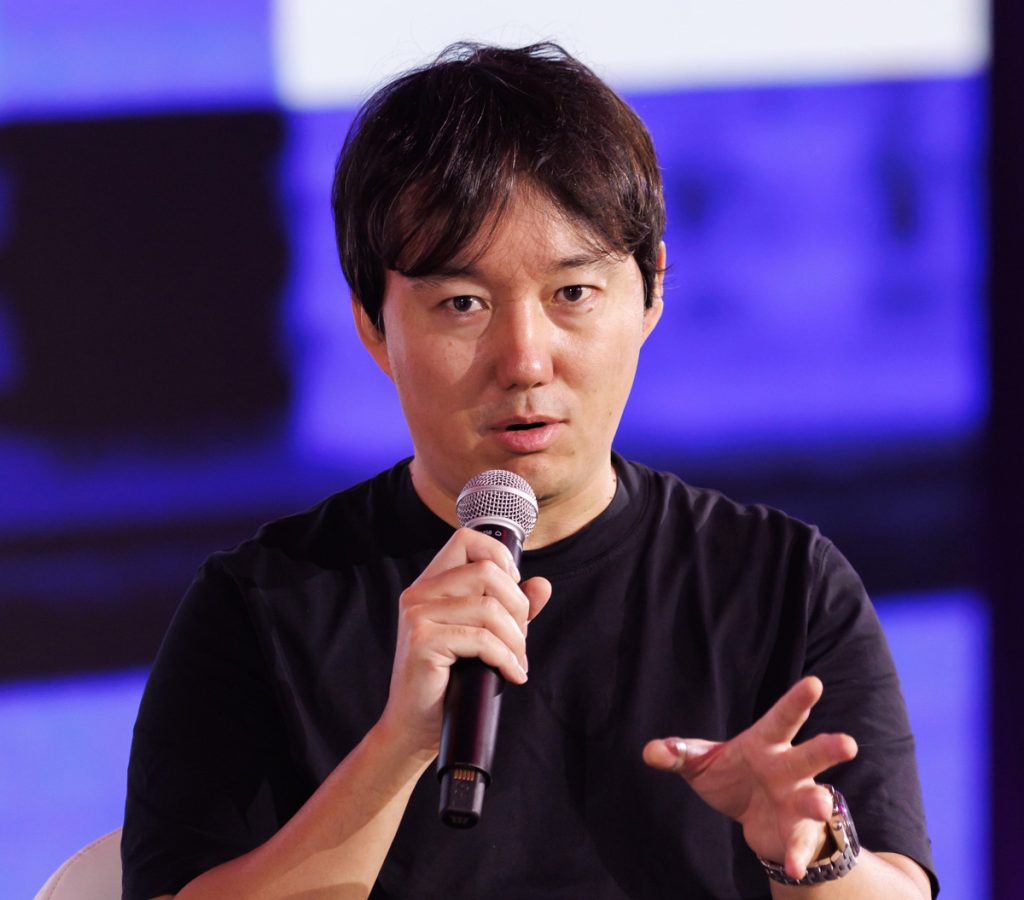
Yet if that sounds like a horror show, Shinozuka is in his element. “It’s really fun,” he quips. “Maybe Jack Bauer himself was really having fun, fixing all those problems.”
The travel galaxy that Reiwa is seeking to build is one where his fellow Japanese can enjoy all the overseas fun and freedom that he has – and do so with ease. “We are here to make booking travel easier than ever,” he notes. “Of course, we’re using AI technology for that, by combining beautiful design and user experience. Then also, by adding the perspective that our Japanese people, from our perspective, don’t go abroad so much,” he noted.
“Compared to South Korea, Taiwan and other destinations, only 20 percent of people will travel. I want to fix that problem. So that’s my next galaxy.”
Many in the audience at WiT Singapore were amazed to learn that currently, only 17% of Japanese people have passports. “Yeah, I think ease of travel really matters. For all Japanese people travel, going abroad looks really difficult,” Shinozuka noted. “And in Japan itself, we have so many sightseeing places, and so much good stuff to enjoy, the food, the change of seasons. So we don’t necessarily need to go abroad.
“My mission is, to help tell people that the world is the world is very beautiful and, how when you know the world better, it’s very good for their lives.”
Having sold Relux to KDDI Media, Shinozuka started Reiwa, flush with a zeal to simplify travel packaging. So what’s the hardest part? He looks sheepish. “Actually package tours are much more complicated than I expected,” he admits.
“My first company was focused on a hotel booking service OTA. While I wouldn’t say it was easy, package tours are that much more complex: we have to buy flight inventory, hotel inventory, and activities too: and mixing them all together – then I have to price it too.”
Thankfully, AI technology is readily available, thanks to the influence of PKSHA Technology, an AI-first firm that recently invested in Rewa. “Given the complexity of our package tours, we’re using AI technology for that, while our big competitors take a longer time using human labour – so that’s a big advantage.”
So what to Shinozuka is one thing about being an Asian founder that outsiders don’t understand? The punk-rock loving entrepreneur is clear about one thing: Asia has too many rules.
“Japan and South Korea in particular, have many invisible local rules,” he reflects. “That’s really difficult for other countries. So it really takes time. But it’s very important for doing business in Japan, maybe South Korea too. Yeah, it’s completely different.”
He takes the example of OpenAI’s recently released ‘Sora’. “At first there were so many problems: with the animations and movies,” he notes. “If some companies in Japan did that, it could be really bad by now – maybe it would shut down the product. But the US is not like that. So yeah, it’s completely different.”
Powered by content, fuelled by fans
If you look at Jiha Jung, Founder of Tripbtoz, you might assume at first that the youthful-looking Korean business leader is a pretty relaxed guy. Indeed, like many things in Jung’s life, gaining balance and perspective is something that he has learned with time.
Yet now in his 40s, Jung is already feeling the time passing. “Yeah, back then in 2019, I was a year into being an entrepreneur – and to be honest with you, while I was out there pitching, I didn’t really know what I was talking about at the time,” he admits.
Before he really understood business, or the people around him, it was easier for the younger version of Jung to feel overwhelmed. “Now, after seven-to-eight years of the entrepreneur journey, and meeting so many travel people around the world, I now understand even more about the business model, and the people side of things.”
Indeed, for many startup leaders, learning the ecosystem needed for travel to work can be quite a journey. “Yeah exactly, and we experienced so many things outside of the travel world. Covid was there for three and a half years – many events we had to go through. I’m lucky I survived.”
As such, one of the big lessons for Jung was about self-care – he experienced an increase in vitality, and in turn, more business growth, by embracing intensive exercise. “Two years ago, I started to learn about how to look after my health,” he shared. “I cycle a lot, including tournaments: they really help increase my vitality for business, as well as my personal life.”
Turning to the world he wants to build with Tripbtoz, Jung lays out the structure that he feels is key to the social travel platform’s success. “Our galaxy comprises three different elements. The first is content. The second is community, the third is commerce,” he notes. “The key for us is that we deliberately built upon a foundation of content – upon which are two different pillars, community and commerce. I think that’s how we balance our platform.
“Our influencer celebrities promote their own accommodation, or the destinations,” he describes. “They collect a certain amount of commission from us. Then on the community side, they talk to one another globally and within South Korea. I think that’s how we created our own galaxy, with our own ecosystem.”
The rise of the social travel platform seems to be a trend, echoed by players like AirAsia MOVE, and of course, TikTok. “Yes, but not many players successfully create an ecosystem. That’s the secret sauce.”
Part of building out the next phase of the company’s journey has been building the infrastructure to successfully support inbound travel. “Three and a half years ago, there was one foreign user, who had looked for us. That was first time we earned US$435 in our bank accounts,” he recalls. “It was one of the incredible moments.”

While the platform has a commerce function that monetises the content experience, most payments had exclusively been in Korean won. “The feeling of having USD in our bank account really felt different,” he recalls. “That was the point when I was thinking, ‘We should go global fast.’
The company started to expand to new markets, starting first with Indonesia, setting up in Bali and Jakarta, through acquiring inventory, and partnering with local travel agencies locally. “So that’s the move that we’ve tried, moving forward for the next three years.”
For Jung, one factor that has helped him and other fellow founders, has been his fellow Koreans’ ability to execute. “When I was at Cornell, professors always observed that Koreans did not speak up,” he recalls. “But that’s not true.
“Whenever there’s a political issue, we all speak up. But most importantly, the part that I believe Koreans are really strong at, is in executing. That’s why we have brands like Hyundai, Samsung or LG that are beloved by the global customers.”
Now that it has momentum, what is one factor that makes Tripbtoz hard to duplicate? When it comes to social content, Jung is bullish about his tribe of fans, and their unique ability to execute. “One factor for us is our 3.5 million fans – our young travellers who upload their own travel videos every three seconds.”
From guardians to giants
As the panel wound to a close, Yeoh asked where they thought the next global travel giant would come from. Without hesitation, all three cheekily said, Japan and Korea.
Yes, the future of travel in Asia is in good hands indeed with these three Guardians.


