



As we learned in the recent WiT documentary ‘Online Travel in Asia: The Untold Story’, the travel leaders who made it to 2025 did so by navigating some game-changing hurdles – and in the case of the COVID pandemic, laboured through challenges that nothing could have prepared them for.
Admittedly, this year’s WIT Singapore Innovation Day (October 6) venue at the Sofitel Singapore Sentosa Resort & Spa’s ballroom felt far removed from such cares and concerns – a place where the greatest potential bodily threat feels likely to come from a bad sunburn, a full stomach, or an amorous peacock.
Yet all seasoned travel professionals know far better than to assume that their tranquil surrounding might some equate to easy, breezy business days ahead. I had of course, recently emerged from WiT’s movie debut – a “story of revolution, resilience and reinvention” – and knew that the stories that would shape “The Next 20” would likely debut on the WiT stage.
Thankfully on Day 1, there were ample reminders of the sort of traits and unique skills that travel’s future leaders would require, to face tomorrow’s challenges with clarity and purpose – starting of course, with two guest entrepreneurs made famous by the land of Braveheart.
Solve real problems: use cutting-edge tools, and automate well
Founded in Edinburgh, Scotland back in 2003, then sold to Ctrip (now Trip.com Group) in 2017 for £1.4 billion, Skyscanner is the story that made many in Britain especially, sit up and take notice of the promise of online travel in the new Millennium. Surely, many thought, this story spelled the gateway to travel’s great beyond.
Yet as Skyscanner co-founder Barry Smith told the WiT crowd, the original genesis of the business model emerged from three friends seeking to rid themselves of the drudgery of their recent day jobs. The three bankers, hating their jobs in London’s financial district, were fuelled by a determination to work together on something fun. “Yet no one had an idea of what that would be,” he recalls.
“The three of us agreed that whoever came up first with the one idea that the other two felt could be a goer, we would spend our time trying to develop that. I think Skyscanner was probably idea 50 or 60 that came out.”
Of course, each young banker would not be easily swayed into accepting that their idea wouldn’t produce the best plan. “Each of the three of us had an ego that wanted to be the one who came up with the idea that the other two agree with. So the guys didn’t like my idea of Spotify,” quipped Smith, an obliging audience cackling knowingly.
As with many great start-up notions, Skyscanner emerged from cleverly solving an existing problem. Fellow co-founder Gareth Williams’ brother, a ski instructor in France, needed a coded online solution that indexed the flight prices from local carriers such as Ryanair and Go Airlines, into a spreadsheet. Despite the “devastation” of Williams’ two friends and roommates, version 1 of Skyscanner was born.
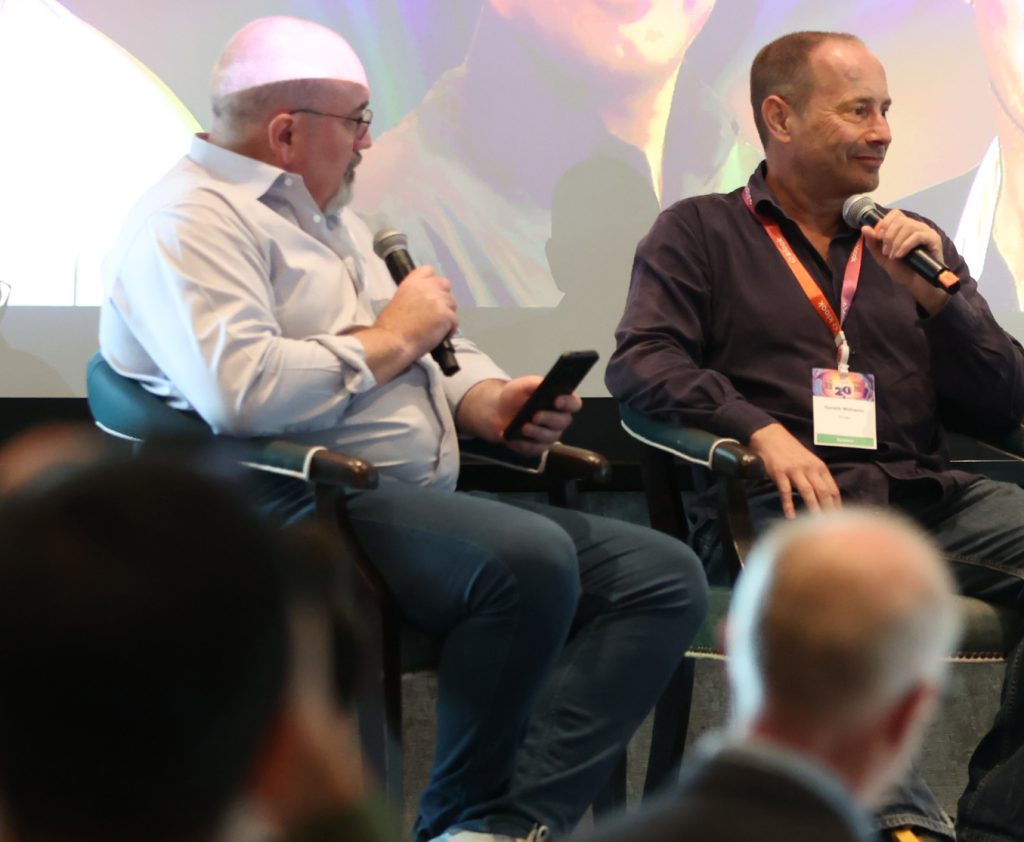
Barry Smith, co-founder of Skyscanner, interviewed by Agoda’s Timothy Hughes during the WiT Bootcamp at WiT Singapore: The Next 20
Yet as Gareth himself attests, that did not mentally equate to instant fame and fortune. “It was a surprise that the sector could even survive,” he reflects. “I think our perspective was that there wasn’t a business model. But we figured, ‘The information needs to be in the traveller’s hands’, because it was just unviable having only partial information. So we just started with that premise.”
There were of course many hurdles to navigate before this idea would eventually become scalable or sellable. Yet as Smith would later learn, the team’s determination to solve big and important problems would become one of the keys to the company retaining its top technology talent.
“We used to think fairly crassly, that salary was the key driver for these people. But we had a number of sessions with the teams to actually get to know what drove them,” he describes.
“And one of the top three things that drove these engineers, was, it wasn’t the salary number – though of course that mattered somewhere in the list – but it was, ‘I want to I want to be on the toughest technical problems available, and I want my code to go live’.”
Williams offered a key piece of advice to future founders: automate the processes as much as you can before you hire any new recruits. “Realise that hiring someone is the last possible solution to a problem you’ve got – and with AI, you’ve got a lot to explore.
“It’s not because you don’t want wonderful people joining you. It’s because every person increases complexity,” he notes. “To the engineers’ mind, with AI tools, you can automate a lot. You can make the same team, deliver a huge amount more, and explore those solutions.”
Build into the gaps: Find your Tribe, and innovate through crisis
Another accidental travel entrepreneur, Jacinta Lim, co-founder of Seek Sophie, shared how, once a legal career was clearly out of the picture, her company grew from a belief that what she and her friends were seeking, didn’t exist in the online world of the time – and that was a travel service driven by a sense of humanity and trust.
“We started Seek Sophie to answer our own questions,” she describes, recounting an online world at the time where every piece of content was being optimised for SEO. “We looked at it and said, “There’s no heart in that, no storytelling. A big part of what we wanted to do was come up with the storytelling, and come up with the content around it – something that showed us, authentically, what was on offer.”
Shrugging off the travel industry’s obsession with automation, Lim and her co-founder and COO, Lina Gedvilaite, felt strongly that enough of their generation would want something from their travel experiences that didn’t exist. “People want to hear from someone who has been there – and not just from a bot,” she insists. “And the more we bring out what is special about a place, the more people will trust us.”
From the outset, Seek Sophie tried to grow without venture capital, given VCs tended to pursue “growth at all costs – but I wanted to grow in a profitable and impactful way, without going down that route,” Lim noted.
Yet similar to Skyscanner, she did take up coding early on, determined that she should avoid the cost of expensive engineers. That said, building a platform from scratch proved very stressful. “Every single time I pushed out any new changes, I was so scared it was going to crash.”
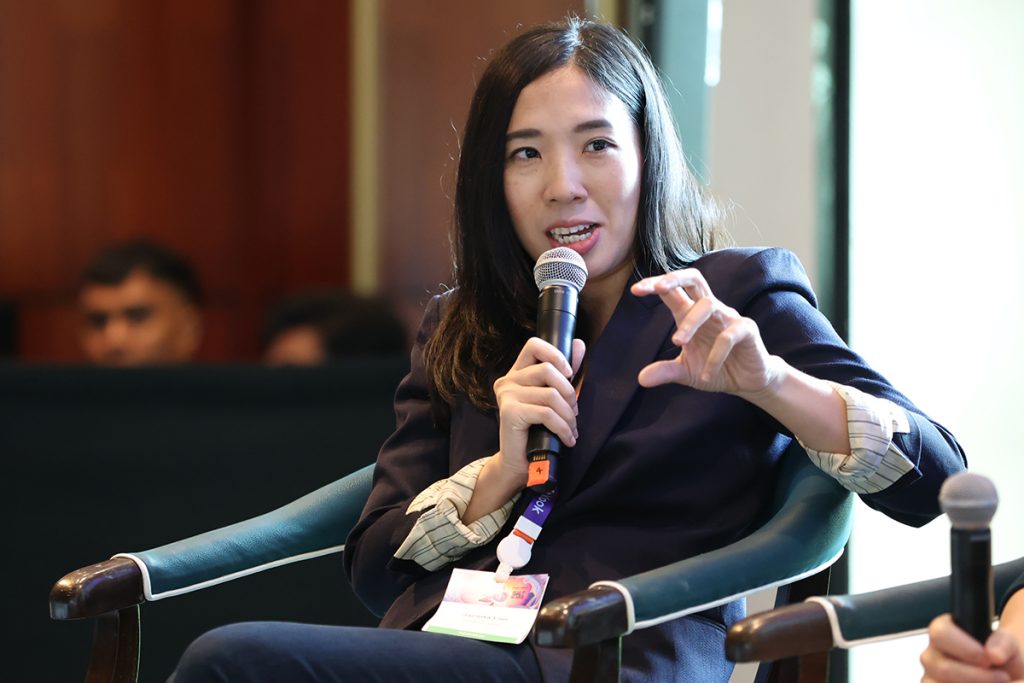
Jacinta Lim (CEO, Seek Sophie): “People want to hear from someone who has been there – and not just from a bot. And the more we bring out what is special about a place, the more people will trust us.”
The pandemic would prove a turning point for the company, for reasons both good and bad. First, having had their best week on 13 March 2020, the COVID-19 lockdowns sweeping through Asia meant swathes of cancellations and refunds. The immediate negative impact on Seek Sophie’s network of tiny family-run businesses, was “heartbreaking”.
Yet for Lim, who led the Next Generation Leaders’ group discussion on “street smart resilience and moral empathy”, the pandemic’s string of structural impediments would provide the ultimate test of both of these qualities. And in the end, she describes, the crisis was also a time when the founders stumbled across some of the innovations that helped their platform take off.
“We said, ‘Okay, there’s a lot of creators that still need to make content’. Yet they had nowhere to go,” she recalls. In response, Seek Sophie sent local photographers and documentary-makers on free experiences that were safely within their respective local ‘travel bubble’. A win-win for both the domestic-bound creators and the local businesses alike, this proved a water-shed moment.
“That’s when the business really took off – because you had all these hidden experiences, and these very professional photographers and creators able to tell really good stories around them,” she recalls. From a model anchored around making their own content, growing this new creator community meant a new professionalised ecosystem, that became “very powerful” as a customer hook. “If you see really good story content, you’ll feel, ‘Oh, I really want to do this. I really want to go there’,” she describes. “And that was when we basically skyrocketed.”
Shaped by the architecture and influence of today’s small group social networks, many in Lim’s generational cohort increasingly find their status and intrigue through collecting unique experiences. “Social media is a very big part of it – travel has become the new luxury,” she describes. “Experiences today have become the new designer handbag.”
When tragedy strikes, listen to what your heart tells you next
While many who worked inside this fragile industry over the past five years have been no stranger to struggle, few business owners begin from a base of genuine human tragedy.
But when Simon Wong, co-founder of Singapore Sidecars, lost his young wife to cancer, there was no doubt that whatever he did next would be a journey through loss. “This project was born out of grief, and then it became a channel for healing,” observed WiT founder Yeoh Siew Hoon. “Ten years on, how has the emotional journey initiated you?”
“I think initially it was really a lot to do with it being a channel for grief,” Wong reflects. “And how do you turn that into something positive? I spent two years sitting at home just staring at the walls,” he recalls – noting that while those around him knew he was in pain, they trusted he could make it through.
Wong admits that a “cheesy” TV commercial served as a turning point. “There was a young couple walking through the autumn forests in Europe, and that’s exactly what me and my wife used to do,” he recalls. Then in the advert, the girl becomes sick, as the guy sits bedside: a seat that Wong personally knew far too well.
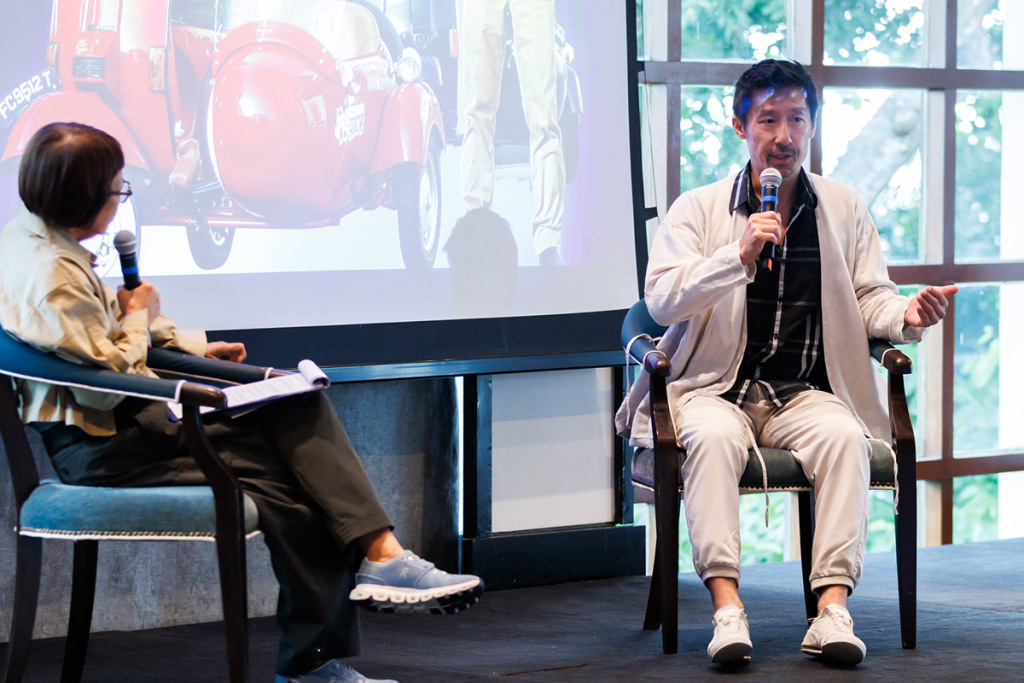
Simon Wong (co-founder, Singapore Sidecars): “Tai Chi is built for you to encounter and deal with superior forces. But the idea is never to meet the force head-on: you always find there is always a point of least resistance,”
“Then there was a tagline from her. ‘I would only be happy if I know that you were happy.’ And I thought, ‘You know what? That’s the best way to do it. I’m going to live a life even better than before – and just keep making things better. That’s the way to make her happy.’ And Singapore Sidecars became the project to do that.”
Born initially as an effort to raise charity money for cancer, Singapore Sidecars began scaling a decade ago, thanks to a local tie-up with the Singapore Tourism Board. Now, thanks to a string of partnerships with five-star hotels in the Lion City including Capella, the Fullerton, and the Mandarin Oriental, the company made a shift in 2025 to an all-electric fleet of sexy scooters-with-sidecars.
This has made the company a perfect addition to any event, ranging from Singapore Zoo, or The Open in St Andrews, Scotland – and indeed on the main stage of WiT Singapore.
The clear sky is now the limit for this zero-emission transport provider. “We are talking to a few guys overseas. We’ve had a few conversations in London,” says Wong. “Very likely we’ll be rolling them out in Barcelona with a hotel partner.”
As someone who has faced his share of personal challenges, Wong still emits a refreshing sense of calmness when you meet him – perhaps due in no small part, to his embrace of the ancient Chinese practice of tai chi.
How does he apply the practice to work challenges? “Tai Chi is built for you to encounter and deal with superior forces. But the idea is never to meet the force head-on: you always find there is always a point of least resistance,” he shares.
The practice means that at their best, adherents can take on rivals far bigger than themselves” “It can be twice your size, it doesn’t matter. Everyone has a centre of balance – and that’s where you hit.”


