



New Loyalty Trends Report 2026 by Marriott Bonvoy shows loyalty engagement is increasingly driven by travel priorities, everyday value and market-specific behaviors.
The new Loyalty Trends Report 2026 by Marriott Bonvoy finds that while 89% of travellers across APEC participate in at least one loyalty program, how they engage is no longer uniform. Instead, engagement is shaped by a combination of travel priorities, everyday value expectations, and distinct local market dynamics, signaling a clear shift away from one-size-fits-all loyalty models. Among those surveyed, millennials aged 30 to 45 emerged as the core audience engine driving loyalty program participation across the region, with Indonesia and Vietnam ranking as the markets most enthusiastic about joining loyalty programs.
Travel passions shape loyalty engagement
Findings from the trend report indicate that travel passions are the strongest indicator of loyalty engagement. How travellers earn, redeem and value loyalty benefits varies most by what they travel for, indicating that successful loyalty design needs more breadth and depth to serve different interests across diverse markets.
Speaking at a media briefing, Mei Xue Ying, VP Marketing, Asia Pacific excluding China, Marriott International, said “Travel passions form a primary driver in how members engage with loyalty programs. How a traveller decides to earn, redeem and use their benefits is very largely dependent on the reason why they are traveling — and only by understanding these differences can we better craft the value proposition for members across different travel groups and markets.”
The report identified the top five travel priorities across APEC: Food & Dining, Nature/Sightseeing, Shopping, Cultural Immersion and Recharge & Disconnect.

Mei Xue Ying, VP Marketing, Asia Pacific excluding China, Marriott International, said “Travel passions form a primary driver in how members engage with loyalty programs. How a traveller decides to earn, redeem and use their benefits is very largely dependent on the reason why they are traveling.”
Food & Dining emerges as the most powerful driver of travel and hotel loyalty, with 63% of APEC travellers prioritizing culinary experiences when planning their trips. Food & Dining travellers show especially clear loyalty behavior: they are more likely to earn through food-related activity and redeem for F&B indulgences, making food one of the most powerful and scalable levers for hotel loyalty engagement.
Recharge & Disconnect travellers are the largest opportunity group for hotel loyalty growth. While less likely than some other traveller groups to be enrolled in hotel loyalty programs, they are highly engaged once they are past property doors. They are more likely to stay at hotels, resorts and villas with a partner, and earn hotel loyalty points through stays, F&B and spas, indicating that for Recharge & Disconnect travellers, properties are the destinations.
Cultural Immersion and Shopping travellers, meanwhile, show a distinct preference for earning loyalty points through co-branded credit card spending, leveraging their travel purchases to accelerate points accrual across partner ecosystems. Solo travel is also notably prevalent among Cultural Immersion and Shopping travellers, who value the freedom to connect with local communities and other travellers on their own terms.
Hotel loyalty sits at the heart of travel loyalty
Hotel loyalty programs are the most widely participated loyalty category across APEC, engaging 66% of travellers — ahead of airlines, retail and dining programs. Membership retention is strong, with most travellers staying enrolled for more than two years — signaling that hotel loyalty continues to anchor travellers’ relationship with brands.
Engagement levels vary by market. “Singapore is a market that is quite a cluttered space from a loyalty program perspective,” added Xue Ying. People here are very savvy — they know how to maximize — and that is precisely why they sit within our Value Optimizers group. It requires us to think more creatively: finding ways to make earning broader, and ensuring our experiences feel genuinely relevant to consumers in this market.”
Immediate, everyday value matters most
A clear baseline expectation cuts across APEC: everyday earning is non-negotiable. The ability to earn points from everyday spend is the most important feature of a good loyalty program. Unlocking value through point redemptions vary: 77% of travellers use points for small rewards they can access right away, 61% for big-ticket items and 37% for exclusive experiences. Notably, this APEC-wide appetite for exclusive experiences drops to 19% among Singaporean travellers, further illustrating the market’s preference for immediate, functional rewards over aspirational ones.
Beyond earn and redeem mechanics, gamification has emerged as a meaningful engagement lever across APEC. Consumers responded strongly to mission-based mechanics — challenges and unlockable tiers where completing defined behaviors yields bonus points or exclusive benefits — pointing to an opportunity for hotel loyalty programs to introduce elements of play alongside transactional utility.
“For a loyalty program to be successful, you need to design rewards on the basis of a good balance — something highly aspirational on one end, and something that delivers practical, tangible value on the other. A well-structured loyalty program has to be able to cover both,” explained Xue Ying.
Partnerships power hotel loyalty
Hotel loyalty programs plugged into a broader partnership ecosystem are more relevant. APEC travellers want more ways to earn and redeem points, with half calling for easier earning and spending options and more partner choices for redemptions. This suggests that hotel loyalty is strongest when it extends beyond stays into a broader, everyday ecosystem.
Hotel loyalty earning across APEC is driven primarily by stays at properties (57%) and co-branded credit card spends (53%), followed by food delivery and dining (48%) and retail and e-commerce partners (45%). This suggests that hotel loyalty grows best when programs align with travel and everyday spend.
John Toomey, Chief Commercial Officer, Asia Pacific excluding China, Marriott International, said “Partnerships have probably been our secret sauce — bringing in great partners that meet the needs of our consumers. We are linking to airlines, to food delivery platforms, to e-commerce. Our members have the opportunity to go through our program and enjoy all of those benefits, and that is what differentiates us from other hotel loyalty programs.”
On the redemption side, travellers most often use hotel loyalty points for property upgrades (58%), small F&B indulgences (57%) and practical travel perks (51%), indicating members value rewards that enhance travel experience.
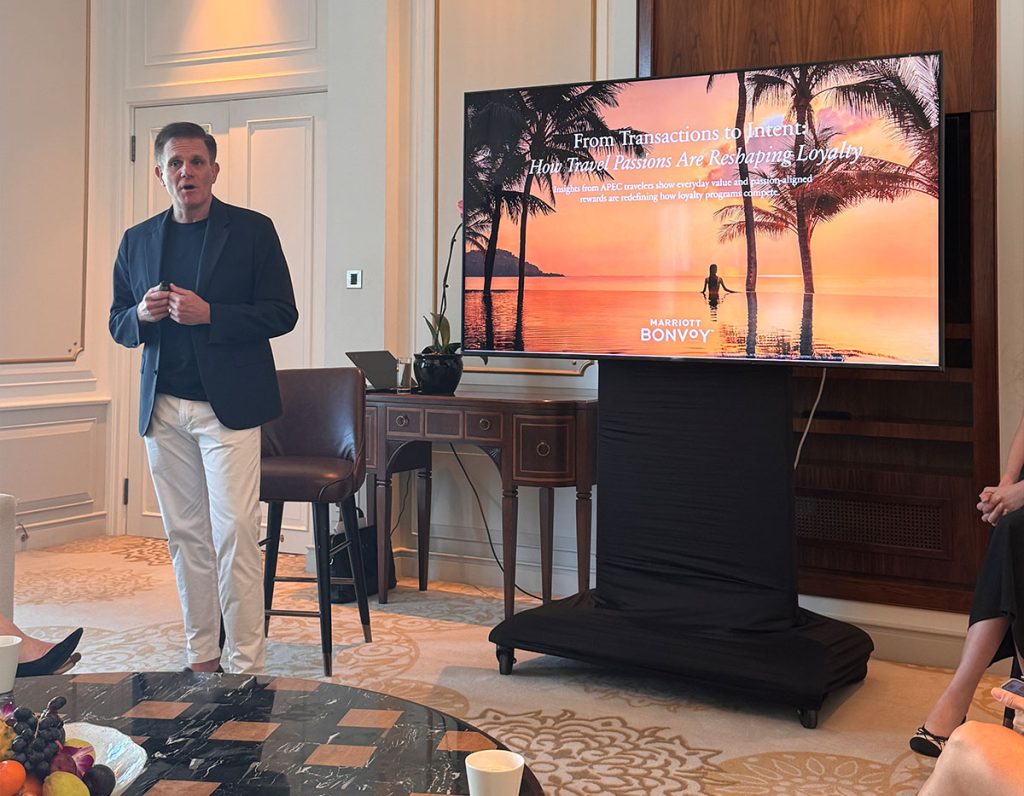
John Toomey, Chief Commercial Officer, Asia Pacific excluding China, Marriott International, said “Partnerships have probably been our secret sauce — bringing in great partners that meet the needs of our consumers.”
Three distinct loyalty mindsets ien APEC
The report identifies three distinct loyalty mindsets in APEC markets, each with different expectations of hotel loyalty programs.
- Loyalty Strategists: Japan and South Korea
In these mature markets, loyalty behaviors are highly deliberate, rational, and optimized. Travellers in these markets engage with loyalty programs as strategic tools — maximizing value through disciplined earning, frequent use of co-branded cards or stay-based accrual, and practical redemptions such as F&B or cost offsets. For these travellers, consistency of loyalty programs build trust, and engagement with various programs is deliberately curated.
- Value Optimizers: Singapore, Australia and Thailand
Value Optimizers sit at the pragmatic center of the loyalty spectrum. Travellers in these markets are active but selective, engaging with loyalty when it clearly improves trip value, flexibility or efficiency. They respond strongly to direct booking incentives, milestone bonuses, upgrades, and practical perks such as late checkout or room enhancements. They are more attracted to hotel loyalty programs that provide tangible enhancements to their travel experience or deliver visible savings.
- Experience Seekers: India, Indonesia and Vietnam
These high-growth markets engage with loyalty both emotionally and transactionally, with travellers showing stronger interest in partnership ecosystems, exclusivity, status and memorable experiences. In these markets, loyalty serves not only as a savings mechanism but also as a gateway to aspiration and discovery. These markets also show rising affluence and represent the region’s strongest growth engine.
Together, the emergence of these loyalty types reinforces a central finding of the report: loyalty growth in APEC will not be driven by a single regional playbook.
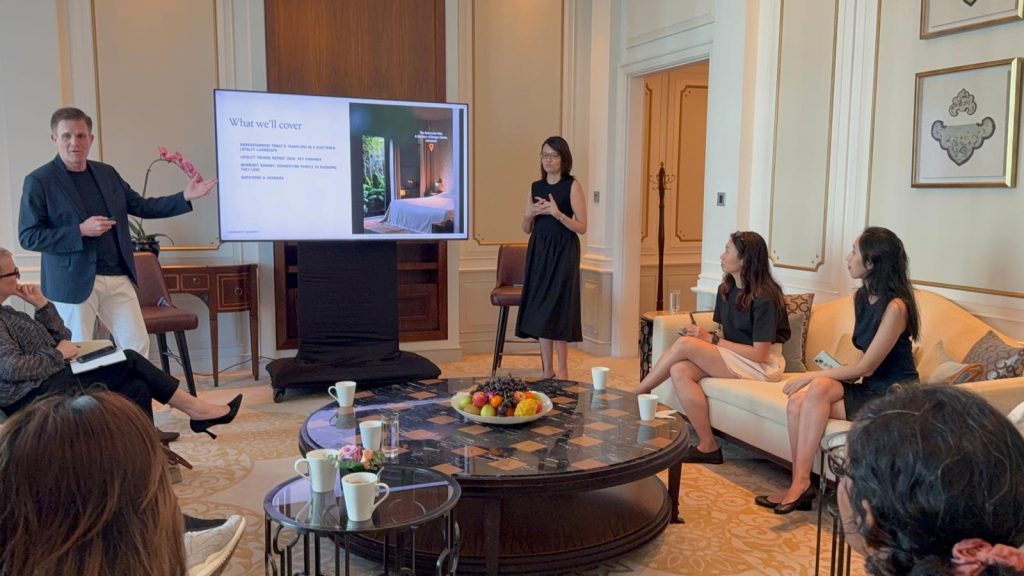
“A one-size-fits-all approach does not suit this part of the world. You cannot use a single regional playbook — it really has to be more hyperlocal and nuanced based on the audience you are trying to reach,” said Xue Ying. “Only by understanding local behaviors can you design a program that remains truly relevant and drives lasting engagement.”
“Hotel loyalty programs must evolve into adaptive ecosystems that grow with travellers, rather than simply around them,” added Toomey. “In a region as diverse and fast-moving as APEC, brands that deeply understand local behaviors and cultural nuances will move beyond scale to earn lasting relevance and advocacy.”


