For Yock Song Law, Co-founder of Ludus Lab, accessibility in tourism is more than just a compliance checklist – it’s about unlocking opportunities, changing mindsets, and building a truly inclusive travel experience. His recent decision to exit Tribe Tours and focus completely on Ludus Lab was sparked by a personal shift in perspective, inspired by working with persons with disabilities (PWDs) and recognising their strengths.
“I was inspired by the people,” Yock Song shares. “When we were working alongside them, creating the tours at the Enabling Village, I started to see their passion, their resilience. It’s really about looking at their abilities rather than their disabilities.” That realisation fueled his motivation to do more. “Accessibility is not just about infrastructure. It’s about focusing on their abilities and crafting opportunities that truly include them.”
“They are masters of improvisation and innovation. And so, that gave me the motivation to want to do more for them. And so that’s quite a personal shift,” adds Yock Song.
Beyond personal inspiration, Yock Song sees a growing market for accessibility-driven initiatives. “Globally, there are more and more persons with some form of disability. Many of us will eventually use assistive technology – glasses are already a form of accessibility tool. The potential is there, not just for tours, but for an entire ecosystem of experiences, consulting, and accessibility solutions.”
He adds that Singapore’s aging population and the country’s push for inclusivity, through policies like the Enabling Masterplan, makes this the right time to take action.
Challenging misconceptions about accessibility
One of the biggest misconceptions about accessible tourism, despite increased awareness, Yock Song says, is the assumption that accessibility is only about wheelchair users. “I learned this the hard way. When we think about accessibility, the first thing that comes to mind is wheelchair users. But actually, they account for only 10% of travellers with disabilities. The broader scope of accessibility includes neurodivergent travellers, individuals with sensory impairments, and those who face mobility challenges beyond wheelchairs. There’s a huge audience we’re not addressing.”
Another misconception is that accessibility ends with physical infrastructure. “People think that because a building has ramps and lifts, it’s accessible. But what about the digital aspect? What about the booking process, or the information available before a traveller even arrives?” Accessibility must be embedded across the entire consumer journey. “It’s not just about the space, but also about human interactions. PWDs want to be treated with respect; if a hotel guest with a disability checks in, talk to them personally, not just to their caregiver. They’re the paying customer.”
Building an accessibility-first organisation
Ludus Lab aims to integrate accessibility into every aspect of its DNA, rather than treating it as an add-on or, in harsher terms, an afterthought. “The first step is adopting a people-first approach in everything we do,” Yock Song explains. “It’s about the ‘heart-ware’. I think whoever that we engage or hire needs to actually adopt the right empathy, as well as a very people-first approach in terms of the program design.”
One major aspect of this philosophy is hiring PWDs as part of the team. “When you work with persons with disabilities, it transforms how your staff interacts – not just internally, but also in how the public perceives your organisation. You’re literally walking the talk.” Beyond optics, it provides real-world insights. “PWDs become your test case for whether your policies, tools, and training actually work. You can’t assume you’re accessible unless you work with the people who will use these services.”
Embedding accessibility also fosters a shift in everyday thinking. “If we go out for lunch as a team, we start asking, ‘Is this place accessible? Is it comfortable for a colleague in a wheelchair?’ That kind of mindset change is what builds inclusivity into an organisation’s DNA.
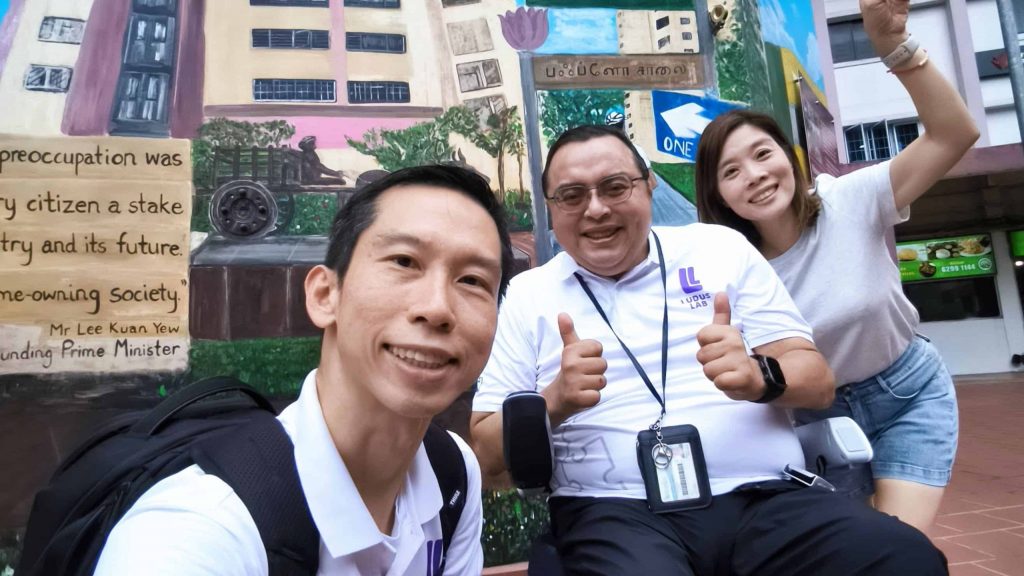
Yock Song Law (Left) on the Little India Singapore Accessible Tour
The business case for accessibility
Some businesses hesitate to prioritise accessibility due to concerns over costs or market size. But Yock Song argues that this is an outdated mindset. “Let’s talk dollars and cents. Globally, 1.3 billion people experience some form of disability. The UNWTO estimates that in five years, one in six people will be over 60. That’s a massive market.”
Moreover, travellers with disabilities rarely travel alone. “They’re usually accompanied by at least one, if not two or three, caregivers or loved ones. So, if you attract one PWD traveller, you’re actually bringing in three or four customers. Your marketing efforts have a built-in multiplier effect.”
Beyond the numbers, businesses that embrace accessibility gain long-term advantages. “It’s not just about compliance. It’s about customer loyalty, positive brand perception, and future-proofing your business for an aging population. Investing in accessibility now means you’re staying ahead of the curve.” With Ludus Lab, Yock Song hopes to drive a shift in how accessibility is perceived in tourism. “We need to go beyond compliance and start thinking about how to truly include everyone. It’s not just about checking boxes – it’s about designing better experiences for all.”
What would Singapore’s tourism blueprint look like if accessibility was the norm?
Imagine a world where accessibility isn’t an afterthought but one of the pillars and building blocks of travel and hospitality. How different would Singapore’s tourism landscape look if every hotel, attraction, and transport system was designed with universal access in mind?
According to Yock Song, one of Ludus Lab’s key initiatives is Accessible Singapore, a crowdsourced platform collecting hotel accessibility data. But as he explains, getting businesses on board isn’t always easy. “I wouldn’t say there’s resistance, but I do think people just ignore you,” he says with a chuckle. “Because it’s not something that’s mandated by the government, right? It’s all voluntary data.” The process of collecting this information is extensive – originally, hotels were asked to fill out a 77-question multiple-choice survey. “It’s definitely not an easy process, and some properties might just ignore it,” he admits.
One of the biggest challenges? There’s often no central authority in hotels responsible for accessibility information. “If you ask about the hotel lobby, they’ll say, ‘Oh, the maintenance team is better positioned to answer that.’ If you ask about the rooms, it’s the housekeeping team. If it’s the restaurant, then the F&B manager. There’s no single source of truth.”
To navigate this, Ludus Lab has taken a targeted approach. “We go with the champions,” Yock Song explains. “There are already hotels and attractions with Enable’s Enabling Mark certification. If we start with those 10 to 12 properties and showcase what they’ve contributed, it can encourage others to participate.”
But he’s also careful about how the data is presented. “We’re not trying to do an audit,” he emphasises. “Sometimes properties feel like, ‘Oh, I have so many ‘No’ answers, does that mean I’m incompetent as a hotel provider?’ It’s not about that. It’s about awareness.”
This awareness extends beyond hotels to the broader community, including corporate team-building activities. One of Ludus Lab’s other initiatives integrates persons with disabilities (PWD) as facilitators in these activities.
The impact has been eye-opening.
PWD involvement from the get-go
“When people interact with a person with a disability, they start to look at their abilities instead,” Yock Song says. “They realise, ‘Hey, you’re just like us, but you’ve overcome so much more.’ That’s really the end outcome of team building, right? Learning to work together, to adapt to problem-solve.”
If accessibility were the foundation of Singapore’s tourism playbook, Yock Song envisions a vastly different industry. “The first thing to look at is Universal Design as a standard,” he says. “It should be integrated from the onset, not retrofitted later.” That means designing attractions, hotels, and transport systems with accessibility in mind from the beginning. He also suggests a certification system similar to Singapore’s sustainability standards. “Just like how the Global Sustainable Tourism Council (GSTC) certification gives Singapore an edge when bidding for events, an accessibility certification could do the same.”
Representation in marketing is another crucial piece. “Right now, marketing materials don’t really feature PWDs,” he notes. “I’m not saying they need to be the center, but accessibility should be part of the message. A fun place to visit should also be accessible.” One success story was Ludus Lab’s Sentosa ‘Wheelventure ’ tour, designed by and for wheelchair users. “The whole idea was co-created with them, making the experience truly accessible.”
Defining success for Ludus Lab
Looking ahead, what would success look like for Ludus Lab? “First, we need to see more PWDs thriving in tourism jobs – not just in back-of-house but in visible, frontline roles,” Yock Song says. “Better yet, seeing someone in a leadership position, openly embracing their disability.”
Second, he hopes to see accessibility become a competitive advantage for Singapore’s tourism industry. “If events and MICE sectors start adopting accessibility standards, that means we’ve moved the needle.” Finally, he wants to see a shift in how society perceives disability. “When we talk about PWDs, it shouldn’t feel like a separate group. They’re just part of Singapore’s social fabric, like everyone else.”
All images courtesy of: Ludus Lab