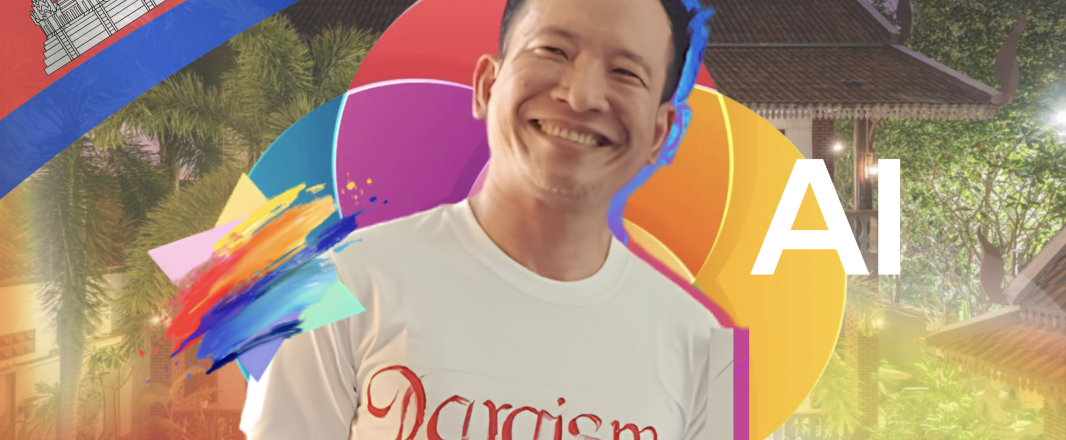
What happens when the former face of a cultural institution steps away, gets stripped back by life, and starts again with only himself, his story, and AI?
There is something not quite straightforward about former CEO of Phare, The Cambodian Circus, Dara Huot’s next chapter.
It is a reinvention, yes, but one done very much in his own way. Not a neat break from the past, and not the sort of polished relaunch that tries too hard to announce itself. If anything, it feels like Dara returning more fully to himself — entrepreneurial, instinctive, values-led, and building again on terms that feel unmistakably his own.
That is where Daraism comes in. When I asked him what it meant, Dara traced it back, unexpectedly, to Ally McBeal. Richard Fish had “Fishism”; Dara borrowed the spirit of that and made it personal. Over time, “Daraism” became, in his words, “an identity”, “the way I do things, the way I think, the values I give, it’s me.” He added, “I have always stayed true to who I am… honesty is the best policy in my life and treat people equitably, honestly, fairly.”
There is another layer to it too. Dara pointed out that “Dara” means star, which is why the star in the company logo matters to him. It is not there just for design, but as a symbol of alignment and guidance in this new phase.
So this new chapter is not about becoming someone else. It is about becoming more fully Dara.
And yet, there is no point pretending this reinvention arrived gently.

For years, Dara Huot was closely associated with one of Siem Reap’s best-known cultural and social enterprises. He spent nearly 13 years at Phare, helping shape a model that brought together art, impact and tourism. By the time he left, this was not a man walking away from a failed vision. “We confirmed that we reach our vision,” he said, adding that the next vision had already been set and the strategy was already in place. He also spoke of his long-held belief in “succession planning” and “replacement planning”, because “an organization cannot rely on one person.”
That matters, because it makes the story harder to flatten into something convenient.
He did not leave because the institution was broken. If anything, he left knowing it had a future beyond him. The harder truth was more personal. “I started to feel not very good inside me,” he said. Then came the line that changes the temperature of the whole story: “my sister passed away… so I became very sick.”
Sometimes a founder does not leave because the organisation is failing. Sometimes he leaves because the body says no before the mouth does.
The controversial part is not what he said. It is what he did
What does it mean when someone so closely identified with a cultural institution decides the next act has to be smaller, more personal and more his own?

Dara had the answer before he had the language for it. For 25 years, he said, he had always called himself “an entrepreneur”, even while working in executive positions. He started young, “10, 11 years old doing small businesses with my mum… on the street, in the market, everywhere.” So even while running an organisation, there was always, in his words, “something entrepreneurial in the executive level position.”
In other words, the CEO title may have fit, but it never fully contained him.
That is why this move feels less like retirement and more like return. Return to instinct. Return to ownership. Return to risk. Return to building something where the line between the person and the product is shorter, and far more exposed.
Still, none of this came with a smooth runway.
In fact, Dara said the difficult part was not simply leaving stability. It was the cut itself, the act of really leaving. He told me he still does not think he has fully left Phare, because his connection with the team, especially the artists, runs too deep. Even now, many still do not quite accept that he has gone.
When Dara left, there was no official announcement. “People don’t know where I am, what I do suddenly,” he said.
That is not a small thing. In travel, your network is not a side asset. It is often the asset. To leave without a formal handover is to vanish, at least for a while, in the eyes of the market. It means rebuilding visibility while rebuilding income, identity and stamina all at once.
He left knowing Phare had to go on without him, but not without difficulty. Nearly two years on, he said, there was still no replacement, a reminder that the mix of tourism knowledge, artistic understanding and trust he had built over 13 years was not something easily handed over. In many ways, that helps explain why leaving never felt clean, either for him or for those around him.
What saved him was not scale. It was coherence
The emotional core of Dara’s story is not hustle. It is coherence.
He said it took him “25 years of career” first “to really call myself an entrepreneur, to start something of my own”, but also to recognise something larger. “Thanks to this experience,” he said, he had found his “confirmed mission in life.” Then came the line that perhaps explains this whole chapter better than any neat summary could: “I did many things in my life… the dot did not connect before. Now everything is connected.”
What seems to have saved him was not simply a new commercial opportunity. It was the rare feeling that the different parts of his life had finally stopped pulling in different directions.

From the outside, what he is doing now may look like several things at once: Daraism & Artists, Oudom Sokhomal Villa & Wellness Retreat, Enterprise Vision Academy, A school for a meaningful Life, “Ask Me About Cambodia Club“. But in Dara’s telling, they are all tied to one deeper throughline: promoting what he calls “Cambodianness”. He describes that as “the collective knowledge and experiences” of Cambodian people, and “the way of life that allows us to be resilient… to continue to be hopeful and positive and to not only survive but thrive.”
Daraism & Artists is not a brand. It is a stubborn refusal to become generic
There is something almost cheeky about the name Daraism & Artists. It sounds self-minted, maybe even a little too founder-ish, until Dara explains it.
Then it starts to make perfect sense.
What he is really describing is not branding. It is authorship. A way of working that is inseparable from the person doing the work. A way of staying recognisably himself even as the structure around him changes.
That matters because his current model is deeply personal. As he put it, “nobody can duplicate Dara.”
That is both the magic and the challenge. Travel today rewards a strong point of view, careful curation and a personal touch. But something shaped so closely by one person is never easy to scale without losing some of what made it special in the first place.
 Dara seems aware of that tension. Some experiences, like his Village Walk, “must be done by me because it’s my personal story.” Others, like the Village Festival or meditation sessions, can eventually be led by artists or other experts. “The organization is scalable,” he said, “though it’s under my name.”
So no, he is not anti-scale. He is anti-meaningless scale.
The villa was not the dream. It was the accident that became the door
Another strong twist in the story is that Dara never actually planned to become a hospitality operator through Oudom Sokhomal Villa & Wellness Retreat.

“I never thought I would have a place like this,” he said. The property came almost absurdly, by chance: “my uncle-in-law just went to put down a US$50,000 deposit on a place, and we didn’t even know, so it ended up under our name.” Today he calls it “my golden door.”
That phrase does a lot of work.
Because what he inherited was not some polished hospitality asset with a strong digital footprint, a ready-made brand, and a neat flow of customers. Quite the opposite. The property “did not have any online presence at all.” He said he inherited “nothing at all except a place that was not well taken care of… no review, no Google map, no name, no nothing.”
This is not a founder cashing out into tasteful hospitality. This is a man trying to make a real asset work in a market where he quickly discovered he could not win the usual room-rate game. “In Siem Reap there are many villas left unoccupied,” he said, and selling rooms one by one at US$45 to US$50 a night simply did not make sense against larger hotels offering breakfast, convenience, and scale.
So the villa becomes something else. Not merely a place to stay, but a frame for a different kind of proposition. A sanctuary, yes, but also a stage for encounters, reflection, curation, and storytelling.
For now, Dara sees this phase as a soft opening of sorts. He told me he is treating July, when he is due to speak at WiT Indie Penang 2026: The Next 20 – Small is Mighty , as the milestone for the official launch of both the tour company and the villa. Before that, the calendar is already beginning to take shape. The first retreat, happening in May, matters especially to him because it is led by a certified teacher from the Art of Living organisation. A second retreat in June will bring together artists and cultural managers, very much in the spirit of the world Dara has spent years building around.

He is not selling rooms. He is selling interpretation
That, really, is the deeper business here.
Dara is not merely creating tours. Nor is he simply packaging a stay. He is turning a lifetime of accumulated empathy, Cambodia advocacy, artist relationships and cultural fluency into a high-touch form of interpretation.
You hear that most clearly when he talks about artists.
This is where his authority comes from. Not from distance, but from proximity. He said he knows the artists’ families, their homes, their children, how they live during rainy season, and what poverty feels like because he lived through hardship himself when his father was sick for more than 10 years and the family “sold everything we had.”

Then comes the line that stays with you: “artists are stars on stage with spotlights but… they come from a very difficult background.”
There is a lot packed into that sentence.
It says something about what visitors see and what they do not, and about the long distance between applause and daily life. He is selling access, yes. But more than that, he is selling context. And in an age when information is abundant and itineraries can be generated in seconds, context may be one of the last defensible luxuries.
That connection has not ended with his departure from Phare. Dara said he still remains involved in artist representation and career development in ways he can, especially around international opportunities. Even outside the organisation, the relationship clearly continues.
His mission now is part tourism, part repair job for Cambodia’s image
Another thread running through Dara’s reinvention is his almost missionary belief in speaking Cambodia up, because too few others do.
He recalled a painful honeymoon moment in Zurich when an immigration officer asked, “Cambodia, where is it?” and then assumed it was in Thailand. From that and other experiences, he came to understand how Cambodia still gets reduced, too easily, to a few tired reference points: “Angkor Wat… Khmer Rouge… landmines.”

His response is classic Dara. If the state cannot market the country with enough force, then he will create a more human kind of advocacy.

Through what he calls the “Ask Me About Cambodia Club”, he wants former guests to become “friends of Cambodian tourism” and “an army of people that talk about Cambodia positively.”
That line is so Dara it almost explains itself. Slightly cheeky. Slightly mad. Actually very smart.
Because he is right about one thing. Cambodia is never going to outspend Thailand on destination marketing. The workaround is not budget. It is the believers.
The solo-preneur superpower in 2026? Taste, scars and AI
And then there is the most contemporary part of the story.
Dara is not doing this with a big team. In fact, he is doing it almost offensively lean.
“I have no technical skill at all and I have no coding knowledge at all,” he said. “It’s only me and AI.” Later he added, “basically I am a solo entrepreneur, really solo entrepreneur… nobody can take part of my work.”
Because in another era, someone like Dara might have needed a larger support system to turn experience into product. Today, AI lets him do more of the backend himself, build the site, shape the copy, test tools and move faster than he otherwise could. He said he created the website himself “with AI without knowing any tech.”
At the same time, his view of tech is refreshingly unromantic. He speaks of wasting four or five months on an established booking management platform, praises his current one, Rezgo, as “a darling”, and describes the frustration of big systems that keep sending him back to square one.
AI does not replace Dara. It removes enough friction for Dara to be more Dara.
And that may be the actual superpower now, especially for seasoned operators. Not noise. Not funding theatre. But judgment. Judgment sharpened by grief, by years in institutions, by knowing artists’ homes, by understanding what poverty costs, by seeing how destination narratives are built and how easily they flatten a place into something sellable but shallow.
What he lost, what he kept
One of the saddest and strongest parts of the conversation comes late.

“I cried one night, one whole night with my wife when we made this decision,” he said. But he later clarified that the pain was not simply about losing financial security. The decision to leave was first a health decision. And what hurt most was not the salary gap alone, but the cut itself, the act of really leaving Phare when, emotionally, he does not feel he has fully left.
Without the sickness, he told me, he would probably never have left at all. Even now, he still feels deeply tied to the team, especially the artists. Many, he said, still do not quite accept that he has gone. In some ways, neither does he.
The financial uncertainty was real. He and his wife did not have the level of savings or startup cushion they might have wanted, having only recently recovered from the strain of Covid. He also said he had never taken a particularly large paycheck, which limited his ability to build significant startup capital.
But the deeper truth is more emotional than financial: this was a man trying to separate from a part of his life that still lives very close to the bone.
He also said something else, and this may be the line that tells you most about him. “My sickness did not allow me to perform the level I performed at Phare before,” he said, and the organisation, he felt, “deserve the most attention, the best leader.”
That is not bitterness speaking. It is dignity.
And dignity, perhaps, is the thread running through all of this. Dignity for artists. Dignity for Cambodia. Dignity in how to leave. Dignity in how to begin again.
Why this matters
Dara Huot’s next chapter matters not because every former CEO should go start a private sanctuary in Siem Reap.
It matters because his story picks at an industry truth we do not always like to say out loud. Sometimes the next smart move is not scaling up. Sometimes it is stripping back. Sometimes the better business is smaller, slower, more precise and more rooted in lived authority.
Or, maybe tourism has spent too long thinking bigger is better, when what travellers want now is something more personal and more carefully chosen.
Dara seems to have figured that out the hard way.
And perhaps that is why this new beginning feels less like a pivot and more like a quiet rebellion, done the Dara way.